
Suriname cherry (Eugenia uniflora): pitanga, Brazilian or Cayenne cherry
Eugenia uniflora, commonly called Suriname cherry or pitanga, is a small fruiting tree in the Myrtaceae family, native to coastal South America and grown worldwide for ornament and fruit; sometimes invasive.
Overview
The Suriname cherry (Eugenia uniflora) is a tropical shrub or small tree known widely by several common names including pitanga, Brazilian cherry and Cayenne cherry. Though its glossy, ribbed fruit resembles a cherry in appearance, it is not related to true cherries. The species belongs to the myrtle family (Myrtaceae) and is valued both for its ornamental habit and its aromatic, tangy fruit.
Image gallery
9 Images




Distribution and habitat
Native to the Atlantic coastal region of South America, the plant occurs naturally from Suriname and French Guiana southward into southern Brazil, and into parts of Paraguay, Argentina and Uruguay. It adapts well to coastal and upland conditions, tolerating a range of soils and climates. Human cultivation has spread the species to other regions, including the Caribbean and subtropical areas such as Haiti, Bermuda and Florida.
Description and botanical characteristics
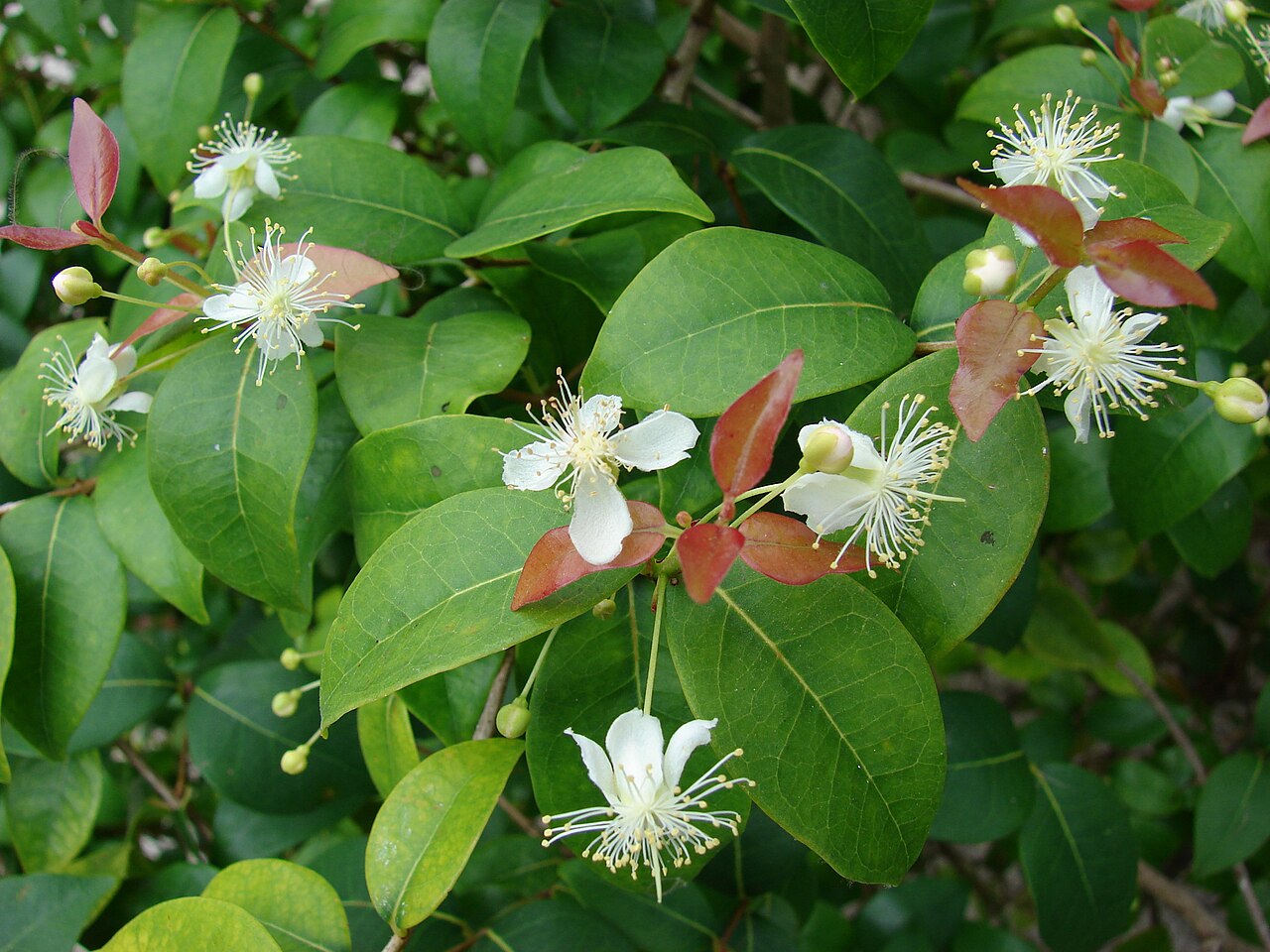
Typically a multi-branched shrub or small tree, the Suriname cherry produces evergreen, opposite leaves and small white flowers. The fruits are distinctive: ribbed, roughly globe-shaped, and varying in color from bright red to deep maroon when ripe. Their flavor ranges from sweet-tart to resinous depending on cultivar and ripeness. Although commonly called a cherry (cherry), it is taxonomically separate from true cherries (genus Prunus). The plant shows natural resistance to many garden pests (pests) and its fruits contain antioxidant compounds (antioxidants) that contribute to their nutritional interest.
Uses and cultivation
Growers value Eugenia uniflora for multiple uses. It is frequently planted as an ornamental and is easily trained into compact shapes; it is commonly used as a living hedge or screen because of its dense foliage. The fruit is eaten fresh, made into jams, jellies, juices and liqueurs, or incorporated into local desserts and sauces. Propagation is by seed or cuttings, and the plant establishes quickly in warm climates. Cultural care is generally simple: regular pruning encourages fruiting and maintains a hedged form.
History, introduction and ecological impact
The species has a long history of use in its native range and was introduced elsewhere as an ornamental and fruit tree. In some introduced areas it has naturalized beyond gardens; for example, it was planted in Bermuda and later described as an invasive species where it escaped cultivation. In parts of the Caribbean such as Haiti, it is a familiar cultivated tree often called Cerisier Carré. In subtropical U.S. states like Florida, it appears in home gardens and occasionally in the wild, where management may be recommended if it spreads into natural areas.
Notable distinctions and common names
Common names reflect regional language and use: pitanga in Brazil and Uruguay, Brazilian or Cayenne cherry in English, and local names such as Monkimonki Kersie or Montjimontji Kersie in Suriname. A brief list of common names and points of interest:
- Pitanga — widely used in Brazil and other Portuguese-speaking areas;
- Brazilian/Cayenne cherry — English vernacular names emphasizing appearance and origin (Cayenne as a historical trade name);
- Cerisier Carré — name found in French-speaking Caribbean regions (French Guiana, Haiti);
- Valued for ornament, fruit and relative resistance to common pests while providing dietary antioxidants.
Overall, Eugenia uniflora is a versatile species with horticultural, culinary and ecological significance. Its attractive fruit and foliage make it popular in gardens, but its capacity to naturalize deserves attention where it is not native.
Questions and answers
Q: What is the Suriname cherry also known as?
A: The Suriname cherry is also known as the pitanga, Brazilian cherry, Cayenne cherry, or Cerisier Carré.
Q: What family does the Suriname cherry belong to?
A: The Suriname cherry belongs to the family Myraceae (the myrtles).
Q: Where does the Suriname cherry mostly grow?
A: The Suriname cherry mostly grows on South America's east coast.
Q: Is the Suriname cherry related to true cherries?
A: No, the Suriname cherry may look like a cherry, but is not related to true cherries.
Q: What is the Suriname cherry used for?
A: The Suriname cherry is often used in gardens as a hedge or screen. It is high in antioxidants and resistant to pests, making it easy to grow.
Q: Where can the Suriname cherry be found besides South America?
A: The Suriname cherry can also be found in parts of Paraguay, Argentina, Uruguay, and the West Indies, specifically in Haiti.
Q: Is the Suriname cherry considered an invasive species anywhere?
A: Yes, the Suriname cherry was introduced to Bermuda for ornamental purposes but is now out of control and listed as an invasive species.
Related articles
Author
AlegsaOnline.com Suriname cherry (Eugenia uniflora): pitanga, Brazilian or Cayenne cherry Leandro Alegsa
URL: https://en.alegsaonline.com/art/95182
Sources
- theplantlist.org : "The Plant List: A Working List of All Plant Species"
- npgsweb.ars-grin.gov : "Eugenia uniflora"
- keyserver.lucidcentral.org : "Weeds of Australia: Eugenia uniflora"
- books.google.com : "Duke's Handbook of Medicinal Plants of Latin America"
- nytimes.com : Berry Helped to Put Reality Show Chef on Top - New York Times
- hort.purdue.edu : Fruits of warm climates
- the.honoluluadvertiser.com : A curious crop | The Honolulu Advertiser
- bermudaconservation.squarespace.com : Bermuda Conservation - Surinam Cherry
- eattheweeds.com : "Surinam Cherry: Only Ripe Need Apply"