
Superman (1999 Nintendo 64 video game)
A licensed 1999 Nintendo 64 action game starring Superman, developed by Titus. Noted for ring-flying missions, control and camera issues, and a reputation as one of the most poorly received licensed games.
Overview
Superman (commonly called "Superman 64") is a 3D action video game released in 1999 for the Nintendo 64. It was developed and published by Titus Interactive under a license to use the character Superman. The game places the player in the role of the iconic superhero charged with rescuing civilians, confronting villains and completing mission objectives set across a stylized Metropolis.
Image gallery
3 Images
Gameplay and mechanics
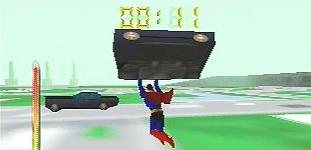
The core missions emphasize flying challenges in which the player navigates Superman through a sequence of floating rings. Other sections attempt to simulate Superman's powers—flight, super-strength, heat vision and ice breath—but these abilities are constrained by level design, collision detection and restrictive control schemes. Levels also include ground combat and object-manipulation puzzles intended to diversify play.
Design elements and technical limitations
Technically, the title uses fully 3D environments but is frequently noted for heavy use of fog, limited draw distance and simplistic geometry. Camera behavior and input responsiveness were widely criticized: many players reported awkward viewpoints and difficulty aligning movements during high-speed flight. Graphical fidelity and animation were modest even by the standards of late-1990s console releases.
Development and context
The game arrived at a time when licensed superhero titles were common but uneven in quality. Under production constraints and the challenge of representing a near-invincible character within balanced gameplay, the design choices favored narrowly defined objectives rather than open-ended use of Superman's abilities. The plot centers on a scheme by villains such as Lex Luthor to endanger Metropolis and its inhabitants, prompting Superman to intervene.
Reception and legacy
On release and in subsequent retrospectives, the game received predominantly negative reviews. Critics and players highlighted repetitive mission structure, frustrating controls, and technical shortcomings. It has been repeatedly cited in lists of poorly executed licensed games and has become a reference point in discussions about the pitfalls of adapting powerful comic-book characters to interactive systems. Despite its reputation, the title remains a frequently mentioned example in studies of game design failures and nostalgia-driven commentary.
Notable facts and distinctions
- The informal name "Superman 64" reflects the console platform and became the common way to refer to the game.
- Its emphasis on ring-flying missions is one of the most commonly recalled gameplay elements.
- As a licensed property, the game demonstrates the tension between representing iconic powers and creating engaging, balanced mechanics.
- It is often discussed alongside other licensed adaptations to illustrate how production limits and design choices affect final reception.
For further context on licensed superhero games and design lessons drawn from titles like this one, see broader discussions of comic-book adaptations and late-1990s console development practices. Helpful starting points include historical overviews of the Nintendo 64 era and critical retrospectives on licensed titles from that period; additional resources may be consulted via developer or platform archives, or modern analyses of legacy games and their influence on subsequent superhero titles. Superman's portrayal in interactive media has evolved since 1999, with later games attempting different approaches to power representation and open-world design. Titus Interactive and other studios' experiences with licensed releases continue to inform modern best practices. Superman (1999) remains a notable case study for both critics and designers.
Questions and answers
Q: What is Superman (video game)?
A: Superman (video game) is a 1999 video game for the Nintendo 64, where the player controls Superman, a fictional superhero.
Q: Who is Superman in the game?
A: Superman is the character that the player controls in the game.
Q: What is Superman's objective in the game?
A: Superman's objective in the game is to save his friends from Lex Luthor, his archenemy.
Q: What activity does the player spend most of their time doing in the game?
A: The player spends most of their time flying through rings in the game.
Q: Why has the game received negative reviews from critics?
A: The game has received negative reviews from critics due to "lame" weapons in the non-ring levels, overcomplicated controls, and bad graphics.
Q: What is a common criticism of the game's controls?
A: A common criticism of the game's controls is that they are overcomplicated.
Q: How has the game been described by some reviewers?
A: The game has been described as "one of the worst games of all time" by some reviewers.
Related articles
Author
AlegsaOnline.com Superman (1999 Nintendo 64 video game) Leandro Alegsa
URL: https://en.alegsaonline.com/art/95064
Sources
- armchairempire.com : "E3 Chronicles: The First 10 Years - 1997"
- ign64.ign.com : "Eric Caen of Titus Software (interview)"
- playstationmuseum.com : "Superman"