
Supercharger — engine forced-induction device
A supercharger is a mechanically driven compressor that raises intake air pressure and density to increase internal-combustion engine power. Used in aviation, automotive, marine and racing applications.
A supercharger is a mechanical compressor fitted to an internal-combustion engine to increase the pressure and density of incoming air. By supplying more oxygen each intake cycle, a supercharger enables more fuel to be burned and therefore increases power output without increasing engine displacement. Because it is driven directly from the engine—commonly by gears, a belt, or a shaft—a supercharger provides nearly immediate boost and predictable response across the rev range.
Image gallery
5 Images
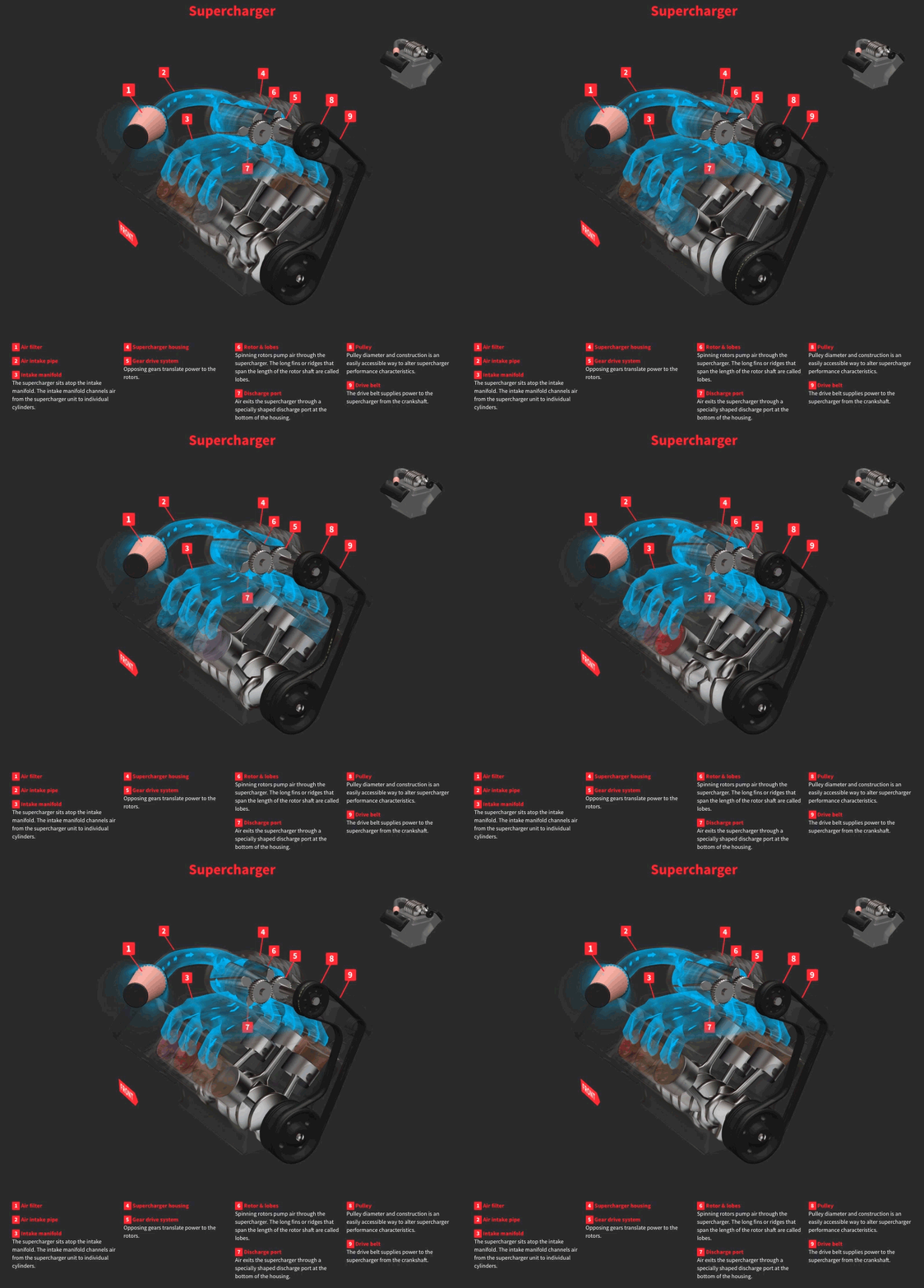


Main types
- Roots-type: a positive-displacement pump that moves air between lobed rotors; it provides strong low-speed airflow but is less thermally efficient than some other types.
- Twin-screw (Lysholm): a positive-displacement design that compresses air internally between intermeshing rotors, generally more efficient and producing cooler discharge temperatures than a Roots unit.
- Centrifugal: an impeller-driven dynamic compressor that accelerates air and diffuses it to higher pressure; it tends to produce boost that rises with engine speed and can be more compact for high-speed operation.
Components and accessories
- Drive system: belts, gears, chains or shafts connect the compressor to the crankshaft; some installations use overrunning clutches or electromagnetic couplings to reduce parasitic load when boost is not required.
- Intercooler: a heat exchanger between the compressor and intake manifold that cools compressed air, increasing density and reducing knock tendency.
- Control valves and bypasses: valves route air around the compressor at idle or cruise to limit unnecessary load and to regulate maximum boost.
Operation and performance
Because a supercharger is mechanically driven, boost pressure generally correlates directly with engine speed. This characteristic produces strong low- and mid-range torque and instant throttle response, which is why superchargers have been popular in performance and racing applications. The trade-off is parasitic loss: some of the engine's output is consumed to turn the compressor, reducing overall mechanical efficiency compared with systems that recover otherwise wasted energy.
Applications and history
Mechanically driven forced induction dates from the early 20th century. Superchargers were widely used on aircraft to compensate for reduced air density at altitude, maintaining engine power. They later appeared in road cars, marine engines and motorsport, where rapid response and compact packaging were valuable. In many modern road and racing engines, superchargers remain a choice where immediate boost and predictable behavior are priorities.
Comparison with turbochargers and emerging trends
Turbochargers are driven by exhaust gas and can be more efficient because they recover waste energy; however, they can exhibit transient lag. Because each type has strengths, some systems combine them (twincharging) to get quick response at low rpm and efficient high-rpm performance. Recent developments include electrically driven compressors, which aim to deliver instant boost without a direct mechanical link to the crankshaft, and various control strategies to balance performance, efficiency and emissions.
Advantages and limitations
- Advantages: immediate boost, strong low-end torque, predictable control and simple integration for certain engine layouts.
- Limitations: parasitic power consumption, additional heat generation that often requires intercooling, and increased mechanical and thermal stresses on engine components.
Proper design, cooling and control are essential to realize the benefits of a supercharger while managing its drawbacks. Routine maintenance—attention to drive belts or gears, lubrication of the compressor unit and monitoring of boost control systems—helps ensure reliable operation in the various roles where superchargers are employed.
Questions and answers
Q: What is a supercharger?
A: A supercharger is a device used in internal combustion engines of aircraft to increase the density of air by compressing it through a compressor wheel.
Q: Why was a supercharger introduced?
A: A supercharger was introduced in aircraft as the atmospheric pressure decreases at higher altitudes which reduces the density of air. Hence, a supercharger was used to increase the density of air.
Q: How does a supercharger work?
A: A supercharger compresses the air by passing it through a compressor wheel which increases the density of the air.
Q: What was the drawback of a supercharger?
A: The drawback of a supercharger was that it worked as a parasitic load on the engine as it was driven through the gear train of the engine.
Q: What is a turbocharger?
A: A turbocharger is a device that is used to increase the density of air by compressing it through the pressure of exhaust gases.
Q: Why was a turbocharger introduced?
A: A turbocharger was introduced to overcome the drawback of a supercharger, which placed a parasitic load on the engine.
Q: Is a turbocharger used in internal combustion engines?
A: Yes, a turbocharger is used in internal combustion engines as it is driven through the pressure of exhaust gases.
Related articles
Author
AlegsaOnline.com Supercharger — engine forced-induction device Leandro Alegsa
URL: https://en.alegsaonline.com/art/95038