
Battle of Hill 60 (Western Front)
A concise account of the 1915 mining attack at Hill 60 near Ypres, the tunnelling methods used, the role of specialist miners and the relation to the Second Battle of Ypres and early gas warfare.
Overview
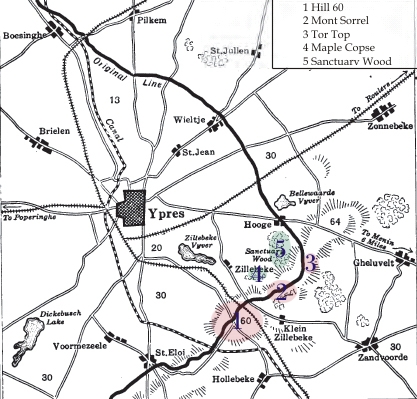
Hill 60 was an artificial rise to the south‑east of Ypres, constructed in the 1860s from material excavated during the building of a nearby railway. Standing roughly 150 feet above the surrounding plain, it acquired tactical importance in the static trench warfare of World War I. Captured by German forces in late 1914, Hill 60 dominated approaches and observation in a sector of the Western Front, and became the focus of a specialized British offensive in April 1915.
Image gallery
6 Images



Terrain and tactical importance
The hill’s artificial nature made it distinct from natural elevations: its compacted spoil formed steep slopes and a compact summit that could be fortified. Control of such a feature gave whoever held it superior observation over the low ground and trenches around the Ypres salient. For attackers, direct frontal assaults against prepared positions were costly, so engineers and miners turned to subterranean methods to undermine the height and the enemy positions on it.
Tunnelling units and their methods
Britain’s response used specialized Royal Engineers Tunnelling Companies staffed largely by experienced civilian miners recruited from coalfields, municipal works and railways. These men came from places as varied as the coalfields of Northumberland, municipal sewers in Manchester and the deep lines of the London underground. Their civilian skills—silence, timbering, ventilation and explosive placement—were adapted to an underground war that was physically demanding and psychologically brutal.
The attack and immediate outcome
Undercover galleries were driven beneath Hill 60 and into the supporting spoil, allowing engineers to emplace a series of large explosive charges directly beneath the German-held summit and adjacent positions. When these mines were fired in April 1915 they destroyed much of the hill’s top, created huge craters and enabled British infantry to seize the shattered ground. The explosions and the fighting that followed transformed the landscape into a scarred moonscape; the newly formed craters became focal points for hand‑to‑hand combat and were contested for weeks thereafter.
Context: the Second Battle of Ypres and gas warfare
The action at Hill 60 occurred in the wider context of the spring 1915 fighting around Ypres. Almost immediately after the mining success, the front was shaken by the Germans’ large‑scale first use of chlorine gas during the Second Battle of Ypres. That offensive forced Allied withdrawals elsewhere and shifted lines closer to Ypres, illustrating how local engineering successes could be overtaken by broader tactical developments and novel weapons.
Legacy and notable facts
Hill 60 is often cited as a vivid example of subterranean warfare on the Western Front: a contest in which miners with specialist skills faced suffocation, flooding, underground collapse and counter‑mining in addition to surface combat. The operation demonstrated the effectiveness of mining to alter terrain and enabled temporary tactical gains, but it also showed the limits of such gains when broader strategic pressures—new weapons, artillery and shifting lines—continued to shape the battlefield. Today the area contains preserved craters and memorials that recall both the engineering ingenuity and the human cost of the fighting around Ypres.
- Key features: artificial hill, extensive mining, cratering and close combat.
- Participants: Royal Engineers Tunnelling Companies and infantry units on both sides.
- Significance: example of mining warfare; occurred just before large‑scale chemical attacks in the same sector.
Questions and answers
Q: What is Hill 60?
A: Hill 60 was a man-made hill created in the 1860s from what was dug out from a nearby railway line.
Q: Who captured Hill 60 in December 1914?
A: The Germans captured Hill 60 in December 1914, giving them a strategic advantage due to its height.
Q: What did the British do to retake Hill 60?
A: In April 1915, the British began tunnelling into and under Hill 60 in order to place 5 mines beneath the hill, which were detonated to blow the top off Hill 60.
Q: Who were the men that joined the Tunnelling Companies?
A: All the men who joined the Tunnelling Companies were experienced miners with generations of mining history. Most of them had been digging since they were 10 years old and came from the coal mines in Northumberland, the sewers in Manchester, and the tubes in London.
Q: What was the death rate among the men in the Tunnelling Companies?
A: In the barbaric, secret wars below ground, the men of the Tunnelling Companies experienced one of the highest death rates.
Q: What significant battle began almost as soon as the battle for Hill 60 was finished?
A: Almost as soon as the battle for Hill 60 was finished, the Second Battle of Ypres began.
Q: What did the Germans use for the first time in the Second Battle of Ypres?
A: In the Second Battle of Ypres, the Germans used chlorine gas for the first time, which contributed to their two-mile advance on the eastern side of the salient by the end of the battle.
Related articles
Author
AlegsaOnline.com Battle of Hill 60 (Western Front) Leandro Alegsa
URL: https://en.alegsaonline.com/art/9488