
Battle of Harpers Ferry (September 12–15, 1862)
A concise account of the 1862 siege and surrender at Harpers Ferry during the Maryland Campaign of the American Civil War, its conduct, outcome, and significance.
Overview
The Battle of Harpers Ferry was fought from September 12 to September 15, 1862, during the Maryland Campaign of the American Civil War. As Gen. Robert E. Lee advanced into Union territory, a detachment was sent to seize the transportation hub and government armory at Harpers Ferry. The operation was carried out by elements of the Confederate forces under the direction of a subordinate commander, and it culminated in the encirclement and surrender of the isolated garrison.
Image gallery
6 Images
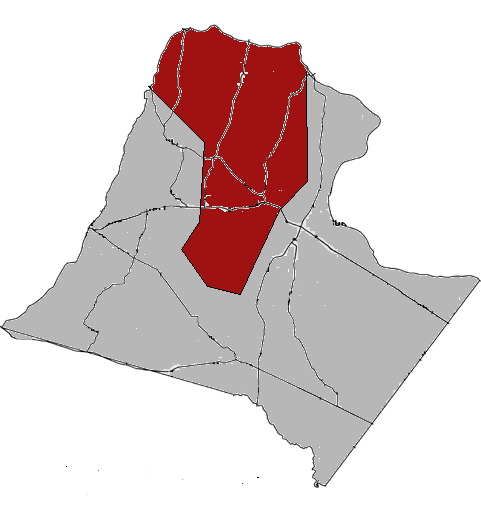


Location and strategic value
Harpers Ferry occupies a commanding position where the Potomac and Shenandoah rivers meet and marks a crossroads between northern and southern theaters. In 1862 it lay in Virginia, an area that later became West Virginia. The town contained armory facilities and rail and river links that made it valuable to either side and vulnerable if poorly defended. Control of Harpers Ferry helped secure rear lines and denied the enemy matériel and a supply base.
Forces and operations
Confederate columns under Maj. Gen. Thomas J. "Stonewall" Jackson executed a rapid march to invest the town, occupying the high ground that rings the valley. The Union garrison found itself surrounded on the heights and subjected to sustained artillery fire. Within a few days the Federals were cut off from relief and supply, and their defensive positions were progressively untenable.
Surrender and immediate outcome
After heavy bombardment and the fall of key commanding positions, the Union commander surrendered on September 15. The capitulation yielded more than 12,000 Union soldiers as prisoners and allowed Confederate troops to seize arms and stores. The action was accomplished at a comparatively low cost to the attackers and is commonly described as a major Confederate victory in the campaign.
Aftermath and significance
The fall of Harpers Ferry removed an isolated threat to Confederate communications and temporarily strengthened Lee's situation, though the larger campaign that followed produced mixed results. Confederate forces cleared the arsenal and transported what they could before rejoining the main body of the invading army. The episode highlighted the importance of terrain, interior lines, and the dangers of isolated garrisons during fast-moving campaigns.
Key facts and notable points
- Dates: September 12–15, 1862.
- Location: Harpers Ferry, then in Maryland vicinity and Virginia region (now West Virginia).
- Commanders: Maj. Gen. Stonewall Jackson for the Confederacy; Union leadership surrendered after siege.
- Result: Encirclement and surrender of the garrison, capture of arms, and a tactical victory for the Confederate forces.
- Context: Part of the broader Maryland Campaign that included the Battle of Antietam and shaped subsequent strategic decisions in the war.
The Battle of Harpers Ferry remains a study in the use of interior lines, rapid maneuver, and the tactical impact of controlling commanding heights. For further reading, consult specialized works on the 1862 Maryland Campaign and biographies of participating commanders for more detail.
Questions and answers
Q: When was the Battle of Harpers Ferry fought?
A: The Battle of Harpers Ferry was fought from September 12-15, 1862.
Q: What was the Battle of Harpers Ferry a part of?
A: The Battle of Harpers Ferry was a part of the Maryland Campaign of the American Civil War.
Q: Who led the Confederate army during the Battle of Harpers Ferry?
A: General Robert E. Lee led the Confederate army during the Battle of Harpers Ferry.
Q: What was Major General Thomas J. "Stonewall" Jackson sent to do during the Battle of Harpers Ferry?
A: Major General Thomas J. "Stonewall" Jackson was sent to capture Harpers Ferry during the Battle of Harpers Ferry.
Q: What did Jackson's troops do during the Battle of Harpers Ferry?
A: Jackson's troops surrounded, bombarded, and captured the Union garrison at Harpers Ferry during the Battle of Harpers Ferry.
Q: Was the Battle of Harpers Ferry a major victory?
A: Yes, the Battle of Harpers Ferry was a major victory.
Q: Was the victory at the Battle of Harpers Ferry costly for the Confederates?
A: No, the victory at the Battle of Harpers Ferry was achieved at relatively minor cost.
Related articles
Author
AlegsaOnline.com Battle of Harpers Ferry (September 12–15, 1862) Leandro Alegsa
URL: https://en.alegsaonline.com/art/9485
Sources
- nps.gov : National Park Service
- nps.gov : "Harpers Ferry"
- civilwar.org : "Battle of Harpers Ferry"
- cmhl.org : "The Maryland Campaign of 1862"
- civilwar.org : "Dixon S. Miles"