
Sulfone (organic functional group)
Sulfones are organic compounds with a sulfur atom bonded to two oxygens (sulfur(VI) dioxide) and two carbon groups; they are stable, polar, and find use in synthesis, materials, and medicine.
Overview
A sulfone is an organic functional group in which a central sulfur atom is bonded to two oxygen atoms and two carbon-containing substituents. The common structural formula is R–S(=O)2–R', where the sulfur is formally in the +6 oxidation state. Sulfones are broadly encountered in synthetic chemistry, polymer science and medicinal compounds because of their thermal and chemical stability and their pronounced electron-withdrawing character. For a concise structural definition see sulfone.
Image gallery
2 Images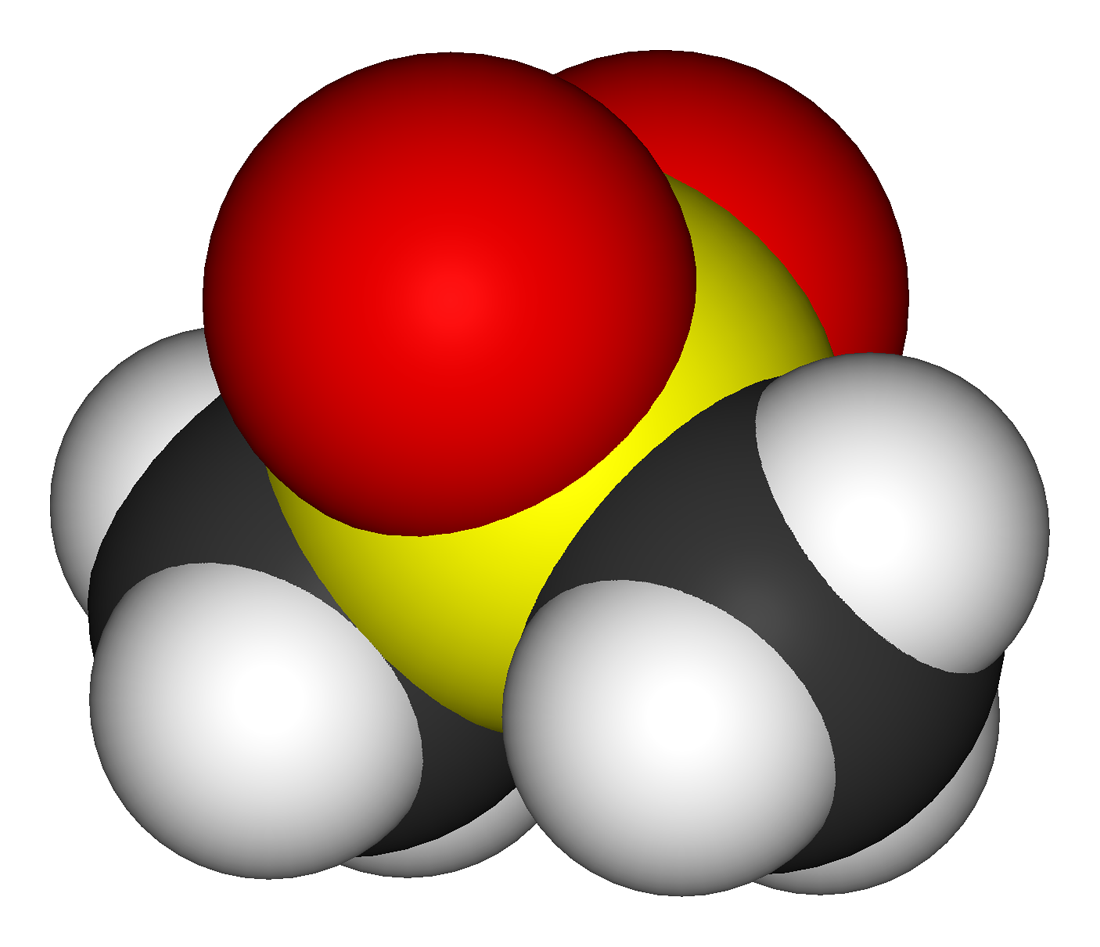

Structure and properties
Structurally, the sulfur atom in a sulfone makes two double-bond-like interactions with oxygen atoms (double bonds) and two single bonds to carbon groups; these sigma bonds lead to a tetrahedral arrangement around sulfur. The oxygens are more electronegative, so the S–O bonds are polarized; this gives sulfones a high dipole moment and often good solubility in polar solvents. The sulfur center and oxygens are sometimes discussed simply as the sulfur and its bonded sulfur and oxygen atoms in structural descriptions, while the other connections are described as bonds to carbon substituents.
Preparation
The most common laboratory route to sulfones is the oxidation of thioethers (sulfides). Controlled oxidation of a thioether first yields a sulfoxide and further oxidation gives the sulfone. Industrial and laboratory oxidants and procedures vary depending on the desired selectivity and scale; see general oxidations of thioethers for methods and considerations.
Reactivity and uses
Sulfones are relatively inert toward many types of nucleophiles and bases compared with sulfoxides and sulfides, but they play important roles as synthetic handles. In carbon–carbon bond-forming chemistry, sulfones can be converted to carbanion equivalents and used in reactions such as the Julia olefination, a named method that couples a sulfone-derived fragment with a carbonyl to give an alkene from an aldehyde or ketone. They are also used as polar aprotic media in some contexts and occasionally as specialty solvents.
- Common practical uses: building blocks in organic synthesis, intermediates in pharmaceutical routes, components of high-performance polymers (polysulfones), and in some specialty solvent applications.
- Properties exploited: thermal stability, resistance to hydrolysis, and strong electron-withdrawing ability that stabilizes adjacent carbanions.
Related groups and notable distinctions
Sulfones should be distinguished from sulfoxides (R–S(=O)–R') which have only one S=O bond and from sulfonic acids (R–SO3H) where an -OH is directly bound to sulfur. In medicinal chemistry, the sulfone functional group appears in several drugs and influences lipophilicity and metabolic stability. In materials science, polymers that incorporate sulfones are valued for toughness and thermal resistance. Because sulfones are chemically robust, they often serve as strategic, removable fragments in multistep synthesis or as permanent features in performance materials.
For more technical summaries and examples of reactions, mechanism diagrams and material applications, consult resources indexed under structural descriptions like sulfone or specific reaction entries such as the Julia olefination.
Questions and answers
Q: What is a sulfone molecule?
A: A sulfone is a molecule that has a sulfur atom with bonds to two oxygen atoms. The sulfur has two double bonds to the two oxygens.
Q: How are sulfones usually made?
A: Sulfones are usually made by oxidising thioethers.
Q: What are some important chemical reactions that use sulfones?
A: The Julia olefination uses a sulfone to make an alkene from an aldehyde. Sulfones are also used in many other important chemical reactions.
Q: What is the role of a sulfone in the Julia olefination reaction?
A: In the Julia olefination, a sulfone is used to make an alkene from an aldehyde.
Q: Can sulfones be used as solvents?
A: Yes, sulfones are sometimes used as solvents.
Q: How many single bonds does a sulfone have?
A: A sulfone has a single bond with the other two groups.
Q: How many double bonds does a sulfone have?
A: A sulfone has two double bonds to the two oxygens.
Related articles
Author
AlegsaOnline.com Sulfone (organic functional group) Leandro Alegsa
URL: https://en.alegsaonline.com/art/94707