
Sugar glider (Petaurus breviceps) — small gliding marsupial
A nocturnal, arboreal marsupial native to Australia and New Guinea, known for its gliding membrane, diet of sap and insects, social behavior, and popularity as a regulated pet.
Overview
The sugar glider (Petaurus breviceps) is a small, nocturnal marsupial native to parts of Australia and nearby islands. Its natural range includes eastern and northern mainland Australia, New Guinea and the Bismarck Archipelago, and it has been introduced to Tasmania. The common name refers to its taste for sweet tree sap and nectar and to its ability to glide between trees; the name itself is sometimes linked in natural history references via earlier field reports.
Image gallery
7 Images


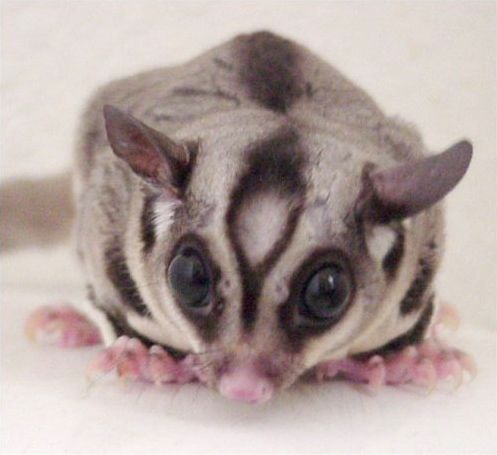

Physical characteristics
Sugar gliders are compact with a soft, furred membrane called a patagium stretching from forelimb to hindlimb that enables controlled gliding. They have large, forward-facing eyes adapted for low-light vision, a long tail used for balance and steering, and a pouch in which females rear young. Their appearance and aerial habits resemble those of flying squirrels, but the similarity is a result of convergent evolution; sugar gliders are marsupials and not closely related to squirrels (flying squirrel comparison).
Behavior and diet
Sugar gliders are primarily nocturnal and live in tree hollows or nests within forested areas. They are social animals that form small family groups and use vocalizations and scent marking to communicate. Their diet is omnivorous and flexible, typically including:
- tree sap, gum and nectars
- insects and other invertebrates
- occasionally small vertebrates, fruits and flowers
This dietary variety helps them adapt to seasonal changes in food availability.
Habitat, distribution and conservation
Sugar gliders inhabit various wooded environments, from eucalyptus forests to woodland edges. They spend most of their time above ground and glide to forage or move between trees, rarely traveling on the ground for long distances. Populations are generally widespread in their native range; international conservation assessments have listed the species as relatively secure overall, though local populations can be affected by habitat loss, fragmentation and some predation pressures.
Relationship with humans
Sugar gliders are sometimes kept as exotic pets, which has increased interest in their care requirements and welfare. They require specialized diets, social companionship, and large, enriched enclosures to allow gliding behavior. Many regions regulate their ownership and trade; potential owners should check local laws and consider ethical and husbandry responsibilities before acquiring one. In scientific and educational contexts, sugar gliders have also been studied for insights into marsupial biology, gliding locomotion and social behavior.
Notable distinctions
Although often compared with arboreal placental mammals such as flying squirrels because of similar habits and morphology, sugar gliders exemplify how unrelated groups can evolve comparable solutions to moving through forest canopies. Their marsupial life history, communicative behaviors and ecological role as both pollinators and insect predators make them a distinctive component of Australasian forest ecosystems.
Questions and answers
Q: What is a sugar glider?
A: A sugar glider is a small marsupial originally from eastern and northern mainland Australia, New Guinea, and the Bismarck Archipelago.
Q: Why is it called a sugar glider?
A: It is called a sugar glider because it likes to feed on the sugary sap from certain trees.
Q: How does a sugar glider move between trees?
A: A sugar glider can jump from trees and glide through the air to another tree.
Q: Where do sugar gliders live?
A: Sugar gliders live in trees and rarely travel on the ground.
Q: What do sugar gliders eat?
A: Sugar gliders eat many foods, but mostly tree sap and insects.
Q: What animal does a sugar glider look and act like?
A: A sugar glider looks and acts much like a flying squirrel, but they are not related.
Q: What is a sugar glider related to?
A: Sugar gliders are actually related to possums.
Related articles
Author
AlegsaOnline.com Sugar glider (Petaurus breviceps) — small gliding marsupial Leandro Alegsa
URL: https://en.alegsaonline.com/art/94637
Sources
- species.wikimedia.org : Petaurus breviceps
- commons.wikimedia.org : Petaurus breviceps
- bucknell.edu : Mammal Species of the World
- iucnredlist.org : Petaurus breviceps
- books.google.co.in : Sugar Gliders!! The Ultimate Owner's Guide
- animal.discovery.com : "Insider the exotic pet trade: fatal attractions"
- dixiglen.com.au : dixiglen.com.au
- bornfreeusa.org : "Summary of State Laws relating to private possession of exotic animals"