
Sudarshana Chakra
The Sudarshana Chakra is Vishnu's discus—both a legendary weapon and a personified deity symbolizing protection, dharma and the cyclical order of time, widely represented in Hindu art, ritual and temple worship.
The Sudarshana Chakra (Sanskrit: सुदर्शन चक्र) is a discus‑shaped weapon associated with the Hindu god Vishnu. Its name is commonly rendered as the "auspicious vision wheel" or "good‑sight disc." In scripture, art and ritual the Chakra appears as a bright, spinning wheel used to uphold dharma, defeat hostile forces and symbolize cosmic order. Over time the Chakra has been treated both as an inanimate divine weapon and as an anthropomorphic, fierce deity invoked for protection and the removal of obstacles.
Image gallery
9 Images


Etymology and early literary references
The term chakra means "wheel" or "disc" in Sanskrit; sudarshana combines su (good, auspicious) and darshana (seeing, vision). In Vedic and early post‑Vedic literature the wheel functions as a symbol of time, sovereignty and the order of the cosmos. References to Vishnu's wheel in the Rigveda and later texts underscore its association with his role in maintaining the world. By the epic and Purāṇic periods the discus figures more prominently as a named divine implement with specific deeds attributed to it.
Iconography and physical description
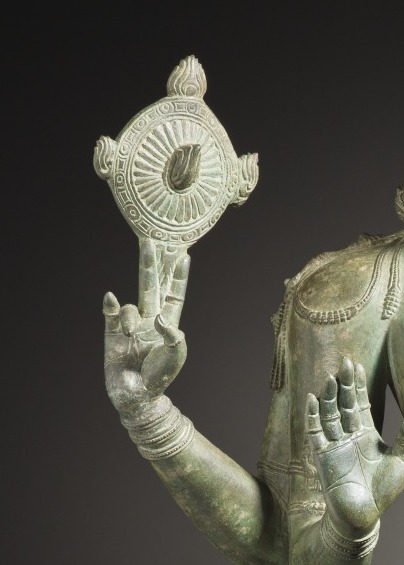
- Form: Depicted as a circular, often serrated disc sometimes shown with radiating flames or spokes. Traditional accounts mention multiple teeth or serrations—some sources note the number 108—which emphasize its cutting power in mythic descriptions.
- Placement: In standard four‑armed depictions of Vishnu, the Sudarshana Chakra is shown in the right‑rear hand, balanced by the conch (shankha), club (gada) and lotus (padma) in the other hands.
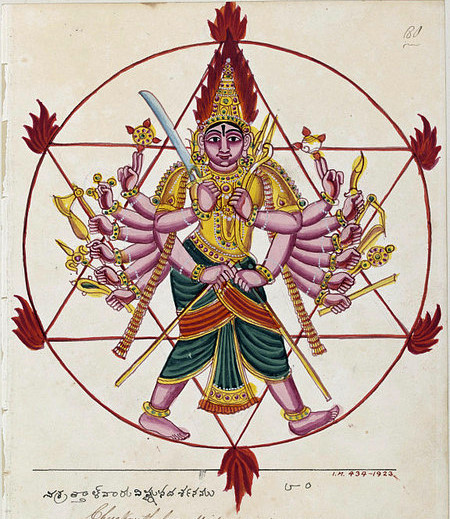
- Personification: In later iconography and ritual the Chakra may be portrayed as an ayudhapurusha—that is, the weapon personified as a distinct divine figure called Sudarshana, sometimes shown with a fierce countenance to suggest its capacity for protection and retribution.
Mythic role and narratives
Scriptural and epic narratives present the Chakra as a decisive instrument used to slay demons, punish wrongdoers and rescue the righteous. Avatars of Vishnu—most notably Krishna in devotional tradition—are described using the spinning discus to overcome powerful adversaries. Because it pursues or returns to its master in many tales, the Sudarshana also embodies swift and unerring justice in popular imagination.
Personified cult and ayudhapurusha tradition
From the Purāṇic period onward, many divine weapons were anthropomorphized and worshiped in their own right. Sudarshana appears in priestly and temple contexts as a distinct deity invoked for protection, healing and the removal of obstacles. In some South Indian traditions the deity is given separate shrines, and ritual forms such as homa (fire rites) dedicated to Sudarshana are practiced to seek defence against illness or misfortune.
Rituals, yantras and devotional practice
Devotional and ritual uses of the Chakra include the consecration of yantras (diagrammatic focal points) bearing wheel motifs, recitation of specialized prayers, and homas (sacrificial fire ceremonies) addressed to Sudarshana for safeguarding individuals, families and communities. In many temple liturgies the emblem of the discus is displayed on flags, standards and sculptural panels as a marker of Vishnu's presence and authority.
Symbolism and interpretation
Symbolically the Sudarshana Chakra carries several interrelated meanings: as a weapon it represents vindication and corrective force; as a wheel it evokes the cycle of time, moral order and sovereign rule; as a personified deity it stands for vigilant protection. In philosophical and devotional reflection the spinning motion of the wheel often signifies the ongoing process of change governed by divine will and the restoration of balance when it is disturbed.
Artistic and cultural presence
The Chakra's imagery appears widely in temple sculpture, painting and bronze work across the Indian subcontinent. In South Indian devotional life, in particular, Sudarshana enjoys pronounced liturgical prominence in some communities, and the motif figures in festivals, processional standards and ritual objects. The name and concept have also entered vernacular devotional languages; for example, in Tamil the Chakra may be referred to as Chakkrath Azhwar (ring or circlet of the deity) in local devotional usage.
Modern relevance
Today the Sudarshana Chakra remains a potent symbol within Vaishnavism and broader Hindu practice. It functions both as an emblem of Vishnu's protective power and as an independent focus of worship in particular rites. Its visual and ritual presence continues to shape religious art, temple practice and devotional imagination, linking ancient concepts of cosmic order and justice with contemporary forms of faith and liturgy.
Questions and answers
Q: What is the Sudarshana Chakra?
A: The Sudarshana Chakra is a spinning, disk-like weapon used by the Hindu god Vishnu with 108 serrated edges.
Q: What is the meaning of Sudarshana Chakra?
A: The Sudarshana Chakra literally means "disk of auspicious vision."
Q: Where is the Sudarshana Chakra generally portrayed?
A: The Sudarshana Chakra is generally portrayed on the right rear hand of the four hands of Vishnu.
Q: What other items does Vishnu hold besides the Sudarshana Chakra?
A: Vishnu also holds a shankha (conch shell), Gada (mace), and a padma (lotus).
Q: What does Sudarshana Chakra represent in the Rigveda?
A: In the Rigveda, the Chakra was Vishnu's symbol as the wheel of time.
Q: What is Sudarshana Chakra's role in the late period?
A: In the late period, the Sudarshana Chakra emerged as an ayudhapurusha (anthropomorphic form), as a fierce form of Vishnu, used for the destruction of an enemy.
Q: What is Sudarshana Chakra known as in Tamil?
A: In Tamil, the Sudarshana Chakra is also known as Chakkrath Azhwar, which is translated as "Ring/Circlet of God."
Author
AlegsaOnline.com Sudarshana Chakra Leandro Alegsa
URL: https://en.alegsaonline.com/art/94577