
Suda — 10th‑century Byzantine encyclopedic lexicon
The Suda is a large 10th‑century Byzantine Greek lexicon‑encyclopedia. It combines word definitions, etymologies, biographies and quotations, preserving material from many otherwise lost ancient authors.
The Suda (also written Souda) is a vast Byzantine compilation in medieval Greek, composed in the 10th century and surviving as one of the principal reference works for the ancient Mediterranean world. It occupies a space between what modern readers call an encyclopedia and a grammatical dictionary: roughly 30,000 entries treat words, names, literary figures and cultural topics while often supplying etymologies, short biographies and occasional quotations from earlier authors.
Image gallery
2 Images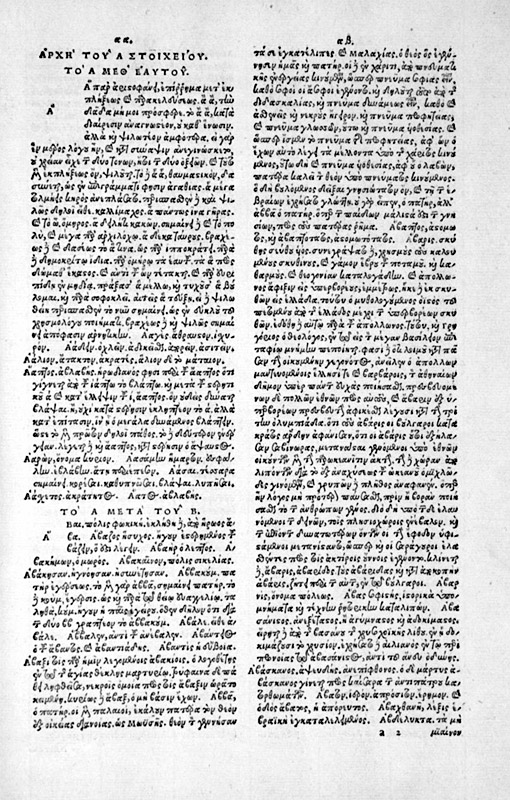

Form and contents
In form the work resembles a lexicon: entries are arranged under headwords and frequently explain the derivation and use of terms according to the philological traditions of the period. At the same time many entries function like encyclopedia articles, giving historical, literary or biographical information. Typical items include brief life notes on poets, historians, philosophers and ecclesiastical figures; explanations of mythological, scientific or rhetorical terms; and excerpts from authors whose works no longer survive.
- Language: medieval Greek, with Byzantine scholarly vocabulary.
- Scope: secular and religious topics — classical, late antique and biblical.
- Scale: tens of thousands of entries, compiled from many earlier sources.
- Method: mixture of quotation, paraphrase, and etymological explanation.
Sources and scholarship
The compilers drew on a wide range of earlier lexica, scholia and histories. Among the texts and traditions incorporated are excerpts and summaries from grammarians and lexicographers, material traceable to Constantinople's intellectual circles, and selections from historical compilations. Older scholarship sometimes attributed the work to a single compiler called "Suidas," but modern researchers treat the book as a layered anthology assembled from many antecedent writings. That composite character explains the varied tone and accuracy of different entries.
Historical context and orientation
As a product of Byzantine learning the Suda reflects both the educational priorities and the religious perspective of its milieu. It addresses classical (often termed pagan) literature alongside biblical and ecclesiastical topics, and its explanations follow contemporary philological methods. Many entries therefore preserve information about authors, texts and interpretations that would otherwise be lost for the study of late antiquity and the early Middle Ages.
Value, limits and notable features
The Suda is prized because it preserves quotations and biographical notices from authors whose complete works have not survived. At the same time it is uncritical: entries can contain errors, folk etymologies and contradictory traditions. Its tendency to compile without always distinguishing source reliability makes it essential for researchers to trace the Suda's claims back to earlier authorities when possible.
Comparisons and legacy
The Suda has been compared to contemporary reference projects elsewhere in the medieval world — for example, the near‑contemporaneous Islamic cataloging tradition exemplified by Ibn al‑Nadim's Kitab al‑Fihrist — both in spirit and in function. Modern editions, translations and digital projects continue to make the Suda accessible for historians, classicists and philologists. For introductions to the nature of the work and its critical study see works that survey Byzantine lexicography and encyclopaedic traditions; such treatments emphasize both the Suda's strengths as a repository of lost material and its role in transmitting the ancient literary heritage through the Middle Ages.
Researchers sometimes consult the Suda to recover lost lines or to corroborate biographical details; students use it as an example of how lexicographical and encyclopedic practices blended in medieval scholarship. The volume remains a cornerstone source for anyone studying the reception of classical learning in Byzantium and the wider Mediterranean intellectual history.
Further reading and digital resources: introductory overviews and catalogues are available for readers who wish to explore manuscript traditions and modern editorial history; for general orientation see surveys of Byzantine reference literature and works on the transmission of ancient texts in the Middle Ages. Examples of related topics include Byzantine encyclopedism (encyclopedic), lexicons and scholia, and later uses of Suda material in both Eastern and Western scholarship (grammatical, educational) — all of which illustrate the Suda's continuing influence on how ancient knowledge was organized and studied. The Suda's Christian framing is noted by many commentators (Christian), even as it preserves pagan learning alongside scriptural material.
Questions and answers
Q: What is the Suda?
A: The Suda is a massive 10th century Byzantine encyclopedia of the ancient Mediterranean world. It is an encyclopedic dictionary, written in Greek, with 30,000 entries.
Q: What does the word 'Suda' mean?
A: The derivation of 'Suda' is probably from the Byzantine Greek word souda, meaning 'fortress' or 'stronghold'.
Q: What type of work is the Suda?
A: The Suda is somewhere between a grammatical dictionary and an encyclopedia in the modern sense. It explains the source, derivation, and meaning of words according to the philology of its period.
Q: What makes articles on literary history valuable in this work?
A: Articles on literary history are valuable because they supply details and quotations from authors whose works are otherwise lost.
Q: Who was likely responsible for writing this lexicon?
A: It is inferred that a Christian was responsible for writing this lexicon due to it dealing with both biblical and pagan subjects.
Q: How reliable are the articles within this work?
A: The articles within this work are not very reliable as they are uncritical and much added to; their value also varies greatly.
Q: Is there an Islamic parallel to the Souda?
A: Yes, there is a near-contemporaneous Islamic parallel called Kitab al-Fehrest by Ibn al-Nadim.
Related articles
Author
AlegsaOnline.com Suda — 10th‑century Byzantine encyclopedic lexicon Leandro Alegsa
URL: https://en.alegsaonline.com/art/94571