
Battle of Badr (624 CE)
A decisive early engagement in Islamic history fought near Badr in 624 CE between Muhammad’s followers and the Quraysh of Mecca, widely remembered for its military and symbolic consequences.
Overview
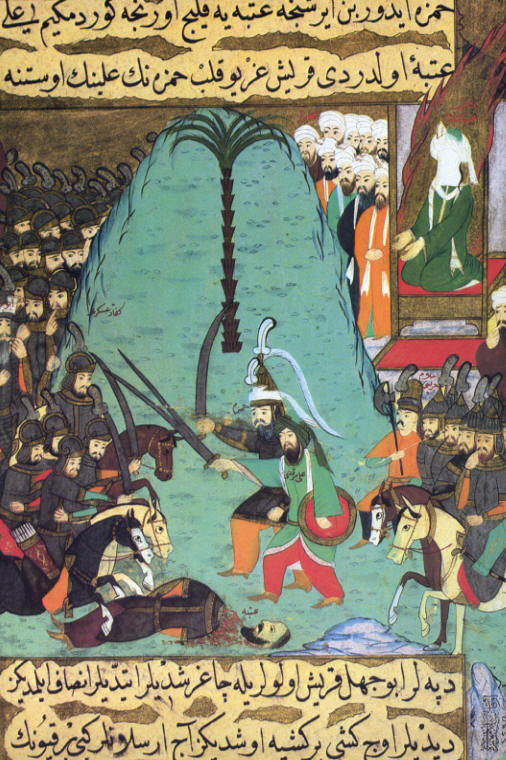
The Battle of Badr, known in Arabic as Ghazwat Badr, took place on March 17, 624 CE on a plain near the wells of Badr in western Arabia. It is one of the most frequently recounted early encounters of Islam and is described in later Muslim sources as a pivotal military and political event. The confrontation involved a band of emigrants and supporters led by Muhammad and a force from the Quraysh of Mecca.
Image gallery
7 Images


Background and causes
After the migration (Hijra) to Medina, tensions between the Medinan Muslim community and Meccan elites increased over trade, tribal honor, and previous persecution. Muslim accounts describe an attempt to intercept a wealthy Meccan caravan returning from Syria as the immediate reason for the expedition; Meccan leaders mobilized to protect their commerce and prestige. The clash at Badr occurred where lines of economic interest and emerging political rivalry met, setting the stage for a larger struggle for influence in the peninsula.
Course of the battle
Contemporary numerical details are not preserved with certainty, but sources agree the Meccan contingent was larger and better equipped. The Muslim fighters occupied advantageous positions near water sources and used the terrain to offset their relative scarcity of mounts and armor. Casualties and prisoners on the Meccan side included prominent leaders, while the Muslim community secured captives and booty, which were subsequently distributed under rules that contributed to communal cohesion. Muslim tradition describes the clash as a decisive victory often attributed to divine intervention, a theme reflected in passages of the Qur'an.
Sources and historiography
Knowledge of Badr comes mainly from early Muslim chronicles, biographies (sira), and collections of prophetic traditions (hadith). These accounts were compiled decades after the event and combine military detail with theological interpretation. Modern historians reconstruct the episode by comparing early narratives, archaeological evidence where available, and critical study of the textual traditions. Muslim remembrance of Badr occupies a central place in the broader Islamic historical tradition, and the battle is frequently cited in discussions of the Prophet’s leadership and early community formation.
Significance and legacy
Badr had immediate practical effects: it boosted the morale and standing of Muhammad’s followers, altered tribal alignments, and demonstrated that the nascent Muslim polity could defend itself and challenge Meccan economic interests. In the longer term the encounter shaped communal rules regarding prisoners, spoils, and leadership legitimacy, and it became an emblematic episode in sermons, legal reasoning, and popular memory. Historians note both the military implications and the way Badr was framed by later generations as a sign of providential favor.
Notable perspectives
- Religious: Many Muslim sources emphasize that success at Badr confirmed divine support for the Muslim community and is referenced in scriptural passages.
- Political: The battle accelerated the shift of regional power and opened the way for later campaigns and treaties.
- Scholarly: Modern scholars treat accounts of Badr critically, acknowledging the combination of factual reporting and theological interpretation in surviving sources.
For further reading on the event, consult primary and secondary treatments that examine the sira literature and archaeological context. The Battle of Badr remains a focal point for understanding how military, social, and religious factors interacted in early Islamic history.
early Islam | Muhammad | Quraysh | Mecca | date | Arabic name | location | Islamic historical tradition | decisive victory | divine intervention | Qur'an
Questions and answers
Q: When was the Battle of Badr fought?
A: The Battle of Badr was fought on March 17, 624 CE.
Q: Where did the Battle of Badr take place?
A: The Battle of Badr took place in western Arabia, which is present-day Saudi Arabia.
Q: Why was the Battle of Badr a key battle in the early days of Islam?
A: The Battle of Badr was a key battle in the early days of Islam because it marked a turning point in Muhammad's struggle with his opponents among the Quraysh in Mecca.
Q: What is the significance of divine intervention in the Battle of Badr?
A: The Battle of Badr is considered a decisive victory because of divine intervention.
Q: Who is credited for the genius behind the Battle of Badr?
A: The genius behind the Battle of Badr is attributed to Muhammad.
Q: Is the Battle of Badr mentioned in the Muslim holy book, the Qur'an?
A: Yes, the Battle of Badr is one of the few battles specifically mentioned in the Qur'an.
Q: Where does most contemporary knowledge of the Battle of Badr come from?
A: Virtually all contemporary knowledge of the Battle of Badr comes from traditional Islamic accounts, including hadiths and biographies of Muhammad, written decades after the battle.
Related articles
Author
AlegsaOnline.com Battle of Badr (624 CE) Leandro Alegsa
URL: https://en.alegsaonline.com/art/9436
Sources
- usc.edu : "Translation of Malik's Muwatta"
- usc.edu : "Translation of Sahih Muslim"
- usc.edu : "Translation of Sahih al-Bukhari"
- usc.edu : "Partial Translation of Sunan Abu-Dawud"