
Structure of the Earth: layers, composition, dynamics and boundaries
Overview of Earth's internal layers, their composition and physical state, how boundaries are detected, and why this structure matters for geology, earthquakes and the magnetic field.
The structure of the Earth is arranged in concentric layers that differ in composition, temperature and mechanical behavior. From the surface inward these layers are commonly described as the crust, the mantle, the liquid core (outer core) and the solid inner core. The planet's overall shape is best approximated by an oblate spheroid, slightly flattened at the poles and bulging at the equator, a result of rotation and the distribution of mass.
Image gallery
4 Images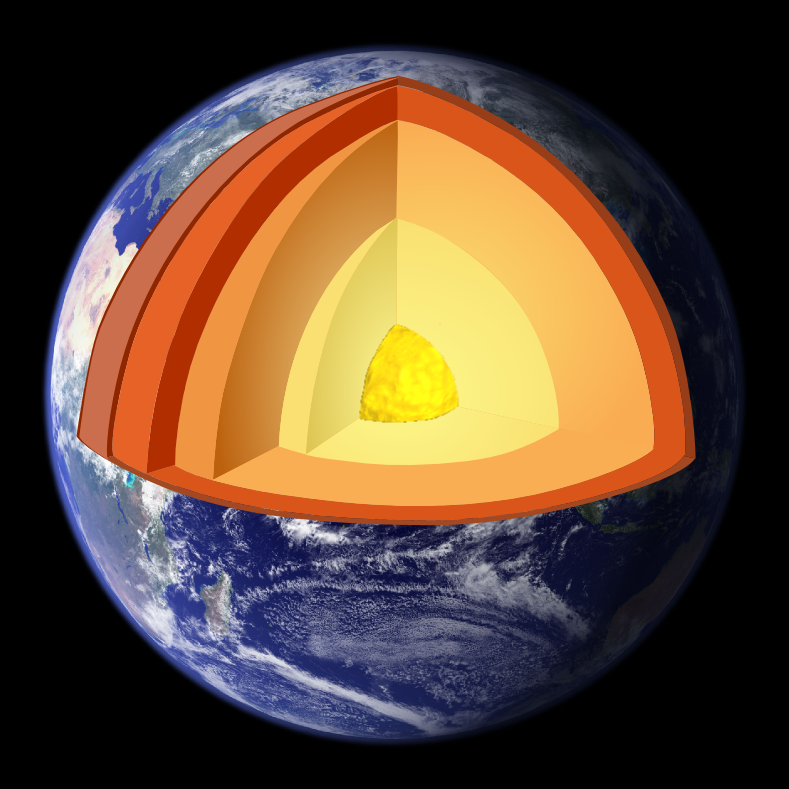


Layers and their key characteristics
- Crust: The thin outermost shell made of solid rock. Continental crust is generally thicker and richer in silica and aluminium (silicon, aluminium) and is often described as felsic. Oceanic crust is thinner and denser.
- Upper mantle and lithosphere: The uppermost mantle plus the crust form the rigid lithosphere, which is broken into tectonic plates. The very top of the mantle is composed largely of peridotite (peridotite).
- Asthenosphere: Beneath the lithosphere lies a zone that behaves plastically; partial melting and the presence of melt and hot solid rock (commonly associated with magma) allow plates to move.
- Lower mantle: A more viscous, higher-pressure region that extends to the core–mantle boundary; it is rich in silicate minerals that include magnesium (magnesium) and silicon and is often termed mafic in bulk composition.
- Core: Composed primarily of iron and nickel. The core has a liquid outer layer and a solid inner center; the motion of the liquid outer core sustains Earth's magnetic field.
These layers are distinguished on both chemical and physical grounds: chemical layering refers to differences in elemental or mineral composition, while physical layering refers to solid, partially molten or fluid behavior. Scientific understanding of these distinctions relies heavily on the study of seismic waves produced by earthquakes and artificial sources. Seismographs detect reflections and refractions at discontinuities such as the Mohorovičić discontinuity (the "Moho") between crust and mantle and the core–mantle boundary; these seismic signatures reveal changes in density and rigidity deep inside the planet.
Boundaries, detection and important discontinuities
Key boundaries are identified when seismic waves change speed or direction. The Moho marks the crust–mantle transition, while deeper boundaries indicate changes in mineral phases and melting behavior. At great depths, pressure and temperature induce mineral transformations and changes in crystallization and density, which affect the propagation of seismic waves. The boundary separating the liquid outer core from the solid inner core was identified by how seismic waves are blocked or transmitted through the central region.
Dynamics, heat and evolution
Earth's internal heat, supplied by residual heat from planetary formation, radioactive decay and core crystallization, drives convection in the mantle and circulation in the outer core. Mantle convection is the engine behind plate tectonics—lithospheric plates move, collide and slide past one another, producing earthquakes, mountain building and volcanic activity. In the outer core, convective motions of electrically conducting iron–nickel fluid produce the geodynamo that maintains the magnetic field, which protects the surface from charged particles.
Over geological time the planet has differentiated: heavier elements sank toward the center while lighter silicate materials rose, forming the layered arrangement seen today. The inner core is believed to be slowly solidifying as the planet cools, releasing latent heat and possibly light elements that contribute to outer-core convection.
Why Earth's structure matters
Understanding Earth's internal structure is essential for multiple reasons: it explains the distribution of earthquakes and volcanoes, guides exploration for mineral and energy resources, informs models of the planet's thermal history, and helps predict changes in the magnetic field. Seismology, mineral physics, high-pressure experiments and geodynamo models together build a coherent picture, yet many details—such as fine-scale heterogeneity in the deep mantle or the precise composition of the core—remain active areas of research.
For additional general reference, see introductory treatments of the layers of Earth and resources on planetary shapes and interiors such as those describing the relationship between rotation and the photosphere of stars by analogy. Together these topics frame why Earth's internal structure is a central subject in geology, geophysics and planetary science.
poles | equator | oxygen | mantle | lithosphere
Structure of the Earth, crust, silicon, aluminium, felsic, magnesium, mafic, peridotite, magma, core, iron, nickel, crystallization
Questions and answers
Q: What are the layers of the Earth?
A: The structure of the Earth is divided into four layers. These include an outer solid layer called the crust, a highly viscous layer called the mantle, a liquid layer that is the outer part of the core called the outer core, and a solid center called the inner core.
Q: How is the shape of Earth described?
A: The shape of Earth is described as an oblate spheroid, which means it is slightly flattened at the poles and bulging at the equator.
Q: What was discovered between Earth's crust and mantle?
A: Between Earth's crust and mantle was discovered a boundary called Moho. This discovery showed major changes in structure as one goes deeper.
Q: What elements make up most of Earth's crust?
A: Most of Earth's crust is made up mostly by lighter elements such as silicon, oxygen, aluminium. Because of this it is known as sial (silicon = Si; aluminium = Al) or felsic.
Q: What makes up most of Earth's mantle?
A: Most ofEarth's mantle consists mostly oxygen, silicon and heavier element magnesium which makes it known as sima (Si for silicon + ma for magnesium) or mafic.
Q:What type rock forms uppermost part of mantle ?
A:The uppermost part of mantle forms base for crust and its made from heavy rock peridotite . It together with continental & oceanic plates form lithosphere .
Q:What are characteristics & compositionof earth’s core ? A:Earth’s core consists mainly iron & nickel , its temperature being around 5000-6000 °C , similar to photosphere on sun . Its composition might be changing mixture liquid & crystals due to high pressure & temperature .
Related articles
Author
AlegsaOnline.com Structure of the Earth: layers, composition, dynamics and boundaries Leandro Alegsa
URL: https://en.alegsaonline.com/art/94343
Sources
- wired.com : "How the Soviets drilled the deepest hole in the world"
- doi.org : 10.1007/s10512-005-0246-y
- iodp.org : iodp.org/232-3-reflex-deep-carbon-reservoirs-fluxes-and-experiments-erik/file
- whc.unesco.org : Macquarie Island - UNESCO World Heritage Centre