
Battle of Artemisium (480 BC)
A naval engagement of the second Persian invasion of Greece fought concurrently with Thermopylae; a series of clashes and storms that shaped later actions at Salamis and the fall of Athens.
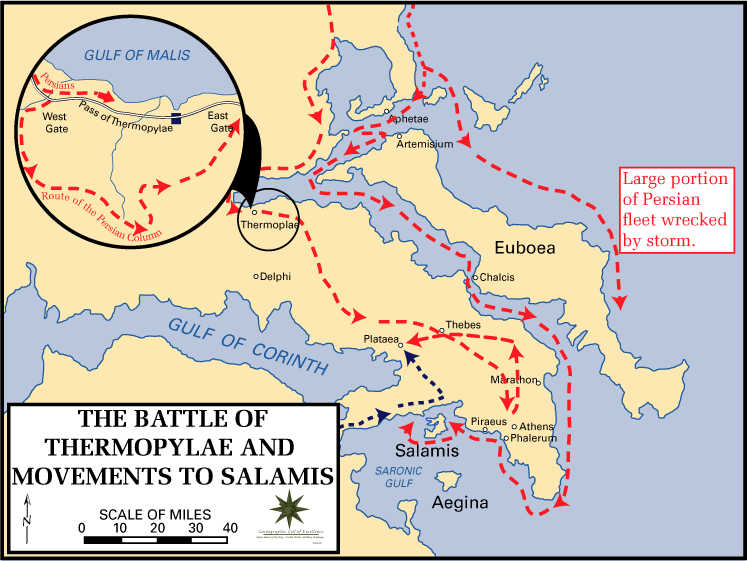
Overview. The Battle of Artemisium was a sequence of naval engagements fought in the summer of 480 BC during the second Persian invasion of Greece. It took place off the northern coast of Euboea, near Cape Artemisium, and was coordinated with the land resistance at Thermopylae. The encounter was marked as much by storms and seamanship as by close combat; contemporary accounts report that the Persian fleet, which ancient historians describe as very large, suffered heavy losses from weather as well as from fighting.
Image gallery
10 Images



Strategic context
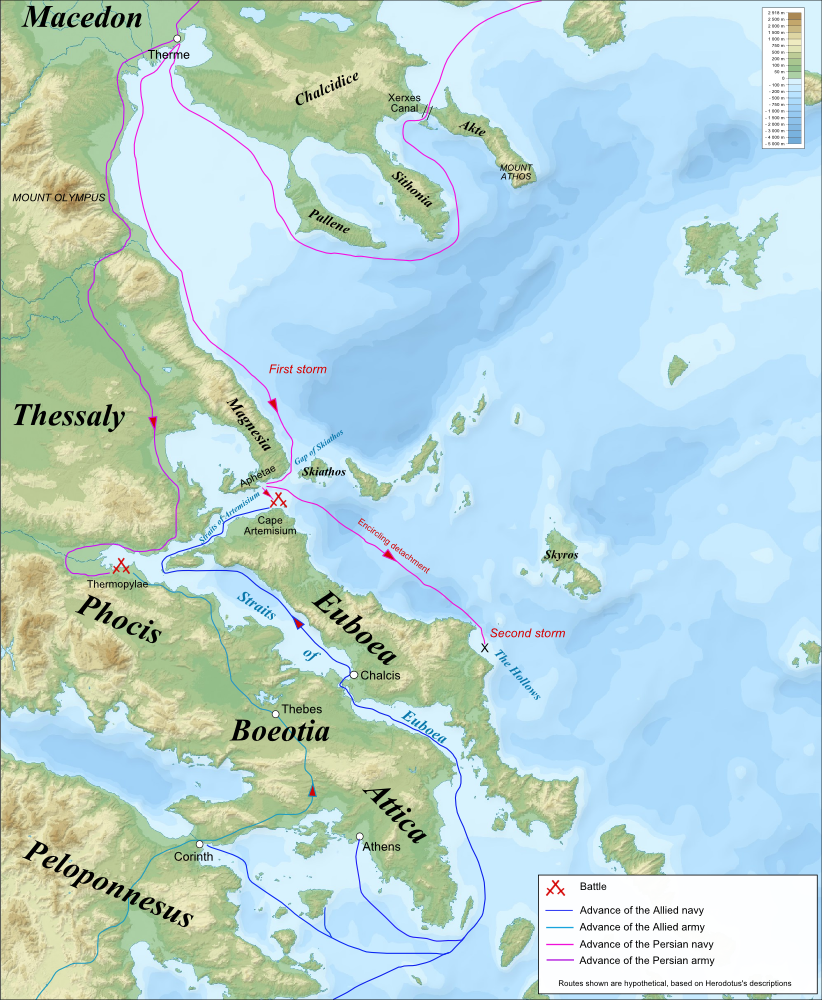
The naval action at Artemisium formed part of a deliberate Greek strategy to block the Persian advance by preventing the enemy fleet from sailing around Euboea and attacking the allied Greek position in the rear. Holding the sea lanes was intended to support the land forces at Thermopylae and to deny the Persians freedom of movement along the eastern Greek coast. Command of the sea was essential for both sides because the Persians relied on their fleet to carry supplies and to enable their vast army to operate far from home.
Forces, ships and conditions
Accounts from antiquity indicate the Persian armada was very numerous; Herodotus reports a fleet on the order of a thousand ships. The Greek alliance assembled a force of several hundred triremes provided mainly by Athens and other maritime states. The trireme—a fast, maneuverable warship propelled by three banks of oarsmen—was the principal fighting unit for the Greeks and played a central role in the engagements. Weather proved decisive: storms off Magnesia and along the Euboean coast damaged and wrecked many Persian vessels before and during the fighting.
Course of the engagements
Rather than a single pitched battle, Artemisium was a sequence of skirmishes and a main action fought after a couple of days of smaller clashes. The Persian fleet attempted an outflanking move by sending ships around the southern tip of Euboea to cut off the Greek line, but some of these vessels were lost in storms. When the two principal fleets met, fighting lasted for much of a day and produced roughly equal material losses. Because the Greek alliance had far fewer ships and men to replace losses, parity in casualties was strategically unfavorable to them.
Aftermath and significance
News of the land defeat at Thermopylae forced the allied naval commanders to reconsider. Their original plan had been to maintain a two-front resistance, but after sustaining losses and learning the land barrier had fallen, the Greek fleet withdrew to preserve its remaining strength and to concentrate for future action. The Persians proceeded to overrun Boeotia and to occupy and ravage Athens, which had been largely evacuated. Yet the Persians, seeking a decisive naval victory over the allied fleet, would ultimately be defeated later that year in the straits off Salamis, a defeat that changed the course of the campaign.
Notable points and legacy
- The engagement is recorded chiefly by Herodotus and has been studied as an example of combined operations—land and sea—where coordination and weather had strategic consequences.
- Storm damage to the Persian fleet demonstrated the vulnerability of large armadas to natural conditions, especially in unfamiliar waters.
- Although Artemisium did not produce the decisive outcome the Greeks sought, the fighting weakened Persian seapower and set the stage for the pivotal clash at Salamis.
- Modern interest in Artemisium focuses on tactics of trireme warfare, the diplomacy of the Greek alliance, and the interplay between naval and land campaigns during the Greco-Persian Wars. For further reading see general treatments of the Persian invasions and naval warfare in classical antiquity via linked resources: Battle overview, Thermopylae, Persian forces, Athens, decisive victory and Salamis.
Questions and answers
Q: When did the naval Battle of Artemesium take place?
A: The naval Battle of Artemesium took place in 480 B.C.
Q: What happened to the Persian navy before they arrived at Artemisium?
A: Approaching Artemisium towards the end of summer, the Persian navy was caught in a gale off the coast of Magnesia and lost around a third of their ~1,200 ships.
Q: What did the Persians do to try to trap the Greeks at Artemisium?
A: The Persians sent a detachment of 200 ships around the coast of Euboea in an attempt to trap the Greeks.
Q: How did the Battle of Artemisium end?
A: After the engagement, the Allies received news of the defeat of the Allied army at Thermopylae. So, given their losses, the Allies decided to withdraw to Salamis.
Q: What did the Persians do after the Allies withdrew to Salamis?
A: The Persians overran Boeotia and captured the now-evacuated Athens.
Q: Did the Persians win the Battle of Salamis?
A: No, the Persians were later defeated at the Battle of Salamis in late 480.
Q: What was the Allies' strategy before the Battle of Artemisium?
A: Their strategy was to hold both Thermopylae and Artemisium.
Related articles
Author
AlegsaOnline.com Battle of Artemisium (480 BC) Leandro Alegsa
URL: https://en.alegsaonline.com/art/9433