
Strike zone (baseball)
The strike zone is the three-dimensional space over home plate in which a pitched ball is called a strike. Its vertical limits depend on the batter’s stance; its width equals the 17‑inch plate.
The strike zone is the defined area above home plate through which a pitched baseball must pass in order to be called a strike by the plate umpire. In practice the zone is three‑dimensional: it has a fixed horizontal width determined by the dimensions of home plate, and vertical limits that are determined from the batter’s stance as he or she prepares to swing. Umpires must interpret the zone on each pitch, and enforcement has been the subject of debate, performance evaluation and technological experimentation.
Image gallery
2 Images
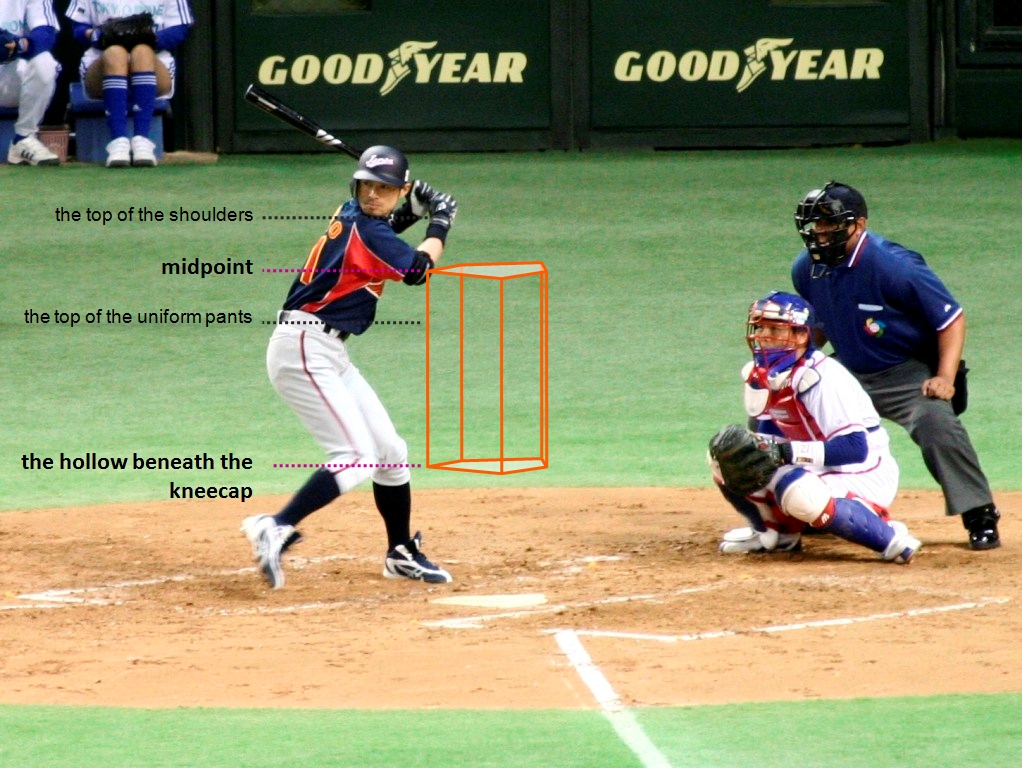
Definition and dimensions
The simplest way to picture the strike zone is as a column above home plate. Key points are:
- Width: Home plate is 17 inches (about 43.2 cm) across at its widest point; that establishes the horizontal span of the zone.
- Vertical limits: The upper and lower boundaries are set with reference to the individual batter’s stance. Modern rulebooks describe the lower limit as a line at the hollow beneath the kneecap and the upper limit as a line at a point between the top of the shoulders and the top of the pants or at the midpoint of the torso, measured as the batter prepares to swing.
- Location of measurement: The ball’s location is judged as it crosses the front plane of home plate, not where it is later caught by the catcher.
Because the vertical boundaries depend on the batter’s height and stance, a taller batter naturally has a taller strike zone than a shorter one. Umpires are expected to apply the same method of measurement for each batter, but human judgment leads to variation.
Umpires, variation and technology
Traditionally the ball‑strike call has been entrusted to the home plate umpire, who must track pitch trajectory and make an instantaneous judgment. Over time leagues and broadcasters have introduced optical and radar systems (commonly referred to by names such as PITCHf/x, TrackMan and Statcast) that can map a pitch’s path and evaluate whether it crossed the strike zone. Those systems are widely used for analysis and umpire evaluation, and have also been tested as the basis for automated ball‑strike adjudication in controlled experiments.
Impact on strategy and the game
The defined strike zone shapes nearly every tactical decision in baseball. Pitchers aim for corners and edges to induce swings at marginal pitches; catchers and pitchers plan sequences to expand or exploit a hitter’s perceived zone. Batters may alter stance or crouch to change their vertical zone. The strike zone influences statistical outcomes such as strikeouts, walks and batting averages, and disagreements over its enforcement have produced high‑profile disputes and calls for reform.
Variations, training and notable facts
- Different rulebooks and age groups apply variations: amateur, youth and international play may use simplified or adjusted zones appropriate for development levels.
- Softball and other bat‑and‑ball sports define distinct strike zones that reflect differences in pitching delivery and equipment.
- Leagues regularly train and evaluate umpires to promote consistency; video review and computerized tracking now play a major role in assessment.
For authoritative language and the exact formulation used by a particular competition, consult the competition’s rulebook or the official rules. Understanding the strike zone requires appreciating both its written definition and its practical enforcement, which together determine how each pitch is judged in play.
Questions and answers
Q: What is the strike zone in baseball?
A: The strike zone is the area over home plate through which a pitch must pass to be called a strike, roughly between the batter's armpits and knees.
Q: How is the strike zone determined for each batter?
A: The strike zone is determined from the batter's stance as the batter is prepared to swing at a pitched ball.
Q: Is there an automatic strike zone in baseball?
A: No, there is no "automatic" strike zone and much of what is a strike or not a strike is left to the judgement of the home plate umpire.
Q: What is the range of the strike zone?
A: The strike zone extends from the batters' knees to the letters across the front of his uniform.
Q: What are the dimensions of home plate?
A: The area of home plate is 17 inches wide (0.4318 meters).
Q: Does the size of the strike zone change for different batters?
A: Yes, the size of the strike zone changes for different batters. A player who stands 5' 6" tall (1.67 meters), for example, will have a much smaller strike zone than a 6' 4" (1.93 meters) homerun hitter.
Q: Where should the ball be when the pitcher wants to throw a strike?
A: To be called a strike, the pitcher must throw the baseball across home plate, an area 17 inches wide (0.4318 meters), and between the knees and letters as indicated.
Related articles
Author
AlegsaOnline.com Strike zone (baseball) Leandro Alegsa
URL: https://en.alegsaonline.com/art/94282
Sources
- mlb.mlb.com : Strike Zone
- hardballtimes.com : hardballtimes.com/main/article/strike-zone-fact-vs-fiction