
Strictly 4 My N.I.G.G.A.Z. — Tupac Shakur's 1993 breakthrough album
Second studio album by Tupac Shakur, released February 16, 1993. Blends social commentary and mainstream singles like "I Get Around" and "Keep Ya Head Up", and marked his commercial breakthrough in the U.S.
Strictly 4 My N.I.G.G.A.Z. is the second studio album by American rapper Tupac Shakur, released on February 16, 1993 via the Interscope Records label. The record expanded Tupac's audience beyond the underground political hip hop of his debut and introduced a balance between socially conscious tracks and radio-friendly singles. It is widely regarded as his breakthrough album in the United States and a major step in his early career.
Image gallery
1 Image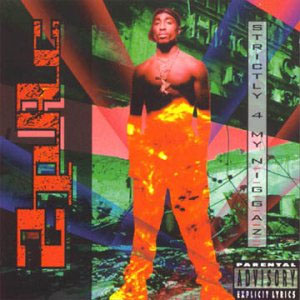
Overview and style
The album mixes direct commentary on social injustice, poverty, and the experience of Black Americans with party-oriented songs and melodically driven singles. Production incorporates early 1990s West Coast hip hop sounds, live-sounding samples, and collaborations that gave the record broader mainstream appeal without abandoning political themes. The title is often stylized with the letters forming an acronym that has been explained by the artist as a positive or ironic reappropriation.
Notable tracks and singles
- "I Get Around" — a charting single that showcased Tupac's playful, charismatic delivery and widened his radio presence.
- "Keep Ya Head Up" — a socially conscious ballad addressing respect for women and community struggles.
- Other album tracks mix protest-driven lyrics with braggadocio and personal reflection, demonstrating Tupac's range as a songwriter and performer.
Development and context
Recorded after his 1991 debut, the album reflects Tupac's growing influence and confidence as both an emcee and a composer of songs with mainstream potential. Contributors to the project included longtime associates and figures from the West Coast scene, and the record arrived at a moment when hip hop was diversifying in sound and audience. The album helped position Tupac for the broader commercial and critical attention he would receive later in the decade.
Reception and legacy
At release, the album received attention for its combination of topical material and accessible singles. Songs from the project received significant radio airplay and music video rotation, helping Tupac gain visibility nationwide. Although his global breakthrough would come with a later record — Me Against the World — the 1993 album established key themes and a public profile that shaped his subsequent work. Its title and some lyrics sparked discussion and controversy in parts of the media, reflecting broader debates about language, representation, and protest in music.
Why it matters
- Signaled a shift toward wider mainstream recognition while retaining political edge.
- Produced enduring singles that remain associated with Tupac's early era.
- Influenced later artists seeking to combine social commentary with commercial rap.
For listeners exploring Tupac's catalog, Strictly 4 My N.I.G.G.A.Z. represents a formative moment: a record that broadened his audience and clarified the dual impulses—outrage and outreach—that would define much of his legacy.
Further information about the artist and related releases can be found through artist and album resources: artist overview, release timeline, record label information, and the subsequent album Me Against the World.
Background
The album was originally supposed to be called Troublesome 21, since Tupac was 21 years old at the time of the recording. The reason for the name change is just that Tupac didn't like the name anymore shortly before the album's release. The "N.I.G.G.A.Z." from Strictly 4 My N.I.G.G.A.Z. stands for Never Ignorant Getting Goals Accomplished, according to Tupac.
Similar to its predecessor, the album contains many personal and political songs. For example, Papa'z Song is about Tupac's antipathy towards his father, while Keep Ya Head Up deals with misogyny. According to his own statements, the album originally consisted only of representer tracks, as Tupac wanted to set a contrast to 2Pacalypse Now.
Production
Due to Tupac's increasing popularity during the recording phase, he recorded the album in three different studios, which also explains the difference in quality between the different songs. The album was largely produced by DJ Daryl, Afron Gregory and Tupac, although Tupac's companions such as Stretch and Bobby Ervin also contributed several productions.
Special to the album is the high number of guest appearances. For example, only five songs are actual solo songs by Tupac, while two others are skits and nine were recorded along with guest appearances. The guest appearances consisted almost entirely of companions of Tupac such as Deathly Threath, Stretch, Mopreme Shakur, and Money B, though Ice Cube and Ice-T were the first time more prominent representatives were featured on a Tupac album. It is not known how exactly the collaboration came about.
The vinyl version of the album was split into two parts. Instead of Book A, the first half, which includes the first eight tracks, was called Black Side and the second half, which includes songs nine through sixteen, was called Dark Side.
Texts
The album's lyrics are not necessarily different from those on 2Pacalypse Now, but are more multifaceted and include the harsh realities of American ghettos as well as several of Tupac's personal stories and rep tracks common to rap music. Particularly often on the album, Tupac rails against American police and advises black people to stand up against police violence and racism, such as on the track Souljah's Revenge, where Tupac plays a person named Souljah alongside himself, encouraging him to take action against police violence in America. Particularly often addressed on the album is Tupac's father, who abandoned the family when Tupac was only a few months old. Several tracks take side swipes at him (e.g. Last Wordz, Guess Who's Back), while Papa'z Song even deals with him in full. The solo song The Streets R Deathrow is also worth mentioning.
Title List
- 1. holler if you hear me
- 2. Pac's Theme (Interlude)
- 3. point the finga
- Something 2 Die 4 (Interlude)
- 5. last wordz (feat. Ice-T and Ice Cube)
- 6. souljah's revenge
- 7. peep game (feat. Deadly Threat)
- 8. strugglin' (feat. Live Squad)
- 9. Guess Who's Back
- 10. representin' 93
- 11. keep ya head up (feat. Dave Hollister)
- 12. Strictly 4 My N.I.G.G.A.Z. (feat. Pacific Heights)
- 13 The Streetz R Deathrow (feat. Ice Cube)
- 14. I Get Around (feat. Shock G and Money-B)
- 15. Papa'z Song (feat. Wycked and Poppi)
- 16. deadly venomz (feat. Treach, Apache and Live Squad)
Related articles
Author
AlegsaOnline.com Strictly 4 My N.I.G.G.A.Z. — Tupac Shakur's 1993 breakthrough album Leandro Alegsa
URL: https://en.alegsaonline.com/art/94278
Sources
- allmusic.com : "2Pacalypse Now - 2Pac - Songs, Reviews, Credits"
- atlantapost.com : atlantapost.com/2010/09/16/tupacs-album-sales-and-his-persisting-legacy56988/