
Battle-axe
A battle-axe is an axe shaped or adapted for use in warfare. It ranges from small one-handed implements to large two-handed cleavers and has appeared in many cultures from the Bronze Age to the medieval period.
A battle-axe is an edged weapon derived from the common axe and optimized for use in armed conflict. Unlike purely utilitarian axes, battle-axes were balanced and finished to suit combat roles: some were light and wielded with one hand, others were large two-handed cleavers intended to deliver powerful blows. Over centuries their forms and fittings evolved in response to changes in armor, tactics and metallurgy.
Image gallery
10 Images

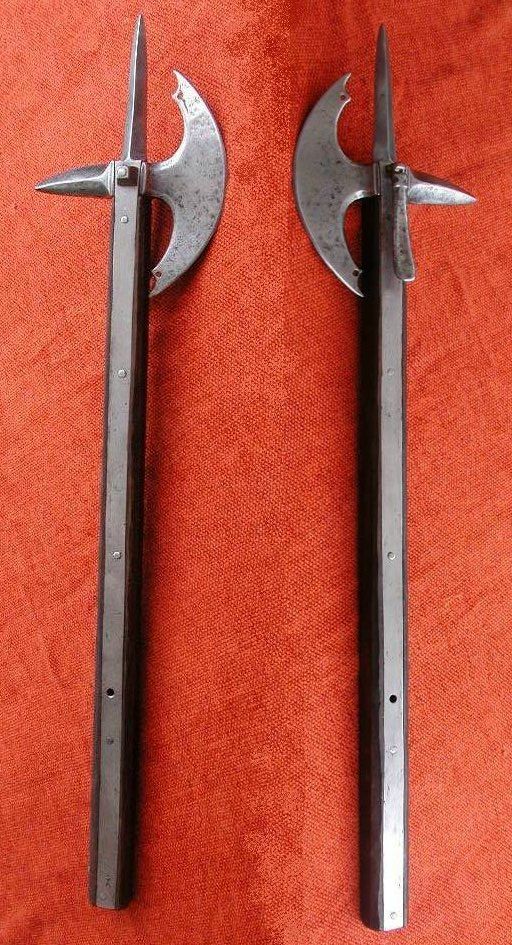


Characteristics and construction
Battle-axes vary widely in weight and length but typically share several design elements. The head may be broad or narrow, single- or double-edged, and fitted to a shaft by an eye or a socket. Common features include a cutting blade, a poll (rear face), and a haft that could be reinforced near the head. Some designs add a spike, bearded (extended lower) blade, or long haft for two-handed leverage. Materials progressed from bronze to iron and then to steel as smithing advanced.
- Head types: single-edged, double-edged, bearded, spike-ended.
- Attachment: through-hole (eye) or socket-mounted heads.
- Haft length: from short short-handled axes usable in close combat to long two-handed forms that approach polearms.
History and development
Axes have been used as weapons since prehistoric times when early heads were made of stone and later of bronze. In the Iron Age and medieval era, many cultures developed specialized battle-axes. Scandinavian sources show the bearded axe in use during the Viking Age, while continental Europe produced variations for infantry and cavalry use. As plate and chain armor improved in the medieval period, axe designs adapted with thicker poll spikes and levering hooks to unseat or cripple armored opponents.
Types and examples
- Bearded axe — a Viking-style head with an extended lower blade allowing a longer cutting edge without increasing weight.
- Danish axe (or sparth) — a large two-handed cleaver used by northern European warriors.
- Francisca — a throwing axe associated with early medieval Germanic peoples.
- Smaller forms such as the tomahawk were used as both tools and weapons in later periods.
Use, tactics and social role
Axes were valued for their ability to concentrate force on a small edge, to cleave wood, armour and shields, and to hook or pry. In battle they were employed for chopping, hooking shield rims, thrusting with poll spikes, and — in the case of some cultures — as thrown weapons. Because many axes began as everyday tools, they were less expensive and more widely available than luxury weapons. While swords were often associated with status, the axe could be both a practical weapon for common soldiers and a ceremonial or symbolic object for elite warriors.
Notable facts and legacy
Archaeological finds and artistic depictions attest to the broad geographic and chronological use of battle-axes. The distinction between short-handled battle-axes and polearms is largely one of haft length and tactical role: a cleaving weapon with a haft longer than about 1.5 m was often classed with polearms. For comparisons with contemporary edged arms see swords. Today the battle-axe remains a familiar symbol in heraldry, literature and historical reenactment.
Questions and answers
Q: What is a battle-axe?
A: A battle-axe is an axe specifically designed for combat.
Q: How did battle axes differ from utility axes?
A: Battle axes were versions of utility axes, but designed for combat purposes.
Q: Were all battle axes suitable for use with one hand?
A: No, some battle axes were larger and designed to be used with two hands.
Q: What was the range of weight for axes designed for warfare?
A: The weight of battle axes ranged from just over 0.5 kg to 3 kg (1 to 6 pounds).
Q: What was the range of length for axes designed for warfare?
A: Axes designed for warfare could range in length from just over 30 cm to over 1.5 meters (1 to 5 feet).
Q: Could cleaving weapons longer than 1.5 m still be considered battle axes?
A: Weapons longer than 1.5 m may be considered polearms rather than battle axes.
Q: Were axes only used as weapons in combat?
A: No, there were many axes that were also used as tools, and some could be modified into throwing weapons as well.
Related articles
Author
AlegsaOnline.com Battle-axe Leandro Alegsa
URL: https://en.alegsaonline.com/art/9419