
Stotting (pronking): the high jump display of antelopes and ungulates
A locomotor display in some ungulates—especially gazelles—where an animal springs with all four feet off the ground. Covers form, proposed functions and observed significance.
Overview
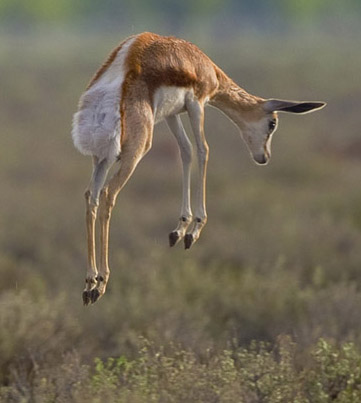
Stotting, also called pronking, is a conspicuous jumping behavior shown by some hoofed mammals. During a stot an animal launches itself upward so that all four feet are simultaneously off the ground, often with the legs held relatively stiff and the back slightly arched. The posture can make the jumper appear stiff-legged and deliberate rather than springy. This behavior is well known in various antelope species; it is commonly observed in gazelles and in springbok, and appears in other ungulates from time to time.
Image gallery
6 Images


Characteristics and contexts
Stotting is usually brief and repeated: an individual may perform a series of jumps separated by walking or running. The jumps vary in height and frequency and are most often seen when a potential predator is present or has been noticed. Observers report that stotting often occurs at the point of detection rather than during flight, and it may be performed by single animals or by groups. The maneuver is energetically costly relative to ordinary gait, which makes its repeated use notable.
Functional hypotheses
Biologists have proposed several non‑exclusive explanations for stotting. Because it is costly, many hypotheses frame the behavior as a form of communication:
- Pursuit‑deterrence signal: a way to show a predator that it has been seen and that the stotting individual is fit and unlikely to be caught, discouraging attack.
- Alarm or group signal: a public cue that alerts conspecifics to danger and may help synchronize escape within a herd.
- Confusion or distraction: an attempt to disrupt a predator's targeting by presenting an unexpected motion pattern.
- Social or sexual display: in some contexts, especially outside immediate predation events, stotting could serve to advertise fitness to conspecifics.
- Play or exercise: juveniles sometimes bound in ways that resemble stotting, which may reflect practice or social behavior rather than direct antipredator signaling.
Evidence and interpretation
Research and field observation lend strongest support to the idea that stotting can function as an honest signal to predators: because jumping is energetically expensive and exposes the animal, only individuals in good condition can afford repeated high leaps, so the display reliably conveys quality. At the same time, not every instance fits a single explanation; the same visible movement can serve multiple roles depending on context, the species involved, and the predator's hunting style.
Terminology and notable facts
The word "pronking" derives from a term meaning to show off; both "stotting" and "pronking" are used in scientific and popular accounts. The behavior has attracted interest because it challenges simple assumptions about escape: rather than fleeing silently, these animals perform a conspicuous, apparently costly act that reveals information. Studying stotting has therefore contributed to broader theories of animal signaling, honest communication, and predator–prey interactions.
Questions and answers
Q: What is stotting?
A: Stotting is a behavior exhibited by some bovines and gazelles where they spring into the air, lifting all four feet off the ground simultaneously.
Q: Which animals exhibit the behavior of stotting?
A: Bovines and gazelles exhibit stotting behavior.
Q: How are the legs positioned during stotting?
A: During stotting, the legs are held in a relatively stiff position.
Q: What is the position of the back and head during stotting?
A: During stotting, the back may be arched with the head pointing downward.
Q: What function does stotting serve?
A: Stotting is believed to be an honest signal to predators that the stotting animal is not worth pursuing.
Q: Is stotting an effective defense mechanism?
A: It is believed that stotting is an effective defense mechanism as it signals to predators that the stotting animal is not worth pursuing.
Q: Have any other explanations been proposed for stotting behavior?
A: Yes, many explanations for stotting behavior have been proposed.
Related articles
Author
AlegsaOnline.com Stotting (pronking): the high jump display of antelopes and ungulates Leandro Alegsa
URL: https://en.alegsaonline.com/art/94127
Sources
- books.google.com : "How the cheetah lost its stotts"
- sciencedirect.com : "The functions of stotting in Thomson's gazelles: some tests of the predictions"
- doi.org : 10.1016/S0003-3472(86)80052-5
- books.google.com : books.google.com/books?id=SUA51MeG1lcC&pg=PA61&lpg=PA61
- webs.wofford.edu : webs.wofford.edu
- sa-lodges.com : Herbivores of the Pilanesberg National Park I