
Stop Online Piracy Act (SOPA)
SOPA was a proposed 2011–2012 U.S. bill to strengthen enforcement against online copyright infringement. It drew intense debate over its provisions, technical effects, free speech, and was shelved after major protests.
Overview
The Stop Online Piracy Act (commonly referred to as SOPA) was a United States legislative proposal introduced in 2011 that sought to expand tools for addressing online copyright infringement. Backers described the measure as aiming to reduce access to websites dedicated to distributing pirated content; opponents argued it would give authorities and rights-holders far-reaching powers to block, restrict, or disrupt web services. The full text and legislative history were discussed widely by lawmakers, industry groups, and civil liberties organizations; more detailed material is available through a variety of legislative resources and commentaries (bill text, legislative summaries).
Image gallery
3 Images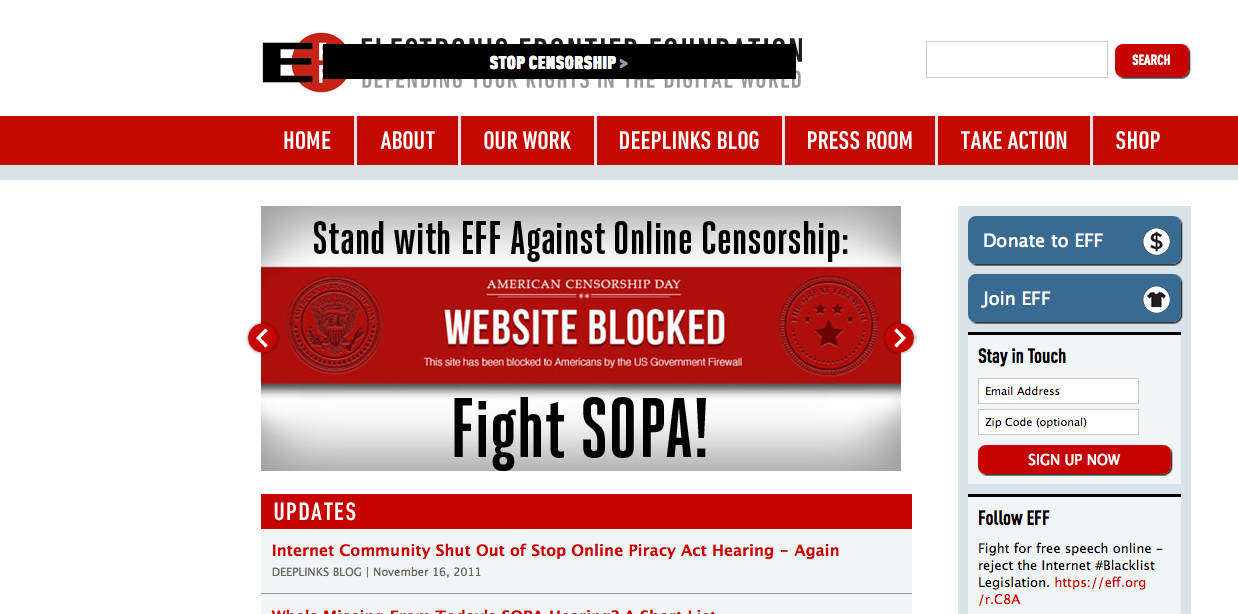

Key provisions and mechanisms
SOPA proposed several enforcement mechanisms intended to cut off the economic and technical means by which infringing sites operate. These measures included court orders that could require search engines to remove links, payment processors and advertising networks to stop doing business with targeted sites, and internet service providers to block access. Supporters argued these steps would help combat foreign web sites that evade U.S. law; critics warned the changes could affect routine online services and intermediaries that host user content or link to third-party material.
History and public response
The bill attracted intense public attention in late 2011 and early 2012. It had a companion Senate proposal known as the PROTECT IP Act. Major technology companies, advocacy groups, and millions of internet users mobilized in opposition, culminating in coordinated online protests and website blackouts in January 2012. Those protests, combined with media coverage and congressional questioning, contributed to sponsors putting the bill on hold and it ultimately did not become law.
Criticisms and technical concerns
Opponents raised legal and technical objections. Legally, they contended SOPA risked imposing prior restraints on speech by enabling rapid blocking of entire sites in response to allegations of infringement. Technically, experts warned that some proposed remedies could interfere with the Domain Name System and undermine internet security and interoperability. Civil liberty organizations and many technology firms emphasized the possible chilling effect on innovation, expression, and the operation of user-generated platforms (critic analyses).
Distinctions, examples, and importance
SOPA differed from traditional takedown procedures by emphasizing proactive blocking and economic disruption rather than case-by-case notice-and-takedown. Practical examples discussed at the time included disabling advertising revenue streams for accused sites or ordering search engines to remove links to entire domains. Critics cautioned that such sweeping measures could ensnare legitimate sites that host user content or provide lawful services, and could produce consequences beyond U.S. borders affecting the broader Internet ecosystem.
Aftermath and legacy
Although SOPA was not enacted, the debate reshaped how policymakers, the technology sector, and civil society approach online copyright enforcement. It highlighted tensions between protecting intellectual property and preserving internet openness, led to greater public engagement with digital policy debates, and influenced subsequent legislative and industry efforts to address piracy while trying to avoid the most controversial technical or speech-related consequences. For additional background on copyright policy and ongoing discussions, see resources on copyright law and online enforcement (copyright enforcement, detailed bill materials).
- Supporters: Entertainment and content industries seeking stronger tools against foreign infringers.
- Opponents: Major technology firms, civil liberties groups, and many internet users.
- Outcome: Widespread protest and legislative delay; the bill was not passed into law.
For contemporary reporting and primary documents, readers can consult legislative archives and analyses by legal and technical experts (policy summaries, critical perspectives).
Questions and answers
Q: What is SOPA?
A: SOPA stands for Stop Online Piracy Act, which was a proposed American law to stop copyright infringement on the Internet.
Q: When did the Internet community have a major discussion about SOPA?
A: The Internet community had major discussions over SOPA in 2011 and 2012.
Q: Was the bill of SOPA passed?
A: No, the bill of SOPA was not passed.
Q: What was the purpose of SOPA?
A: The purpose of SOPA was to stop copyright infringement on the Internet.
Q: What were some of the proposed changes to the internet that could have worldwide effects if SOPA was passed?
A: Some experts said the proposed changes to the internet would have worldwide effects, but the specific changes were not mentioned in the text.
Q: What were some of the criticisms of SOPA?
A: Many critics said SOPA would have bad unintended consequences, but the specific criticisms were not mentioned in the text.
Q: Was SOPA ultimately implemented as a law or regulation?
A: No, SOPA was not implemented as a law or regulation.
Related articles
Author
AlegsaOnline.com Stop Online Piracy Act (SOPA) Leandro Alegsa
URL: https://en.alegsaonline.com/art/94077
Sources
- ibtimes.com : "What is SOPA Bill 2012? 7 Things to Know About Controversial Legislation,"
- news.cnet.com : "How SOPA would affect you: FAQ,"
- whitehouse.gov : "Combating Online Piracy while Protecting an Open and Innovative Internet,"
- brookings.edu : "Cybersecurity in the Balance: Weighing the Risks of the PROTECT IP Act and the Stop Online Piracy Act,"
- rt.com : RT
- wikimediafoundation.org : English Wikipedia anti-SOPA blackout
- csmonitor.com : "Wikipedia blackout: Why even supporters question anti-SOPA move,"
- lexpress.fr : "Loi antipiratage américaine: RSF ferme son site en anglais en signe de protestation,"
- tempsreel.nouvelobs.com : "Ce mercredi, c'est la 'Journée de la censure américaine'',"
- telegraph.co.uk : "Wikipedia Sopa blackout won't solve the problem,"