
Stolen base (baseball)
An overview of the stolen base in baseball: definition, technique, scoring rules, strategy, history and notable players, plus distinctions such as defensive indifference and caught stealing.
In baseball a stolen base is recorded when a baserunner advances to the next base while the pitcher is delivering the ball to home plate and the advance is the result of the runner's action rather than a defensive mistake. The statistic is abbreviated SB and is one of the basic counting stats used to measure a player’s baserunning aggressiveness and speed. A runner may steal second, third or home; under normal circumstances a player cannot "steal" first base.
Image gallery
8 Images

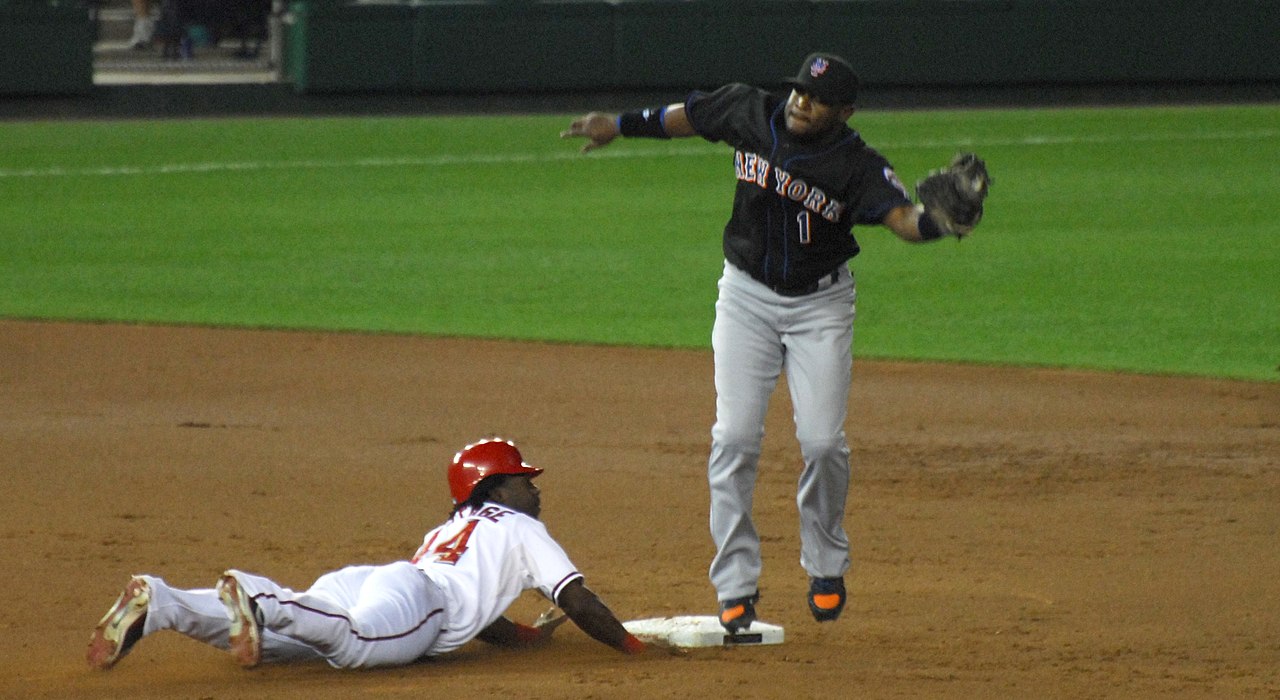


How a stolen base is executed
Successful stealing typically requires a combination of timing, speed and deception. Key elements include the runner's lead (how far he takes off the base), the secondary lead (advancing toward the next base after the pitcher begins his delivery), a quick and efficient slide, and reading the pitcher and catcher. The catcher attempts to throw the runner out at the next base, often assisted by infielders covering that bag. Pitchers use control of their delivery—pickoff moves, slide-steps and holding runners—to limit opportunities.
Common techniques and moves include:
- Taking a short or long lead depending on the pitcher's tendencies
- Timing the jump as the pitcher begins his motion
- Using a head-first or feet-first slide to reach the bag and avoid the tag
- Using deception, such as a delayed steal, hit-and-run, or running on a passed pitch
Scoring and related rules
Official scorers credit a stolen base when the runner advances solely because of his attempt while the pitcher is delivering the ball. If the advance is judged to be the result of a wild pitch, passed ball, balk, or a defensive error, the scorer may not award a stolen base. When the defense makes no play to prevent the advance—commonly late in lopsided games—the play is usually recorded as defensive indifference (also called fielder's indifference) rather than a stolen base. Major League Baseball cites this situation in its rules (see MLB Rule 10.07(g)).
Caught stealing (CS) is charged when a runner is thrown out attempting to steal. Analysts often combine SB and CS to calculate a player's stolen base percentage and to evaluate whether the risk is justified: stealing is only valuable when the success rate exceeds a break-even threshold, which depends on run environment and game context but is frequently estimated at roughly two-thirds to three-quarters success.
Strategy, history and notable facts
Steals affect game strategy by creating scoring opportunities, pressuring pitchers and catchers, and changing defensive alignment. The role of the stolen base has fluctuated over time: teams in some eras emphasized aggressive base stealing more than others. Several players are widely famous for stealing bases, and the activity remains a celebrated aspect of the sport for its combination of athleticism and split-second decision-making. For broader context on rules and historical leaders, see additional references in baseball literature and rulebooks such as official resources.
Because stolen bases involve split-second judgments by players and scorers, some plays invite debate—whether an advance was a true steal, a result of defensive indifference, or the consequence of a misplay. That judgement is why the official scoring of a stolen base is as much a matter of interpretation as it is of raw speed.
Questions and answers
Q: What is a stolen base in baseball?
A: A stolen base is when a baserunner advances to the next base while the pitcher is throwing the ball to home plate.
Q: How are stolen bases displayed in baseball statistics?
A: Stolen bases are displayed as SB.
Q: Which bases can be stolen in baseball?
A: It is possible to steal second base, third base, or home plate, but not to steal first base.
Q: What is defensive indifference in baseball and when is it scored instead of a stolen base?
A: Defensive indifference is when the defense does not try to put the baserunner out. It is usually only scored instead of a stolen base when the game is in a late inning and the team with the stealing baserunner is down by more than one run.
Q: What is the MLB rule that defines defensive indifference?
A: MLB Rule 10.07(g) defines defensive indifference.
Q: Is a stolen base credited to the runner in the case of defensive indifference?
A: No, no stolen base is credited to the runner in the case of defensive indifference.
Q: What is another name for defensive indifference in baseball?
A: Defensive indifference is also called fielder's indifference.
Author
AlegsaOnline.com Stolen base (baseball) Leandro Alegsa
URL: https://en.alegsaonline.com/art/94025