
Stockholm Bloodbath (1520): Mass executions after Christian II's conquest
Stockholm Bloodbath (1520): mass executions in Stockholm after King Christian II’s conquest, when dozens of Swedish nobles and clergy were killed, provoking national outrage and resistance.
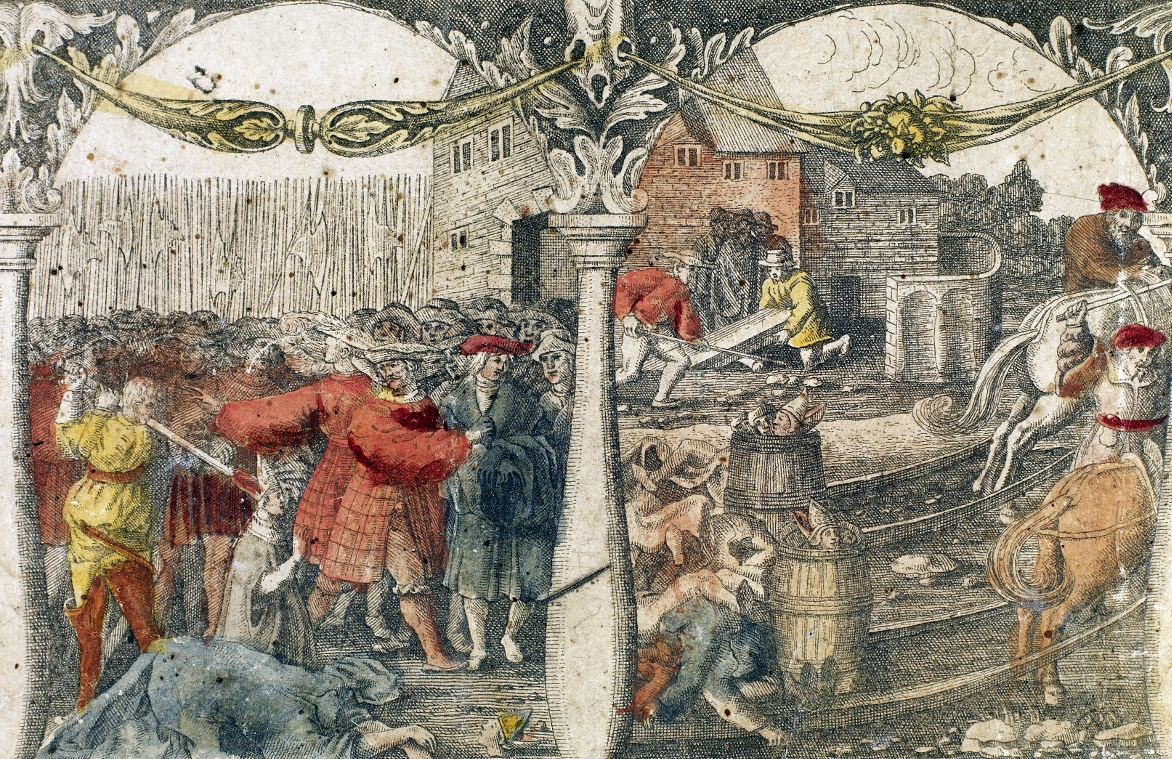
Stockholm Bloodbath refers to the mass executions carried out in Stockholm on 8–9 November 1520. The event followed the capture of the city by forces of King Christian II of Denmark. Dozens of leading Swedes were put to death; the episode is also called the Swedish Massacre.
Image gallery
3 Images

Names and language
The name for the event in Swedish is Stockholms blodbad. It concerned people from Sweden, notably members of the local nobility, who were targeted after the city's surrender.
Political context
At the time Denmark, Norway and Sweden were linked under the Kalmar Union. Tensions had been rising for years between those who wanted to keep the union and others pressing for Swedish independence. Christian II advanced into Sweden in 1520; the Swedish regent Sten Sture the Younger died in combat and Stockholm endured a four‑month siege before capitulating.
The executions and accusations
After Christian II assumed control of Stockholm he ordered the execution of a large group of prominent Swedish figures—official counts typically cite eighty‑two victims, among them two bishops who were condemned for heresy. In a further indignity, Sten Sture’s remains were exhumed and burned. The scale and brutality of the killings provoked widespread outrage and contributed to Christian’s loss of support in Sweden.
Aftermath
The massacre hardened resistance to Danish rule and played a role in the chain of events that led to Christian II’s removal from power in Sweden in 1523.
Questions and answers
Q: What was the Stockholm Bloodbath?
A: The Stockholm Bloodbath was a mass killing of Swedish nobility by the Danish King Christian II in 1520.
Q: Why did Christian II invade Sweden?
A: In 1520, Christian II invaded Sweden due to the conflict between those who supported the Kalmar Union and those who wanted independence.
Q: Who was the regent of Sweden at the time?
A: The regent of Sweden at the time was Sten Sture the Younger.
Q: How long did Christian II besiege Stockholm?
A: Christian II besieged Stockholm for four months.
Q: What happened to Sten Sture the Younger?
A: Sten Sture the Younger was killed in battle, and his body was dug up and burned at the stake.
Q: What was the reason for the heresy trials?
A: The reason for the heresy trials was that the people of Stockholm had replaced Archbishop Gustav Trolle, which was considered a crime against the Church.
Q: What was Christian II's nickname after the killings?
A: Christian II became known as "Christian the Tyrant" after the killings.
Related articles
Author
AlegsaOnline.com Stockholm Bloodbath (1520): Mass executions after Christian II's conquest Leandro Alegsa
URL: https://en.alegsaonline.com/art/93987
Sources
- britannica.com : "Stockholm Bloodbath (Swedish history) -- Britannica Online Encyclopedia"
- executedtoday.com : "1520: Stockholm Bloodbath"
- credoreference.com : "Stockholm Bloodbath (1520)"