
Stingray (Myliobatoidei): biology, behaviour and human interactions
Comprehensive overview of stingrays (Myliobatoidei): anatomy, senses, feeding, reproduction, habitats (marine and freshwater), defensive sting and venom, human interactions and conservation concerns.
Stingrays are a diverse group of flattened cartilaginous fishes in the suborder Myliobatoidei, a clade closely related to sharks. They share the basic elasmobranch body plan but are distinguished by large, wing-like pectoral fins that form a broad disc, a ventral mouth adapted for feeding on the seafloor, and a long tail in many species. Size, shape and ecology vary widely across the group: some are small benthic species that spend most of their time buried in sand, others are large, pelagic relatives that travel in open water.
Image gallery
10 Images




Anatomy and locomotion
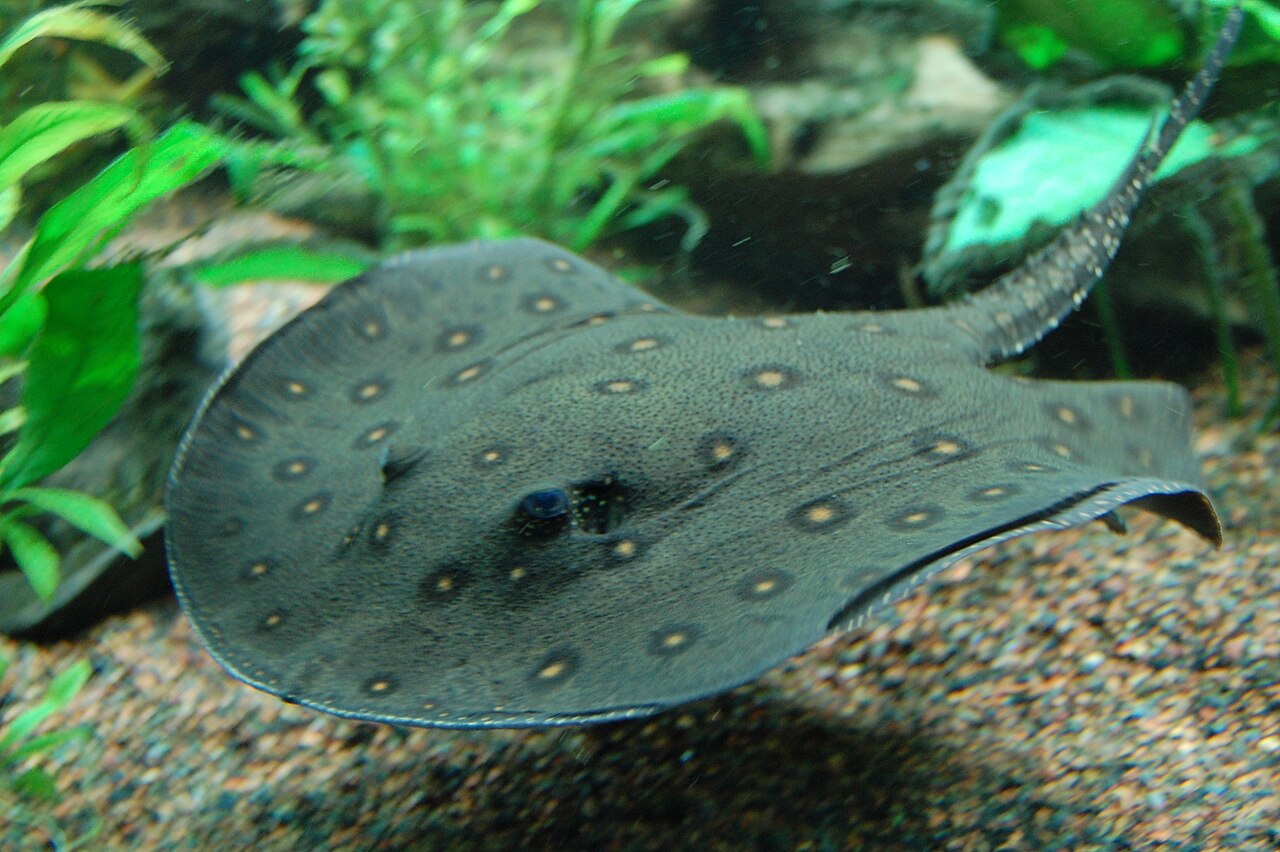
Most stingrays have a flattened body with eyes and spiracles (breathing openings) on the upper surface and the mouth, gill slits and nostrils on the underside. The pectoral fins are fused to the head and provide lift and propulsion; motion is produced either by undulating the fin margins or by flapping them in a wing-like manner. The skeleton is cartilaginous, as in other members of the class Chondrichthyes. Many species possess one or more barbed spines on the tail; these are modified dermal denticles with grooves that are associated with venom-secreting tissue.
Senses and feeding
Like other elasmobranchs, stingrays have well-developed senses adapted to a benthic lifestyle. They detect prey through vision, smell and subtle pressure changes, and critically by electroreception using ampullae of Lorenzini to sense the weak bioelectric fields of buried organisms. Diets are typically composed of molluscs, crustaceans, worms and small fishes; many rays use suction and strong crushing plates or pavement-like teeth to break shells. As predators and foragers they influence sediment mixing and benthic community structure.
Reproduction and life history
Reproductive strategies vary, but many stingrays are live-bearing. Embryos may begin development relying on yolk, then receive additional nourishment from uterine secretions (a form of aplacental viviparity). Gestation periods and litter sizes differ significantly among species. Mating behaviour often includes courtship bites and close association between male and female prior to copulation. Longevity and age at maturity vary; larger species generally mature more slowly.
Defence: spines and venom
Most members of the group use the tail spine as a defensive weapon. The spine is usually sheathed in skin until deployed; when broken or driven into a target it can deliver an unpleasant venom. Stings are typically used in defence rather than for hunting. Injuries to people can cause severe pain, localized tissue damage and, occasionally, more serious complications such as infection or allergic reaction. First aid guidance commonly recommends careful removal of the spine if visible and immobilizing the affected area, while immersion in hot (but not scalding) water may help reduce pain by denaturing some venom components; medical attention is advised in all cases. A few large relatives, such as manta and mobula rays, lack a tail spine and employ size and agility to deter predators (manta and mobula rays).
Distribution and habitats
Stingrays are widespread in tropical and subtropical coastal waters worldwide and occur in warm temperate regions as well. Many species are demersal, occupying sandy or muddy bottoms, seagrass beds and coral reef flats, where they often bury themselves for camouflage. Several lineages have adapted to freshwater systems and inhabit rivers and lakes in regions such as South America and Asia; these freshwater taxa have independently evolved from marine ancestors in multiple groups (freshwater stingrays).
Taxonomy, evolution and conservation
Stingrays form part of the order Myliobatiformes and are divided among several families that reflect a range of morphologies and ecologies. They evolved from shark-like elasmobranch ancestors and diversified into bottom-dwelling and pelagic forms. Taxonomic and evolutionary studies draw on morphology and genetic data to resolve relationships within the group (classification and taxonomy). Many species are affected by human activities: targeted fisheries, bycatch, habitat loss and coastal development all threaten local populations. Conservation approaches include fisheries management, protected areas and public education about safe human–wildlife interactions (human interactions and conservation).
Human interactions and safety
People encounter stingrays through fisheries, recreational activities such as snorkeling and in public aquaria. Most interactions are harmless when rays are respected; accidental stings often occur when a ray is stepped on or provoked. Understanding behaviour, observing from a distance, and following local guidelines reduce risks. For further general background on elasmobranch biology and identification consult resources on sharks and rays (shark relatives, defence biology, taxonomic overviews).
Questions and answers
Q: What are stingrays?
A: Stingrays are a suborder of cartilaginous fish related to sharks, with one or more barbed stings on the tail that is solely used for self-defense.
Q: What suborder do stingrays belong to?
A: Stingrays belong to the suborder Myliobatoidei of the order Myliobatiformes, which consists of nine families.
Q: What is the purpose of the stingrays' tail?
A: The purpose of the stingrays' tail is self-defense, with one or more barbed stings that can reach up to 35cm, and its underside has two grooves with venom glands.
Q: What is the sheath of a stingray's sting?
A: The sheath of a stingray's sting is a thin layer of skin that holds the venom.
Q: Do all stingrays have stings on their tails?
A: No, not all stingrays have stings on their tails, such as the manta rays and the porcupine ray.
Q: Where are stingrays commonly found?
A: Stingrays are common in coastal tropical and subtropical marine waters throughout the world, with some species in warm temperate oceans, and some found in fresh water.
Q: Where do most stingrays live?
A: Most stingrays live at or near the bottom of the water, but some are pelagic.
Related articles
Author
AlegsaOnline.com Stingray (Myliobatoidei): biology, behaviour and human interactions Leandro Alegsa
URL: https://en.alegsaonline.com/art/93951
Sources
- fishchannel.com : "Dangerous and Venomous Aquarium Fish"
- doi.org : 10.1580/1080-6032(1997)008[0024:SI]2.3.CO;2
- pubmed.ncbi.nlm.nih.gov : 11990133
- fishbase.org : FishBase online
- flmnh.ufl.edu : "Pelagic stingray"
- divephotoguide.com : "Stingray City - Altering Stingray Behavior & Physiology?"
- scubaboard.com : "Stingray behavior?"
- floridamuseum.ufl.edu : "Dasyatis sabina"
- dailymail.co.uk : "Zoo staff thought stingrays in female-only tank were bloated... that was until they gave birth to SEVEN pups"