
Stickleback (Gasterosteidae): biology, distribution, and behavior
Overview of sticklebacks (family Gasterosteidae): distinctive anatomy, reproduction and nesting, habitat and distribution, and their role in research and ecosystems.
Sticklebacks are small ray-finned fish belonging to the family Gasterosteidae. They occur across the Northern Hemisphere and show a wide range of forms and behaviors despite their generally modest size. Many species live in freshwater, and some occupy coastal or anadromous niches, adapting to different salinities and environments.
Image gallery
5 Images
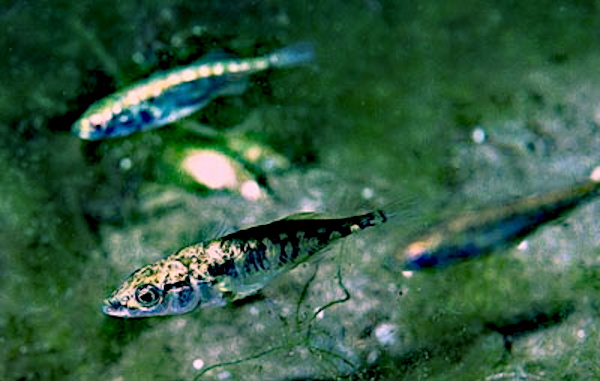


Distinctive characteristics
Sticklebacks are immediately recognizable by anatomical features uncommon among small fishes. Their skin normally lacks true scales, though several species bear rows of external bony armour plates that provide protection. Another prominent trait is a series of independently movable spines at the front of the back, set before the soft-rayed portion of the dorsal fin. Other general traits include a streamlined body, varied coloration during breeding seasons, and mouthparts suited for picking small prey.
- External armour: plates or reduced plating depending on species.
- Fin spines: defensive, erectable spines ahead of the dorsal fin.
- Diet: primarily small crustaceans, insect larvae, and fish larvae.
- Size: most are small, often only a few centimetres to a decimetre long.
Reproduction and nesting behavior
Reproductive behavior in sticklebacks is notable for male-centered parental care and elaborated courtship. Males build a nest from bits of vegetation and other materials, held together by a sticky secretion produced by the kidneys. After construction, males perform displays to attract females; a female that accepts lays eggs into the nest where the male fertilizes them. The male then tends and aerates the clutch, a form of active egg protection that improves offspring survival.
- Male builds and defends a nest.
- Male courts and entices females to inspect the nest.
- Female deposits eggs; male fertilizes them.
- Male guards and fans eggs until hatching.
Distribution, habitats and species diversity
Members of Gasterosteidae inhabit fresh waters and coastal areas across Europe, Asia and North America. Some populations are entirely freshwater, others migrate between fresh and salt water, and a few are resident in estuaries and nearshore seas. Taxonomy is specialized but not fully settled; for example, FishBase currently recognizes sixteen named species in several genera, and researchers continue to refine relationships within the family.
Scientific importance and notable facts
Sticklebacks are important in evolutionary and behavioural studies because they show rapid adaptation to local conditions, repeated evolution of armour and pelvic traits, and clear, studyable mating systems. The threespine stickleback (a common, well-studied species) has been used to investigate speciation, adaptation to freshwater from marine ancestors, and the genetic basis of morphological change. Beyond research, sticklebacks play roles in food webs as predators of invertebrates and as prey for larger fish and birds.
They are related to seahorses and pipefish within the broader group of Syngnathiformes-like relatives, often mentioned in comparative studies of morphology and life history (pipefish and seahorses). For further reading and taxonomic resources consult specialized databases and regional faunal surveys via the links below.
Relevant links: general guide to sticklebacks, Gasterosteidae family overview, scalation details, armour plate variation, relatives: pipefish and seahorses, European distribution, Asian distribution, North American distribution, fin spines description, dorsal fin anatomy, parental care and egg protection, nest construction, nest materials and plant use.
Questions and answers
Q: What family do sticklebacks belong to?
A: Sticklebacks belong to the Gasterosteidae family.
Q: How many species of sticklebacks are recognised by FishBase currently?
A: FishBase currently recognises sixteen species in the stickleback family.
Q: Where are stickleback species found?
A: Stickleback species are found in fresh water environments in Europe, Asia, and North America.
Q: What do sticklebacks feed on?
A: Sticklebacks feed on small crustaceans and fish larvae.
Q: What is the mating behavior of sticklebacks?
A: All stickleback species show similar mating behavior, with cooperation between the sexes and protection of the eggs.
Q: How do male sticklebacks construct nests?
A: Male sticklebacks construct a nest from vegetation held together by secretions from their kidneys.
Q: How do male sticklebacks care for their eggs?
A: Male sticklebacks guard the eggs until they hatch after the females lay their eggs inside the constructed nest, and the males fertilise them.
Related articles
Author
AlegsaOnline.com Stickleback (Gasterosteidae): biology, distribution, and behavior Leandro Alegsa
URL: https://en.alegsaonline.com/art/93912