
Steppe bison (Bison priscus): Pleistocene grazing megafauna
Bison priscus, commonly called the steppe bison or steppe wisent, was an extinct Pleistocene bison that ranged across Eurasian steppes, Beringia and North America; known from fossils, preserved carcasses and cave art.
Overview
The steppe bison, Bison priscus, was a large grazing bovine of the Pleistocene–Quaternary era. Fossil and frozen remains show it occupied open grasslands and tundra-like environments across the Eurasian continent and into North America. The species is commonly referred to as the steppe bison or steppe wisent and is associated with expansive steppes and cold-adapted habitats. Its presence is a defining part of Quaternary megafauna assemblages recorded throughout the Quaternary.
Image gallery
7 Images



Appearance and distinguishing features
Steppe bison were robust, with large shoulder humps, curved horns, and a shaggy winter coat in colder regions. Compared with the modern American bison and European forms, B. priscus often showed proportions adapted for long-distance grazing on open ground. It can be confused in broad outline with the wild ox or aurochs, but they are separate lineages: the aurochs is the wild ancestor of domestic cattle, while the steppe bison belongs to the bison clade that led to later species such as the modern wisent.
Range, origin and evolutionary context
Evidence suggests the steppe bison evolved in parts of Eurasia, with some hypotheses pointing to origins in South Asia before expanding across Central Asia, the European plains and into Beringia. During cold intervals, populations crossed the Bering land connection into North America, where they gave rise to or were succeeded by large Nearctic bison such as Bison latifrons and later Bison antiquus before the lineage culminated in the modern American bison. In Europe, B. priscus populations were ultimately replaced by the lineage leading to the present-day wisent.
Fossil record and preservation
Remains of steppe bison are found as bones, skulls and in a few remarkable cases as partially preserved carcasses in permafrost and ice. These frozen specimens have provided insights into coat color, age at death and stomach contents. The species is well represented in archaeological and palaeontological sites across its range, yielding radiocarbon dates and morphological data that clarify its distribution through the Pleistocene and into the last glacial cycles.
Human interactions and cultural significance
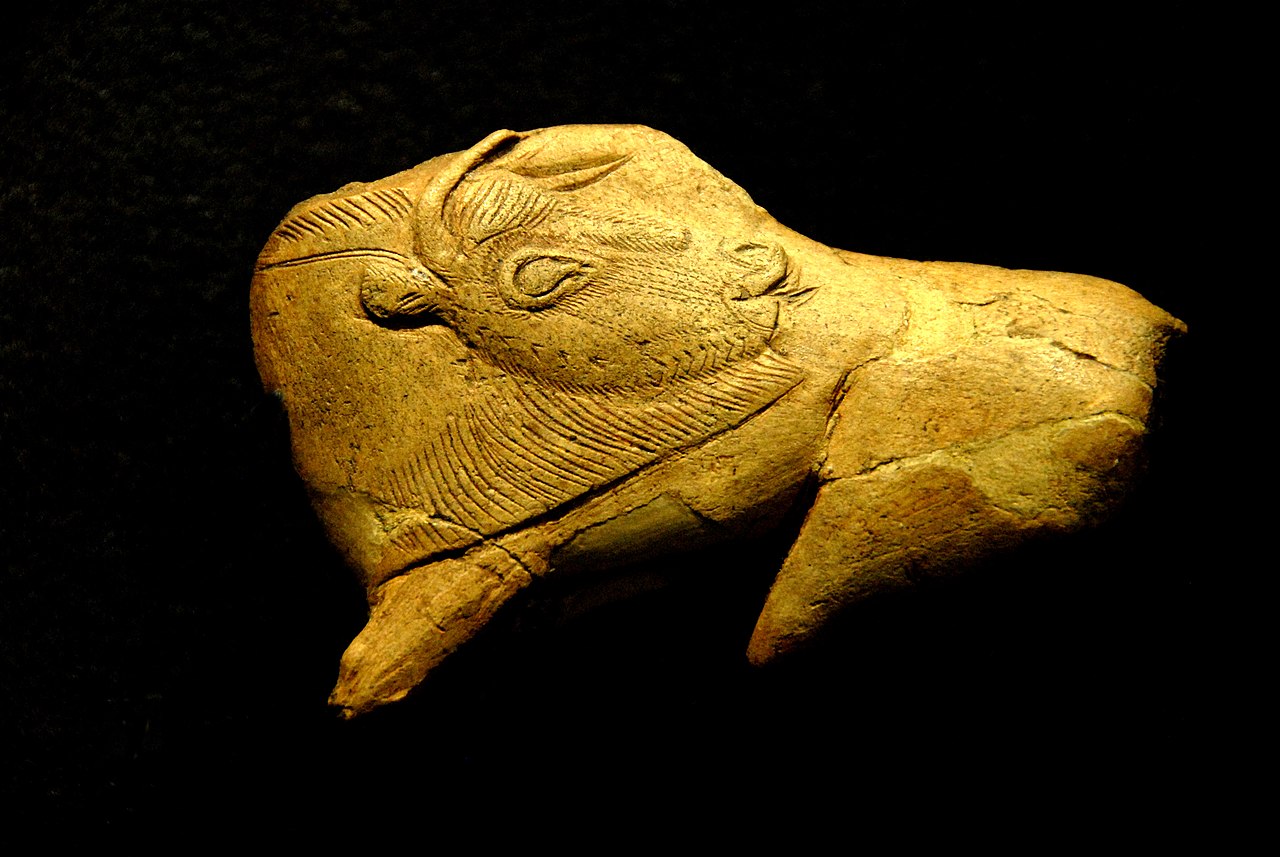
Steppe bison appear repeatedly in Paleolithic art and hunting contexts. They feature in Paleolithic cave painting traditions and are depicted in some of the most famous gallery sites, including the Cave of Altamira and Lascaux. These images, along with butchered bones and associated tools, indicate that bison were an important prey species for prehistoric people and occupied a prominent place in their symbolic world.
Notable facts and distinctions
- Geographic breadth: from Eurasian plains to the grasslands of North America and across Beringia.
- Evolutionary role: an ancestor or close relative to later American and European bison, bridging Old and New World megafauna dynamics.
- Preservation: rare ice-preserved individuals have allowed study of soft tissues and diet.
- Cultural record: frequent subject of Paleolithic art and archaeological assemblages.
Study of Bison priscus continues to refine its precise relationships with later bison species and to illuminate how climate shifts and human hunting shaped the distribution and eventual disappearance of many Pleistocene megafauna.
Questions and answers
Q: What is the steppe bison?
A: The steppe bison, also known as the steppe wisent, is an extinct bison that lived on steppes in Europe, Central Asia, Beringia, and North America during the Quaternary.
Q: Where is it believed that the steppe bison evolved?
A: It is believed that the steppe bison evolved somewhere in South Asia.
Q: With which animal are the descendants of the steppe bison sometimes confused?
A: The descendants of the steppe bison are sometimes confused with the aurochs, as they appeared at about the same time and region.
Q: When did the steppe bison become extinct?
A: The steppe bison became extinct in the Pleistocene.
Q: What replaced the steppe bison in Europe?
A: The steppe bison was replaced in Europe by the modern wisent species.
Q: What animals replaced the steppe bison in America?
A: The steppe bison was replaced in America by Bison latifrons, then later Bison antiquus, and finally the modern American bison.
Q: Where have steppe bison occasionally appeared in art?
A: Steppe bison have occasionally appeared in cave paintings, such as in the famous Cave of Altamira and Lascaux. They have also been found in naturally ice-preserved form.
Related articles
Author
AlegsaOnline.com Steppe bison (Bison priscus): Pleistocene grazing megafauna Leandro Alegsa
URL: https://en.alegsaonline.com/art/93779
Sources
- beringia.com : Steppe Bison – Yukon Beringia Interpretive Centre
- doi.org : 10.1093/molbev/msh064
- pubmed.ncbi.nlm.nih.gov : 14739241
- books.google.com : "Frozen fauna of the Mammoth steppe: the story of Blue Babe"