
Stephen Hopkins (Rhode Island Governor and Declaration Signer)
Stephen Hopkins (1707–1785) was a Rhode Island statesman, chief justice, and delegate to the Continental Congress who signed the Declaration of Independence and shaped colonial governance in the mid‑18th century.
Stephen Hopkins (March 7, 1707 – July 13, 1785) was a prominent political leader from Rhode Island. During a long public career in the mid‑18th century he held the colony's highest civil and judicial offices and represented Rhode Island in important intercolonial assemblies. Hopkins is best known today as one of the signers of the Declaration of Independence.
Image gallery
10 Images



Roles and responsibilities
Hopkins served repeatedly as governor of colonial Rhode Island and sat as chief justice of the colony's superior court. Those posts combined executive and legal authority in a small, maritime colony where commerce, local law, and relations with Britain and neighboring colonies required frequent negotiation. He also took part in early efforts to coordinate colonial responses to imperial policy and frontier defense.
Intercolonial representation
Hopkins was a Rhode Island delegate to the Albany Congress of 1754, an early meeting of colonial representatives to discuss common concerns such as military defense and relations with Native American nations. Two decades later he served in the Continental Congress from 1774 to 1776, joining other colonial leaders as the movement toward independence accelerated.
Declaration and Revolutionary period
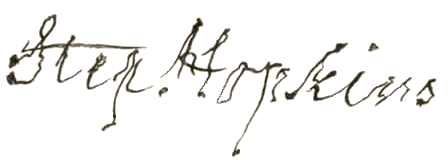
As a delegate in 1776 Hopkins voted with the majority for independence and added his name to the Declaration. His signature placed him among colonial leaders who converted provincial grievances into a formal assertion of sovereignty. Back in Rhode Island he continued to shape local government as the colony adjusted from royal instructions to statehood.
Legacy and historical notes
Hopkins's house in Providence survives as an historic landmark and his name is associated with Rhode Island's political development before and during the American Revolution. He is sometimes confused with other contemporaries of the same name; when studying the period it is useful to distinguish him by his roles as governor, chief justice, and Continental Congress delegate.
- Born: March 7, 1707; Died: July 13, 1785.
- Delegate to the Albany Congress (1754).
- Member of the Continental Congress (1774–1776) and signer of the Declaration.
For broader context on his career and the institutions he served, see resources on colonial Rhode Island and the Continental Congress. More detailed biographical and documentary material can be consulted through state archives and collections of founding‑era papers. Further reading on the Continental Congress is available from specialized historical repositories.
Questions and answers
Q: Who was Stephen Hopkins?
A: Stephen Hopkins was an American political leader from Rhode Island.
Q: When was Stephen Hopkins born?
A: Stephen Hopkins was born on March 7, 1707.
Q: When did Stephen Hopkins pass away?
A: Stephen Hopkins passed away on July 13, 1785.
Q: What did Stephen Hopkins do during his political career?
A: Stephen Hopkins served as the Chief Justice and Governor of colonial Rhode Island, was a Delegate to the Colonial Congress in Albany in 1754, and was a Delegate to the Continental Congress from 1774 to 1776.
Q: Was Stephen Hopkins a signer of the Declaration of Independence?
A: Yes, Stephen Hopkins signed the Declaration of Independence.
Q: Which state did Stephen Hopkins represent in the Continental Congress?
A: Stephen Hopkins represented Rhode Island in the Continental Congress.
Q: When did Stephen Hopkins serve as Governor of colonial Rhode Island?
A: It is not specified in the text when exactly Stephen Hopkins served as Governor of colonial Rhode Island.
Related articles
Author
AlegsaOnline.com Stephen Hopkins (Rhode Island Governor and Declaration Signer) Leandro Alegsa
URL: https://en.alegsaonline.com/art/93755