
Stegosauria: plated dinosaurs of the Jurassic and Early Cretaceous
Stegosauria were herbivorous, armored dinosaurs in Thyreophora noted for rows of plates and tail spikes. Lived from the Upper Jurassic to the Lower Cretaceous; plate function remains debated.
Overview
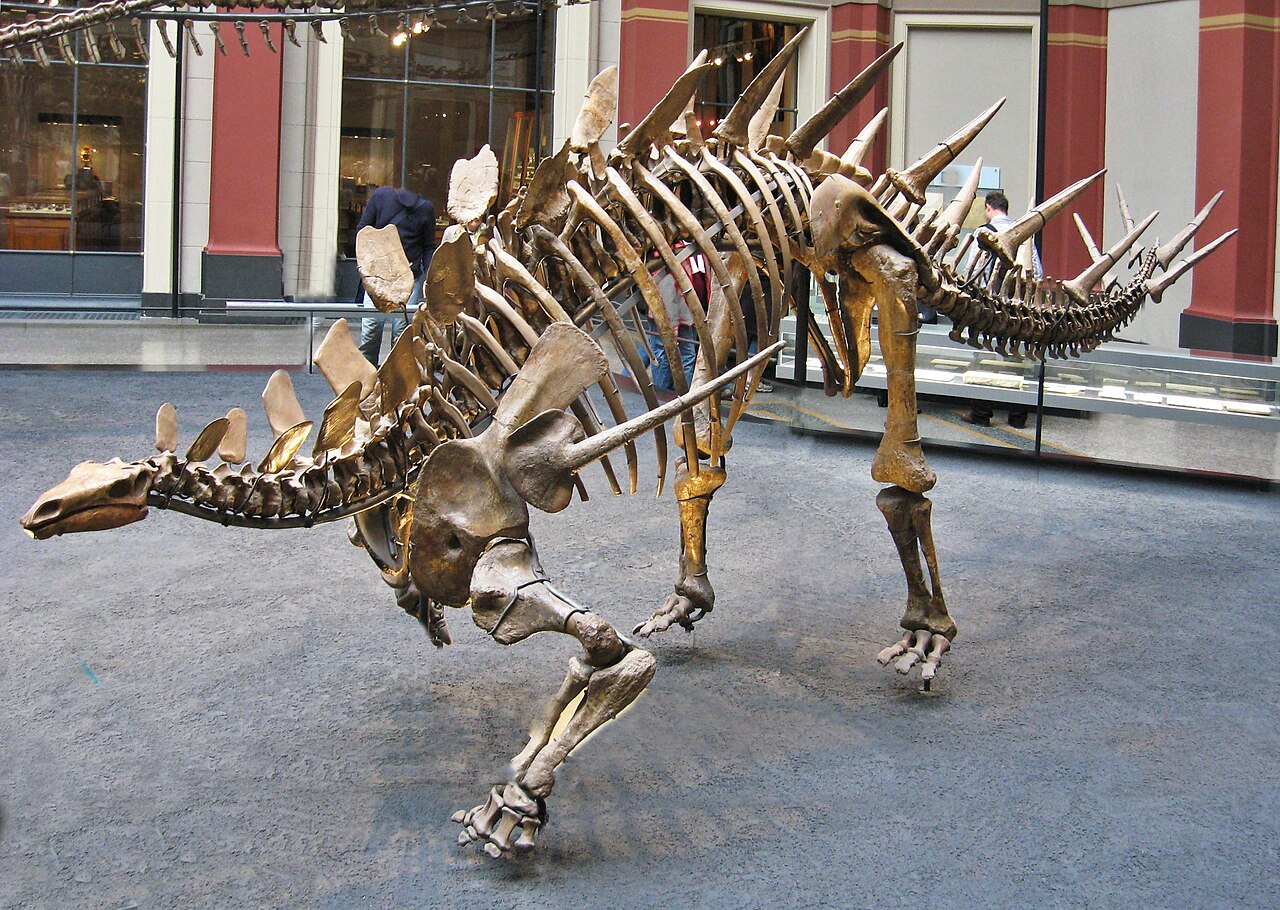
The Stegosauria were a distinctive group of herbivorous dinosaurs within the armored suborder Thyreophora. Recognized for their rows of large, vertical bony plates and tail spikes, stegosaurs are among the most immediately recognizable prehistoric animals and feature prominently in discussions of dinosaur posture, armor and display.
Characteristics: Members had relatively small heads with simple, peg-like teeth adapted to a plant diet. Along the back and tail they bore alternating or paired upright plates and defensive spines, often formed from thick dermal bone or osteoderms. Hindlimbs were typically longer and stronger than the forelimbs, giving stegosaurs a distinctive sloping stance and limited forelimb reach.
Evolution and time range: Fossils indicate stegosaurs were widespread from the Upper Jurassic into the Lower Cretaceous. Remains have been recovered from North America, Europe, Africa and Asia, and early forms such as Huayangosaurus help bridge them to more primitive armored dinosaurs.
Function and behavior: Paleontologists debate the primary roles of plates and spikes. Hypotheses include display for species recognition or sexual signaling, passive or active defense, and thermoregulatory functions. The tail spikes—commonly called a "thagomizer"—are widely interpreted as effective defensive weapons. The once-popular idea that stegosaurs possessed a second brain in the hips has been largely discounted; their brains were small relative to body size.
Image gallery
10 Images


Notable genera and significance
- Stegosaurus — the largest and best-known genus from North America.
- Kentrosaurus — a more spine-dominated stegosaur from Africa.
- Wuerhosaurus and Huayangosaurus — Asian genera that show the group’s diversity and early evolution.
Stegosaurs provide key evidence about how armor and display structures evolved among herbivorous dinosaurs and how body plan and behavior adapted to different environments. Their fossils have shaped public and scientific views of dinosaur biology since their discovery and remain central to studies of dinosaur ecology and functional anatomy. For broader context see general dinosaur resources at dinosaur overviews and focused works on Thyreophora.
Questions and answers
Q: What is the Stegosauria?
A: The Stegosauria is a group of dinosaurs in the suborder Thyreophora.
Q: What are some physical characteristics of the Stegosaurs?
A: They have small heads, peg-like teeth and vertical bony plates and spines on their back and tail.
Q: When did the Stegosaurs flourish?
A: The Stegosaurs flourished from the Upper Jurassic to the Lower Cretaceous.
Q: What is the appearance of bony plates and spines?
A: The appearance of bony plates and spines is vertical.
Q: What is the suborder Thyreophora?
A: The suborder Thyreophora is a group of dinosaurs that have bony plates or shields on their body.
Q: How did Stegosaurs' teeth look like?
A: Stegosaurs have peg-like teeth.
Q: Was the Stegosauria an extinct group of animals or are they still present today?
A: The Stegosauria was an extinct group of animals.
Related articles
Author
AlegsaOnline.com Stegosauria: plated dinosaurs of the Jurassic and Early Cretaceous Leandro Alegsa
URL: https://en.alegsaonline.com/art/93674
Sources
- rspb.royalsocietypublishing.org : "A new long-necked 'sauropod-mimic' stegosaur and the evolution of the plated dinosaurs"
- doi.org : 10.1098/rspb.2008.1909
- ncbi.nlm.nih.gov : 2674496
- pubmed.ncbi.nlm.nih.gov : 19324778
- doi.org : 10.1017/S1477201908002459