
St Michael's Church (Michaelskirche), Bamberg
Romanesque hilltop church in Bamberg dating from the 12th century; former Benedictine monastery, now a viewpoint with an almshouse, museum and municipal art collections.
Overview
St Michael's Church, known locally as the Michaelskirche, crowns the highest of Bamberg's seven hills and dominates views across the town of Bamberg. Constructed in the 12th century, the church is a prominent landmark that can be seen from multiple directions. Its elevated site on the hilltop (the Michaelsberg) makes the church both a visual focal point and a natural observation point over the surrounding urban area and the nearby countryside.
Image gallery
5 Images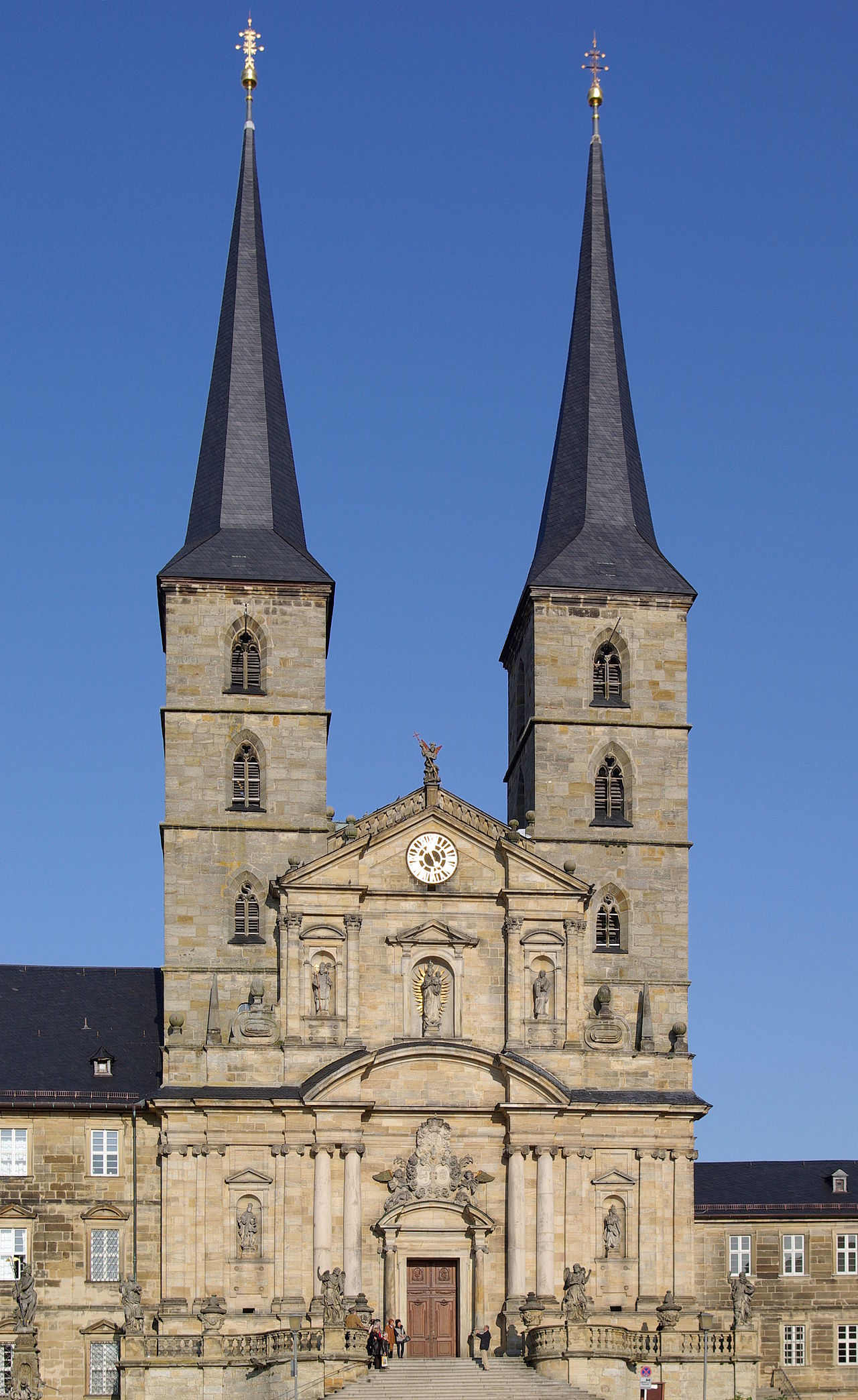


Approach and setting
Visitors commonly reach the church by an old, cobbled lane that climbs from the cathedral precinct and passes a string of historic homes and structures. The steep approach is lined with several centuries-old buildings that evoke the medieval character of the town center; the path itself is often described as an atmospheric route to the hilltop site (cobbled path, historic houses). Beyond the church the landscape opens onto fields and patches of woodland, offering a sudden shift from urban to rural scenery (fields, woods).
Architecture and layout
St Michael's is principally Romanesque in style, a characteristic reflected in its sturdy walls, relatively small window openings and the use of rounded arches. Built in the 12th century, the church originally formed part of a Benedictine monastic complex. As with many Romanesque churches, its plan is simple and robust, emphasizing mass and horizontality rather than the verticality and large glazed surfaces of later Gothic buildings. The surviving fabric and the preserved spatial sequence give a good sense of medieval ecclesiastical architecture and monastic arrangement (Benedictine monastic traditions, monastery).
History and transformation
The church and its associated monastery date from the high Middle Ages, when monastic communities played an important role in religious life, learning and land management. Like many religious houses in Germany, the Benedictine monastery attached to St Michael's was secularized in the early 19th century during the wave of reforms and territorial reorganizations; the formal secularization of the house took place in the secularization period and is commonly dated to 1803. After secularization the complex was adapted to new civic and charitable functions rather than being restored to monastic use.
Uses, collections and public importance
Today the former monastic buildings and the church accommodate a mix of civic uses. Part of the site serves as an almshouse and social housing, continuing a long tradition of social care on the hill. Other rooms have been repurposed for cultural uses: a local museum and municipal art collections are displayed in sections of the complex, making the site both a heritage attraction and a community resource (museum, municipal art). The position and longevity of St Michael's contribute to Bamberg's historic townscape; the city's ensemble of hilltop churches is one reason Bamberg's historic core is widely recognized for its cultural value.
Notable facts and visiting tips
- St Michael's stands on the highest of Bamberg's seven hills and is visible from many points in the town.
- The site blends urban medieval streets with nearby open fields and woodland, offering panoramic views.
- When planning a visit, expect a steep climb along historic cobbles and modest interior lighting typical of Romanesque churches.
- The complex illustrates a typical European pattern: medieval monastic foundation, secularization in the early 1800s, and modern reuse for social and cultural purposes.
For further information about the town, the Michaelsberg site, the historic route and the museum, consult local guides or municipal resources before visiting: Bamberg information, Michaelsberg hill, access route, historic houses, surrounding fields, nearby woods, Benedictine order, monastic history, secularization context, the year 1803, museum details, municipal art collections.
Questions and answers
Q: What is St. Michael's Church?
A: St. Michael's Church, also known as the Michaelskirche, is a church in Bamberg.
Q: When was St. Michael's Church built?
A: St. Michael's Church was built in the 12th century.
Q: Where is St. Michael's Church located?
A: St. Michael's Church is located on the top of a very high hill overlooking the town of Bamberg.
Q: How many hills is Bamberg built on?
A: Bamberg is built on seven hills.
Q: What style is St. Michael's Church built in?
A: St. Michael's Church is built in the Romanesque style.
Q: What was the original purpose of St. Michael's Church?
A: St. Michael's Church used to be the church of a Benedictine monastery.
Q: What is located near St. Michael's Church today?
A: Today, there is an almshouse, a museum, and municipal art collections near St. Michael's Church.
Related articles
Author
AlegsaOnline.com St Michael's Church (Michaelskirche), Bamberg Leandro Alegsa
URL: https://en.alegsaonline.com/art/93184