
Bassoon: overview, construction, repertoire and distinctive features
A detailed encyclopedia entry on the bassoon: its design, parts, playing technique, range, historical development, orchestral and chamber roles, and distinctions between German and French systems.
Overview
The bassoon is a long, conical-bore woodwind instrument played with a double reed. It occupies the lowest main register of the woodwind family in orchestras and chamber groups, combining a resonant bass foundation with an unexpectedly agile upper voice. The instrument is valued for its warm, reedy timbre, its capacity for expressive legato, and its aptitude for both lyrical solos and humorous, characterful lines in the orchestral literature.
Image gallery
10 Images




Construction and main parts
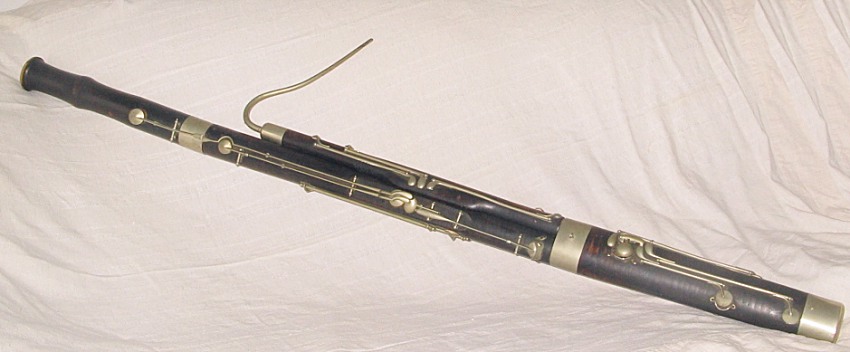
The modern bassoon is built from several wooden or composite sections that fit together and are supported partly by a metal crook (also called a bocal) to which the double reed is bound. The core components are:
- Crook/bocal and reed: a curved metal tube connects the reed to the instrument. The reed itself is made from two blades of cane bound to a small tube and adjusted by the player for tone and response.
- Wing (or tenor) joint: the upper long section that takes many of the fingerings for the higher part of the instrument’s compass.
- Bass joint: the longer lower tube that contains many of the tone holes and keys for the lower register.
- Boot joint: a U-shaped connector that joins the wing and bass joints and turns the airflow back up the instrument.
- Bell joint: the flared top section that helps shape the instrument’s highest notes and projection.
Traditionally the body is carved from maple or other hardwoods; modern instruments may use stabilized wood or synthetic materials. Some German-made models display a white decorative ring (historically made of ivory) around the bell joint: these are commonly associated with the Heckel design, while French-style instruments (Buffet system) differ in bore and ornamentation.
Playing posture, support and technique
Because a bassoon is relatively large and heavy, players use supportive devices: many employ a seat strap that hooks to the boot joint and rests on the chair, while others use harnesses or neck straps to distribute weight. The instrument is held to the player’s right side with the bell rising near hip level. Sound production depends on the reed and the coordination of breath, embouchure and fingerings. Reed-making and adjustment are integral to bassoon technique; many professionals make or modify their own reeds to achieve the desired response and tone color.
Range, fingerings and systems
The bassoon covers a wide pitch span—typically over three octaves—extending from deep bass notes up through a tenor and into the treble staff. Players commonly read bass and tenor clefs, and occasionally treble clef passages for high solos. Mechanically the bassoon’s keywork is complex and does not follow the Boehm fingering system used by most other modern woodwinds. Instead, two principal national systems are in use: the Heckel (or German) system, predominant in much of the world and noted for its particular bore and fingering layout, and the Buffet (or French) system, which has different voicing and keywork. Instrument makers and players often have strong preferences for one system over the other; comparisons can be found in maker catalogs and specialist texts about reed and instrument differences.
History, repertoire and contexts of use
The bassoon evolved from Renaissance and Baroque bass instruments and became a standard orchestral voice by the Classical era. Composers from Mozart to Stravinsky have exploited its expressive range: Mozart’s wind writing and several solo works highlight its lyrical potential, while 20th-century composers used its unique color for distinctive thematic material and occasional high-register solos. The bassoon is a core member of the wind quintet and appears in chamber combinations, concertos, opera orchestras, film scores and contemporary ensembles. A larger member of the family, the contrabassoon, sounds an octave lower and often reinforces the lowest orchestral passages.
Distinctive facts and considerations
The bassoon is sometimes perceived as a comic instrument because of its tonal character and agility in lower registers, yet it also provides crucial harmonic foundation and soloistic depth. Making and adjusting reeds, maintaining the instrument’s keywork, and mastering its fingerings demand significant time and skill. Choice between German and French instruments involves trade-offs in tone, intonation and technique; for maker and system comparisons see representative sources on instrument systems and on historical development and modern practice. Collectively, these aspects make the bassoon both a technically challenging and musically rewarding instrument in classical and contemporary settings.
Questions and answers
Q: What is the lowest of the four main instruments in the woodwind family?
A: The bassoon is the lowest of the four main instruments in the woodwind family.
Q: How is a reed attached to a bassoon?
A: A reed is attached to a curved metal mouthpiece called a "crook" or "bocal" which is joined to the main part of the bassoon.
Q: What are two parts that make up most of a bassoon?
A: Most bassoons consist of two parts called ‘bass joint’ and ‘wing joint’ (or ‘tenor joint’). These two are joined at the bottom by a U-shaped piece called the ‘boot’. At the top of the instrument is the ‘bell joint’.
Q: How do players usually support its weight when playing?
A: Players usually use either a neckstrap around their neck or seat strap that connects at the bottom of boot and goes across floor to support its weight when playing.
Q: What range does it cover on treble clef?
A: The bassoon has one of largest note ranges, going from low B flat to high F on top line of treble clef.
Q: Does it have keys like other woodwind instruments?
A: Yes, Bassoons have keys to help player cover all holes, but these keys do not use Boehm fingering system like other woodwind instruments. German bassoons use Heckel system and French bassoons use Buffet system.
Q: Why was saxophone rejected as replacement for oboe and bassoon in orchestra?
A: Saxophone was rejected as replacement for oboe and bassoon in orchestra because it didn't sound same in orchestra.
Tags
Related articles
Author
AlegsaOnline.com Bassoon: overview, construction, repertoire and distinctive features Leandro Alegsa
URL: https://en.alegsaonline.com/art/9318