
St. Edward's Crown
The principal coronation crown of the British monarch, created for Charles II in 1661; a heavy, richly decorated gold crown used ceremonially to symbolize royal authority and continuity.
St. Edward's Crown is the historic coronation crown of the British monarch and one of the central pieces of the Crown Jewels. Traditionally used at the moment of crowning, it is a ceremonial object that embodies royal authority and continuity. While other crowns have been worn for state occasions, St. Edward's Crown retains a unique place in the coronation rites and in popular imagination.
Image gallery
5 Images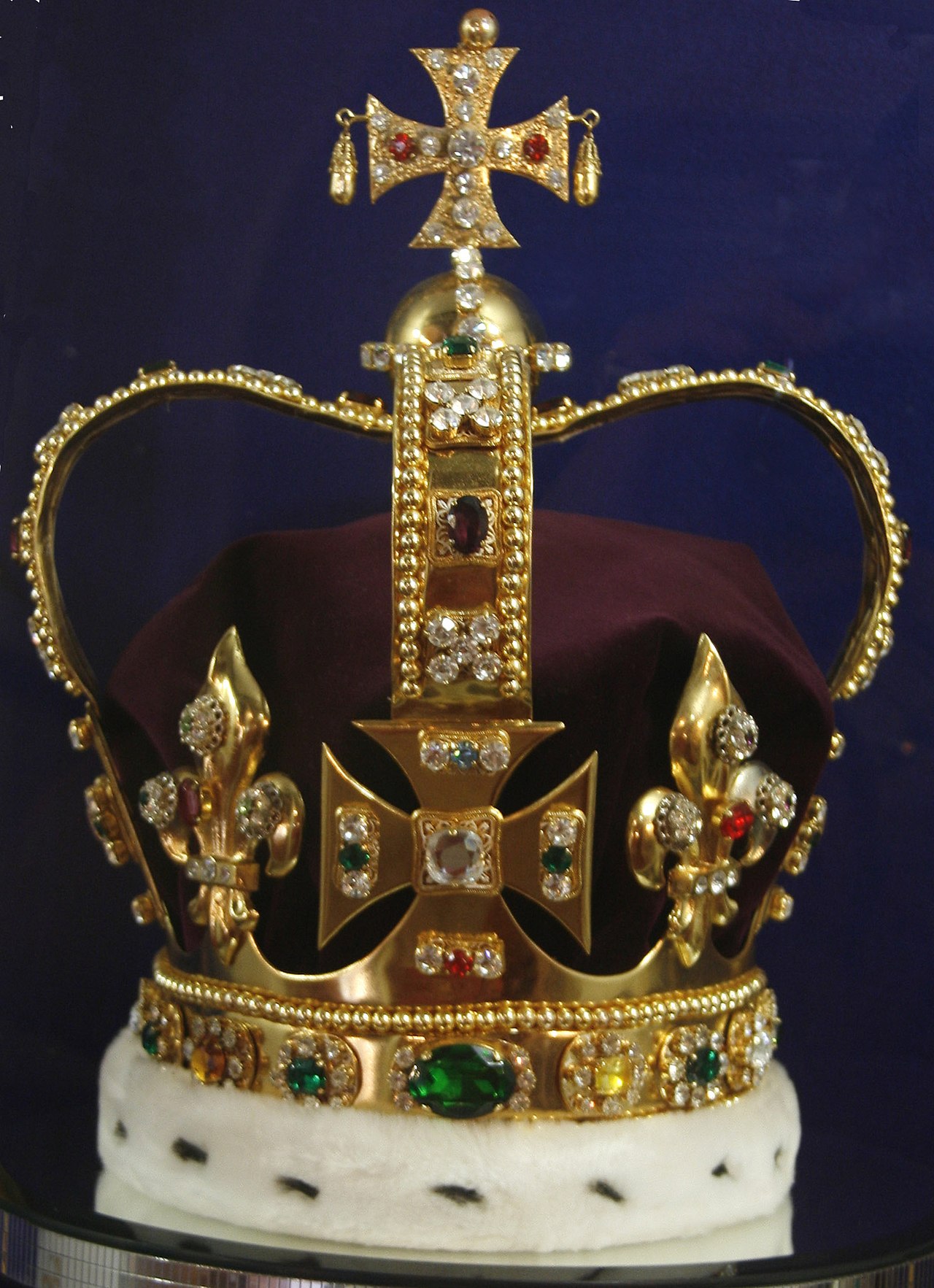


Overview
The crown as it is known today was commissioned for the 1661 coronation of King Charles II and made by the Crown Jeweller Robert Viner. Its frame dates to that Restoration-era rebuilding, although some elements may incorporate older material. For long periods of British history the crown has been kept with the Crown Jewels and is traditionally brought to the coronation service as part of the coronation regalia. It is not normally used as a day-to-day state crown but is reserved for the formal act of crowning.
Design, weight and materials
St. Edward's Crown is fashioned from solid gold with a conventional medieval form: a circlet of alternating crosses and fleurs-de-lis, four raised arches that meet at a monde (orb) surmounted by a cross. Its substantial weight—often remarked on in descriptions of coronations—means it is worn only briefly during the ceremony. The present frame from 1661 was set with hired precious stones for coronations; for display and preservation it later received semi-precious imitations. In the early 20th century it was reset with many semi‑precious gems for museum display.
- Metals: principally gold (with historic use of silver, and later refinements such as platinum in repairs).
- Stones: originally jewelled for ceremonies; later fitted with hundreds of semi‑precious stones or imitations for public display.
- Textiles: central cap of velvet and trim of ermine worn inside the circlet.
History and changing use
The crown was made for the first coronation after the Restoration of the monarchy in 1661. After the Glorious Revolution and the 1689 coronation of William III its use changed: the heavier St. Edward's Crown was often carried in procession or set upon the altar while the smaller and more practical Imperial State Crown frequently served for the actual crowning or other public duties. This secondary use continued for more than two centuries. The traditional practice of placing St. Edward's Crown on the monarch's head at the moment of crowning was restored at the coronation of George V in 1911 and has been observed at subsequent coronations.
Ceremony and symbolic role
At the coronation service the Archbishop of Canterbury takes the crown from the altar and places it upon the sovereign's head, a liturgical act that marks the formal investiture of royal authority. The archbishop's role in this rite is long established; references to this moment highlight the crown's status as a sacramental and constitutional emblem of kingship and queenship. Immediately after the crowning, acclamations are made, courtiers don their coronets, trumpets sound and salute fires are often discharged — historically including a royal salute at the Tower of London — followed by the oath, enthronement and homage of peers and clergy.
Notable facts and conservation
Because the 1661 crown was jewelled with hired gems for ceremony and later fitted with imitations for public display, modern descriptions emphasize its historic frame more than a fixed inventory of famous stones. Its striking weight and medieval style set it apart from lighter crowns designed for repeated use. Today it is preserved as part of the Crown Jewels and shown to the public when not required for a coronation, and it serves as a powerful symbol of continuity in the British monarchy.
For further reading on coronation ceremony and regalia see sources on the coronation rites and the offices involved, such as the role of the Archbishop of Canterbury, and institutional histories of the Crown Jewels kept at the Tower of London.
Questions and answers
Q: What is St. Edward's Crown?
A: St. Edward's Crown is a part of the coronation regalia, commissioned for the Coronation of Charles II on 23 April 1661 from the Crown Jeweller, Robert Viner.
Q: When did its importance diminish?
A: Its importance diminished after the 1689 coronation of William III.
Q: What was used instead for actual crowning?
A: The Imperial State Crown was used instead for the actual crowning.
Q: When did it resume its traditional place?
A: It resumed its traditional place at George V's coronation in 1911.
Q: What materials are used to make St Edward's Crown?
A: Materials used to make St Edward's Crown include gold, silver, platinum, enamel, tourmalines, topazes, rubies, amethysts, sapphires, garnet, peridot, zircons, spinel, aquamarines , velvet and ermine.
Q: Who places the crown upon the Monarch's head during a coronation?
A: During a coronation ceremony the Archbishop of Canterbury takes the crown from the altar and places it reverently upon the Monarch's head.
Q: What happens after a monarch is crowned?
A: After being crowned with St. Edward’s Crown during a coronation ceremony “God save the King/Queen” is heard and then princes and princesses as well as peers and peeresses put on their coronets and caps while trumpets sound and a royal salute is fired at Tower of London . Afterwards ,the Monarch is enthroned and receives homage from clergy ,princes ,and peers .
Related articles
Author
AlegsaOnline.com St. Edward's Crown Leandro Alegsa
URL: https://en.alegsaonline.com/art/93068
Sources
- royalcollection.org.uk : St. Edward's Crown