
Square root of 2
The positive number whose square equals 2; an irrational constant with geometric, algebraic, and historical significance, commonly written √2 and approximately 1.41421356.
The square root of 2, written √2, is the positive real number that when multiplied by itself yields 2. This specific value is known as the principal square root; the equation x2 = 2 also has the negative solution −√2. As a classification, √2 is an irrational number, meaning it cannot be expressed exactly as a ratio of two integers.
Image gallery
1 Image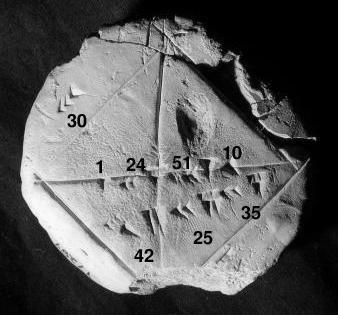
Definition and basic properties
Formally, √2 is the unique nonnegative real x satisfying x·x = 2. It is algebraic of degree two (a root of the polynomial x2 − 2 = 0) but not rational. Its decimal expansion begins 1.41421356... and continues without repeating. The continued fraction for √2 is simple and periodic, typically written as [1; 2, 2, 2, …], a fact that reflects its close connection to simple quadratic surds.
Geometric interpretation
Geometrically, √2 is the length of the diagonal of a unit square. If the sides of a square measure 1, the Pythagorean theorem gives the diagonal length as √(1² + 1²) = √2. This concrete appearance in Euclidean geometry is why the number is sometimes called Pythagoras's constant. The geometric view also motivates many constructions and approximations.
History and proofs
The irrationality of √2 is one of the earliest known results about incommensurable magnitudes. Classical proofs use contradiction and parity arguments to show that no pair of integers in lowest terms can square to 2. Over centuries, mathematicians have explored alternative demonstrations and generalized the reasoning to other non-square integers.
Representations and approximations
Several practical representations are used depending on context: decimals (≈1.41421356), continued fractions (periodic [1;2,2,2,...]), and convergent rational approximations such as 1, 3/2, 7/5, 17/12, which arise from Pell-type recurrences. For symbolic work one writes √2 or 2^(1/2). Numerical methods supply arbitrarily accurate approximations when required.
Uses, importance, and distinctions
√2 appears in design, engineering, and number theory: from aspect ratios (the ISO paper sizes are based on √2) to solutions of quadratic equations, lattice geometry, and continued-fraction studies. It should be distinguished from the negative root and from approximations used in computation. For further mathematical background see general references on irrational numbers and algebraic integers, or consult introductory materials linked here and here.
- Principal value: √2 (positive)
- Equation: x² = 2
- Decimal: ≈1.41421356
- Continued fraction: [1; 2, 2, 2, ...]
Questions and answers
Q: What is the square root of 2 in mathematics?
A: The square root of 2 in mathematics is represented as √2 or 21⁄2.
Q: What is the definition of the square root of 2?
A: The square root of 2 is a positive irrational number that, when multiplied by itself, equals the number 2.
Q: Is there a negative version of the square root of 2?
A: Yes, there is a negative version of the square root of 2 where the same condition is met.
Q: What is the correct term used to distinguish the square root of 2 from its negative version?
A: The correct term used to distinguish the square root of 2 from its negative version is the principal square root of 2.
Q: How can we find the length of the diagonal across a square with sides of length '1'?
A: The length of the diagonal across a square with sides of length '1' can be found using the Pythagorean theorem.
Q: What is the other name given to the square root of 2 due to its geometrical significance?
A: The square root of 2 is also called "Pythagoras's constant" due to its geometrical significance.
Q: Is the square root of 2 a rational or an irrational number?
A: The square root of 2 is an irrational number.
Related articles
Author
AlegsaOnline.com Square root of 2 Leandro Alegsa
URL: https://en.alegsaonline.com/art/92937