
Spring (device): types, materials, uses, and behavior
A spring is an elastic mechanical component that stores and releases energy. Article covers common types, materials, history, manufacturing, applications, and important safety and performance traits.
Overview
A spring is a mechanical device designed to store mechanical energy and release it when required. Springs deform under load—by compression, extension, bending, or twisting—and return toward their original shape when the load is removed. They are fundamental components in machines, tools, and everyday objects because of their predictable elastic behavior and ability to absorb or exert forces. For a concise definition and functional classifications see related reference.
Image gallery
10 Images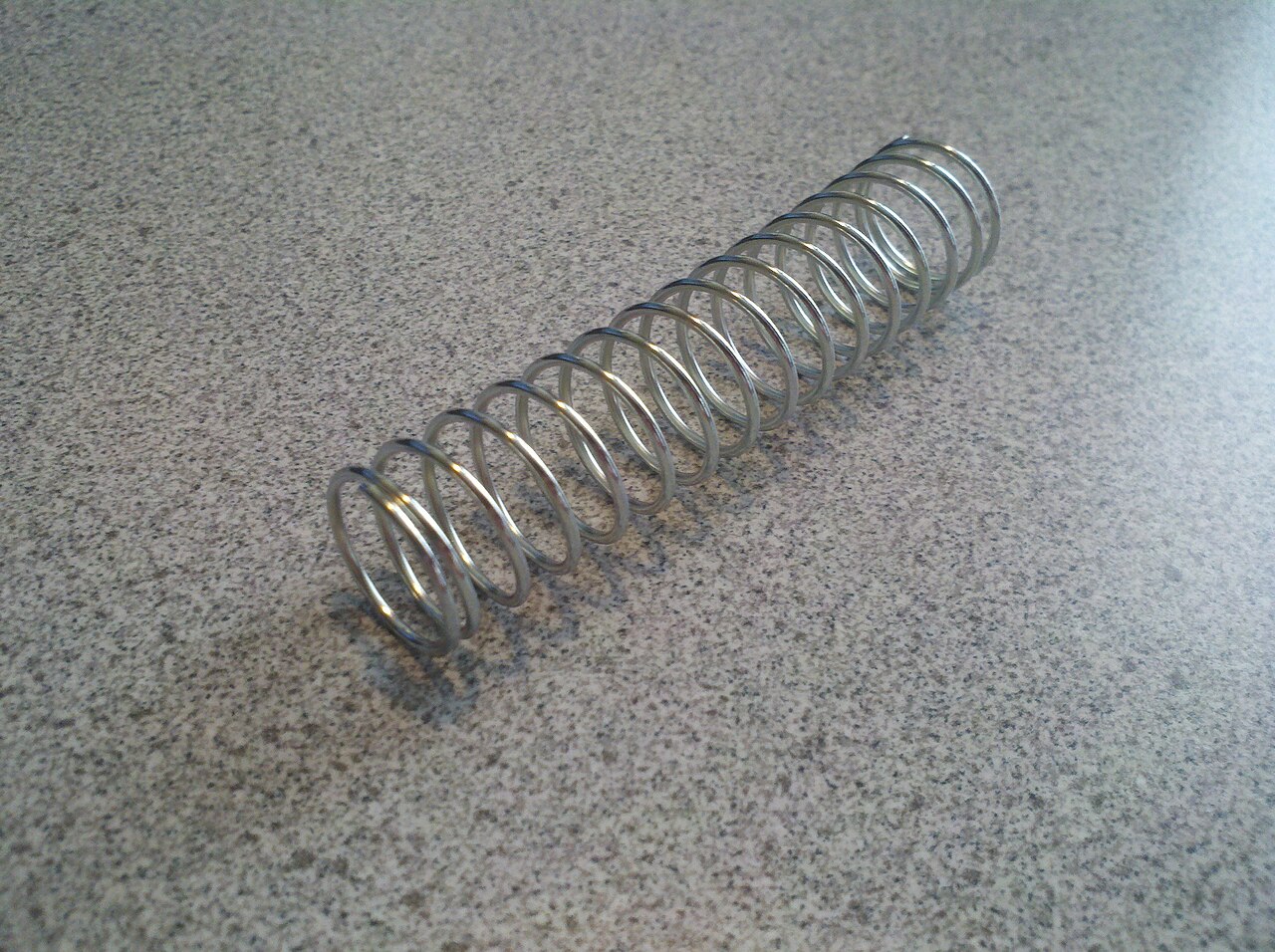


Types and basic parts
Springs appear in many forms. Major categories include:
- Compression springs — resist compressive forces and shorten under load.
- Tension (extension) springs — resist stretching and have hooks or loops at their ends.
- Torsion springs — operate by twisting about an axis to store rotational energy.
- Leaf springs — flat, layered strips used in vehicle suspensions.
- Gas springs — use compressed gas to provide a controlled force, common in hatchbacks and office chairs.
Materials and manufacturing
Springs are commonly made from metals chosen for strength and elastic limits. Carbon and alloy steels, stainless steels, and specialized spring steels are widely used because they combine high tensile strength with good fatigue resistance. Nonmetallic springs also exist in polymeric or composite materials for corrosion resistance or weight reduction. The selection of material influences heat treatment, finishing, and design tolerances; see general material information at metal types and specifics about spring steel at spring steel.
History and development
Early uses of spring-like behavior date back to simple bows and water clocks. As metallurgy and manufacturing advanced, coiled and shaped metal springs became practical for clocks, locks, and vehicle suspensions. Over time improvements in steel alloys, heat treatment, and precision forming expanded the range and reliability of spring designs used in modern engineering.
Applications and examples
Springs serve diverse roles across industries. Common applications include:
- Automotive suspension, valve springs, and seat mechanisms.
- Mechanical clocks, watches, and timing devices.
- Fastening and return mechanisms in tools, switches, and toys.
- Damped or gas-assisted lifting in furniture and vehicle hatches.
- Vibration isolation and energy storage in machinery and instruments.
Characteristics, testing and safety
Key characteristics of a spring include spring rate (stiffness), free length, maximum load, and fatigue life. Designers must consider operating temperature, corrosion, and the number of load cycles to prevent failure. Improper use—such as overloading, repeated shock loading, or corrosion—can cause permanent deformation or fracture. Routine inspection and correct specification for the intended duty are essential for safe, reliable service.
Understanding these fundamentals helps in selecting or designing springs for particular tasks, balancing material, geometry, and finishing to meet mechanical and environmental demands.
Questions and answers
Q: What is a spring device?
A: A spring device is a device made of metal, usually steel, that can be compressed and returns to its original length when the compression force is removed.
Q: What type of metal is typically used in the making of springs?
A: The metal typically used in the making of springs is spring steel.
Q: Can a spring be designed for pulling instead of pushing?
A: Yes, some springs can be designed for pulling instead of pushing.
Q: What is a gas-spring?
A: A gas-spring is a type of spring that is often used with the tailgate of a vehicle.
Q: How is a spring wound?
A: A spring is wound tightly.
Q: Are there variations in size and type of springs?
A: Yes, there are a lot of variations in size and type of springs.
Q: What happens when a compression force is removed from a spring?
A: When a compression force is removed from a spring, the spring returns to its original length.
Related articles
Author
AlegsaOnline.com Spring (device): types, materials, uses, and behavior Leandro Alegsa
URL: https://en.alegsaonline.com/art/92848
Sources
- madehow.com : Springs
- books.google.com : A History of Mechanical Inventions
- books.google.com : History of the Hour: Clocks and Modern Temporal Orders