
SPQR: Meaning, history, and enduring use of the Roman emblem
SPQR (Senatus Populusque Rōmānus) denotes 'The Senate and People of Rome'. This article explains its origin, official uses in ancient Rome, later adaptations, and modern significance and controversies.
The abbreviation SPQR stands for the Latin phrase Senātus Populusque Rōmānus, literally "The Senate and People of Rome". Those four letters summarized Roman sovereignty and public authority in a compact emblem that identified the state and its institutions. The initials themselves are commonly written and preserved as SPQR, and they functioned as both a formal signature for official acts and a symbolic reminder of the shared name and dignity of the Roman polity.
Image gallery
10 Images


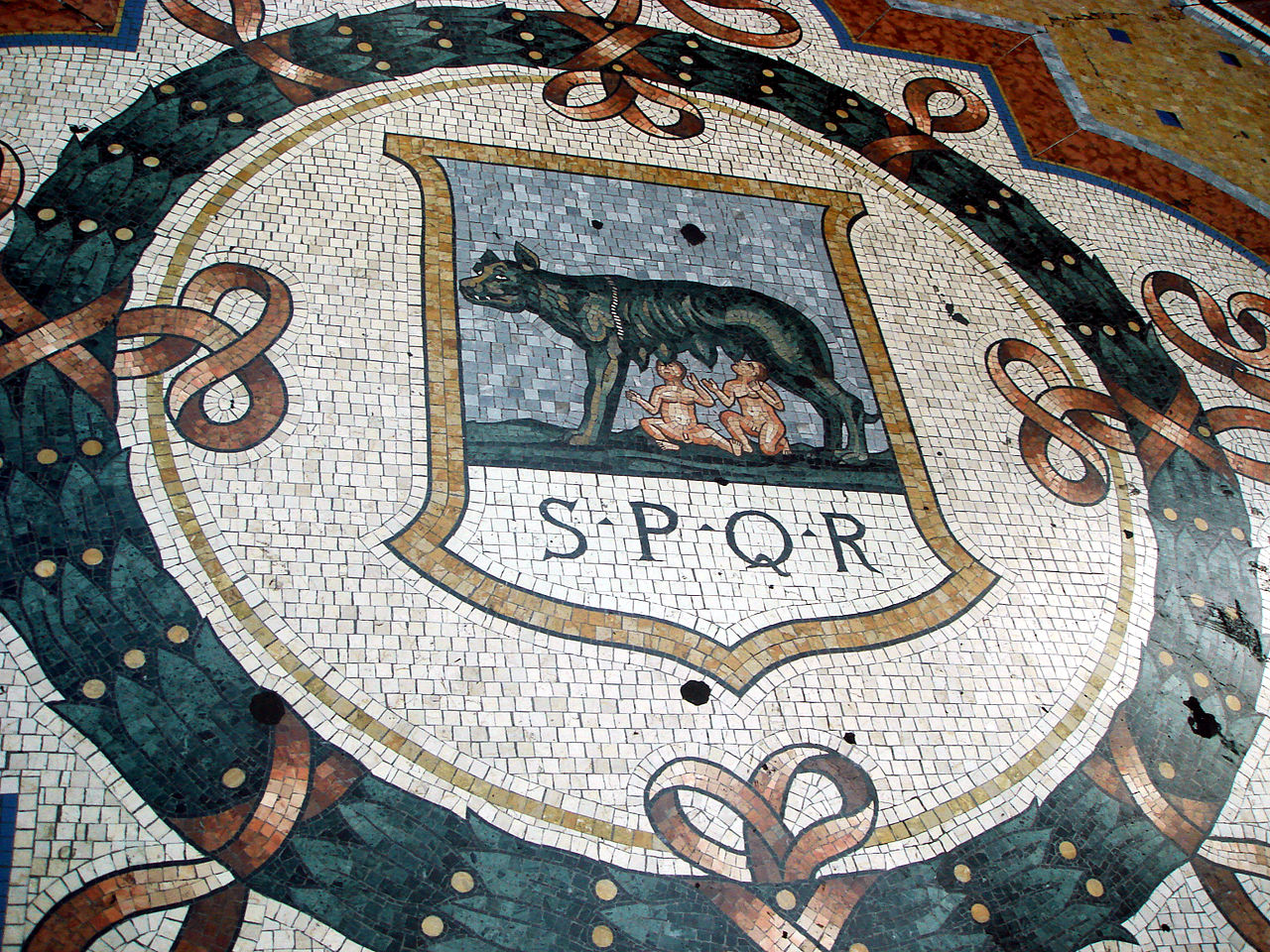


Overview and characteristics
In Republican ideology the phrase linked two sources of power: the Senate, a council of elite magistrates and former magistrates, and the Roman people, the citizen body represented through assemblies and magistrates. Acting together in name and ritual, the Senate and people were presented as the collective sovereign of Rome. The emblem appeared on a wide range of public media: coinage, military standards, public inscriptions, and dedications of buildings and monuments. It often concluded official proclamations or was carved on stone to mark civic projects.
Historical development
Although the exact moment of first use is uncertain, surviving epigraphic evidence places consistent appearances of the abbreviation from the late Republic onward, roughly from the 1st century BC. The expression and its initials continued in official use after the transition to imperial rule: emperors used SPQR to emphasize continuity with Roman tradition while also projecting their own authority as the people's leader. Notable ancient writers who used the full phrase include orators and historians such as Cicero and Livy, who placed the idea of a shared public sovereignty at the center of Roman political vocabulary.
Typical contexts and examples
- On coins and monetary issues issued for public circulation and military pay — visible evidence of state authority.
- On legion standards and military emblems, where the abbreviation could be painted or inscribed to claim service to Rome: see references to the legions and their banners.
- On municipal registers, public monuments, and building inscriptions that recorded funding and dedications.
- At the end of public documents and decrees drafted by the Senate or magistrates.
Modern legacy and controversies
The compact symbolism of SPQR survived into the modern era. It remains an official emblem of the city and municipal government of Rome and appears on city seals, manhole covers, public plaques, and some ceremonial uses. The initials also have been appropriated at various times to lend historical gravitas to later regimes: for example, during the early 20th century the Fascist government under Benito Mussolini used Roman imagery and SPQR-style inscriptions to connect its rule to the idea of a revived Roman state. This reuse triggered debate about cultural memory, political symbolism, and historical interpretation.
Distinctions and notable facts
SPQR does not designate a single institution but rather a formula that tied together multiple authorities. Under the empire the practical balance of power shifted: emperors increasingly directed policy and the Senate often acted in a consultative or endorsing role, yet the formula continued as a formal acknowledgement of Roman constitutional language. The abbreviation remained visible on coins as late as the reign of Constantine and persisted in legal, ceremonial, and epigraphic traditions long after its origins. For those researching Roman government and symbolism, references in classical literature—from speeches by Cicero to historical narratives such as Livy's writings—illustrate how SPQR functioned as a concise expression of civic identity.
For further reading on institutional roles and the usage of public formulas in Rome see specialist studies of the Republic and Empire, discussions of Roman civic inscriptions, and analyses that compare ancient and modern political symbolism (vexilloid traditions, municipal heraldry, and rhetorical usage). Additional resources may explore how the phrase was represented in documents, monuments, and the visual culture of Rome across centuries (Christianization, imperial transformation, and 20th-century appropriation). For municipal and archaeological resources consult collections and local archives that catalogue inscriptions and civic emblems (archival collections, city repositories, and digital inscription databases at institutional sites) or introductory surveys on Roman political language (constitutional studies).
Questions and answers
Q: What does SPQR stand for?
A: SPQR stands for the Latin phrase Senātus Populusque Rōmānus, which translates to "The Roman Senate and People" or "The Senate and People of Rome".
Q: What does SPQR refer to?
A: SPQR refers to the government of the ancient Roman Republic.
Q: Where is SPQR still used today?
A: SPQR is still used as an official emblem of the modern-day municipality of Rome.
Q: How was SPQR used in ancient times?
A: In ancient times, SPQR appeared on Roman coins, at the end of documents made public by inscription in stone or metal, in dedications of monuments and public works, and on the flag (vexilloid) of the Roman legions. It also appears in Roman political, legal and historical literature such as speeches by Cicero and Ab Urbe Condita Libri ("Books from the Founding of the City") by Livy.
Q: When did people first start using SPQR?
A: The date when people first started using SPQR is not known but it first appears in inscriptions from around 80 BC onwards.
Q: When was it last seen on coins?
A: The phrase was last seen on coins during Constantine's reign (AD 312-337), who was the first Christian Roman emperor.
Q: How did Mussolini use this phrase during his regime?
A: During Mussolini's Fascist regime, he emblazoned this phrase onto many public buildings as a way to promote his dictatorship as a "New Roman Empire".
Related articles
Author
AlegsaOnline.com SPQR: Meaning, history, and enduring use of the Roman emblem Leandro Alegsa
URL: https://en.alegsaonline.com/art/92832