
Spirochaete (Spirochaetae) — helical, motile bacteria and their significance
Spirochaetes are a phylum of distinctive spiral-shaped, double-membrane bacteria with internal flagella. They include free-living species and important pathogens such as Treponema, Borrelia and Leptospira.
Overview
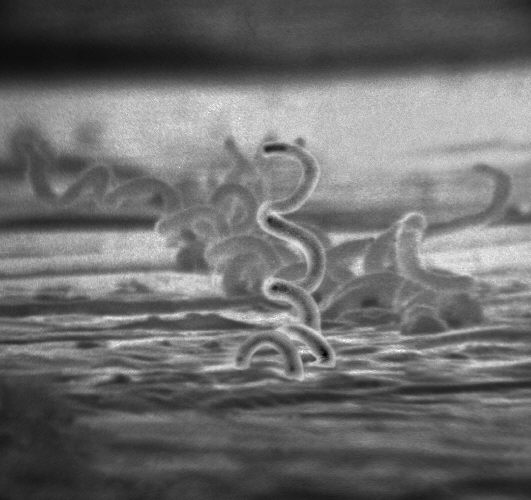
Spirochaetes (also spelled spirochetes) are members of the phylum Spirochaetae, a group of Gram-negative–like bacteria characterized by long, slender cells that are helically coiled. They are true bacteria and share broad features with other bacterial groups, but their shape, mode of motility and cell-envelope arrangement set them apart as a distinct lineage with ecological and medical importance.
Image gallery
4 Images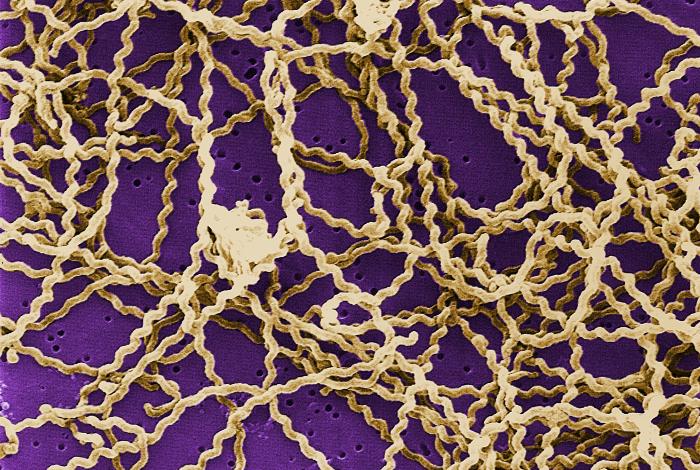


Structure and motility
Spirochaete cells are typically thin and elongated with a flexible spiral form. Unlike many bacteria that bear external flagella, spirochaetes have periplasmic flagella — also called axial filaments — that lie between the inner cell membrane and the outer membrane, adjacent to the cell wall. Rotation of these internal flagella causes the whole cell to twist and rotate, producing a corkscrew motion that is especially effective for swimming through viscous environments such as mucus or connective tissues.
Ecology and examples
Members of this phylum occupy diverse habitats. Many are free-living organisms found in aquatic sediments, anaerobic soils and the guts of animals where they can play roles in organic matter breakdown or symbiosis. Others are associated with animals as commensals or pathogens. Representative genera include:
- Treponema — contains species linked to periodontal disease and the agent of syphilis.
- Borrelia — includes species that cause Lyme disease and relapsing fever.
- Leptospira — contains agents of leptospirosis transmitted from animals to humans.
- Spirochaeta and related genera — free-living, found in sediments and microbial mats.
Medical and ecological significance
Some spirochaetes are major human and veterinary pathogens; they can cause chronic infections that are difficult to diagnose and treat because of their biology and intracellular or tissue-invasive lifestyles. Other species are benign or beneficial, contributing to nutrient cycles or helping host digestion in termites and ruminants. Their distinctive motility and envelope make them subjects of interest in microbiology, immunology and ecology.
Study, history and distinguishing facts
Spirochaetes were among the microorganisms observed with early microscopes and later became better understood as culture and staining methods improved. They are often challenging to grow in the laboratory, and some clinically important species require specialized techniques or animal models for study. Key distinguishing features are the internal axial filaments, the spiral cell shape, and a double-membrane envelope that produces a Gram-negative–like appearance yet has unique molecular signatures. Researchers continue to study their evolution, roles in microbial communities, and mechanisms of pathogenicity.
For concise overviews and classification details, see taxonomic resources and microbiology texts via links such as Spirochaetae overviews or general bacterial references. For morphology and motility studies consult specialized sources on helical bacteria and periplasmic flagella such as articles indexed at helical cell studies or laboratory methods pages at cell wall and envelope.
Questions and answers
Q: What are Spirochaetes?
A: Spirochaetes (or Spirochetes) are a phylum of double-membrane bacteria with long, helically coiled (spiral-shaped) cells.
Q: What is the function of the flagella in Spirochaetes?
A: The flagella in Spirochaetes cause a twisting motion which moves the bacteria about.
Q: What is the body shape of Spirochaetes bacteria?
A: Spirochaetes bacteria are helically coiled (spiral-shaped).
Q: Are all Spirochaete bacteria parasitic in nature?
A: No, most Spirochaetes are free-living and anaerobic, but there are many parasitic species.
Q: What is the structure of Spirochaetes bacteria?
A: Spirochaetes bacteria have a double-membrane structure and flagella that run lengthwise between the cell wall and outer membrane.
Q: What is the movement pattern of Spirochaetes bacteria?
A: Spirochaetes bacteria move in a twisting motion due to the flagella.
Q: Do Spirochaetes bacteria require oxygen to survive?
A: No, Spirochaetes bacteria are anaerobic, meaning they do not require oxygen to survive.
Related articles
Author
AlegsaOnline.com Spirochaete (Spirochaetae) — helical, motile bacteria and their significance Leandro Alegsa
URL: https://en.alegsaonline.com/art/92727
Sources
- doi.org : 10.1097/01.qco.0000178824.05715.2c
- pubmed.ncbi.nlm.nih.gov : 16148523
- pubmed.ncbi.nlm.nih.gov : 8805079
- pubmed.ncbi.nlm.nih.gov : 14718105