
Spiritual warfare (Christian belief and practice)
Spiritual warfare is a Christian framework describing conflict with evil spiritual forces and the practices—prayer, exorcism, fasting, anointing—used to oppose them.
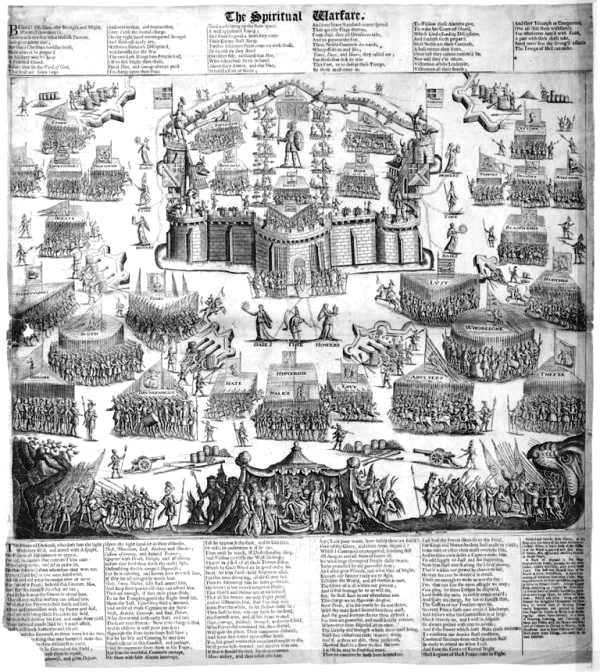
Spiritual warfare is a Christian concept that frames certain struggles as an ongoing contest between believers and malevolent spiritual forces. Proponents understand these hostile powers as supernatural beings—often called demons—that can influence individuals and societies. The idea appears alongside broader discussions of Christianity and the supernatural, and it rests on a view that spiritual realities can affect physical lives.
Image gallery
2 Images
Core characteristics
The central claim of spiritual warfare is that evil spirits or influences exist and oppose divine purposes. This belief is related to, but distinct from, formal demonology, because spiritual warfare emphasizes practical resistance and protection. Many adherents cite biblical passages as the basis for the worldview; for example, passages describing spiritual struggle are frequently invoked as warrant for the practice.
Common practices
Groups and individuals who engage in spiritual warfare use a variety of methods intended to counteract or remove harmful spiritual influence. Typical practices include:
- Prayer, including intercessory and declarative prayer, often described as the primary tool (prayer).
- Exorcism or deliverance rites aimed at removing a spirit from a person or place (exorcisms).
- Laying on of hands and anointing with oil, rites meant to invoke healing and protection.
- Fasting and other spiritual disciplines used to intensify prayer and focus (fasting).
Practitioners emphasize spiritual discernment and pastoral care, and some traditions require trained ministers to perform formal rites while others encourage lay participation.
Historical development and denominations
Belief in malevolent spirits and rites to address them has deep roots in Christian history, visible in early Church practices and later formalized in various ways by different traditions. In modern times, the topic gained renewed visibility in charismatic and Pentecostal movements of the 20th century, while Roman Catholicism and some historic Protestant bodies continue to recognize official forms of deliverance and exorcism. Debates about method and authority vary across denominations.
Critiques and pastoral considerations
Spiritual warfare is controversial in several respects. Critics caution against attributing psychological or medical problems to spiritual causes without proper assessment, and they warn that sensationalism can harm vulnerable people. Pastoral leaders and clinicians often recommend careful evaluation that respects both spiritual beliefs and mental-health science. Advocates argue that when practiced responsibly, spiritual warfare is intended to bring comfort, boundary-setting, and moral renewal.
For further reading on the theological and pastoral aspects, see discussions that link spiritual warfare to broader Christian teaching on evil, prayer, and community care (bad spirits). Related topics include historical demonology and practical guidance on prayer and discipline (prayer, fasting), as well as ceremonial responses like exorcisms.
Questions and answers
Q: What is spiritual warfare?
A: Spiritual warfare is a Christian belief of fighting against bad supernatural forces (demons).
Q: What is the main idea behind this belief system?
A: The existence of bad spirits which can affect humans is the main idea for this belief system.
Q: How have Christian groups used ideas from this movement to fight back these bad forces?
A: Many Christian groups have used ideas of this movement to hold back these bad forces. These ideas mainly come from Christian demonology.
Q: What are some ways to fight these forces?
A: A way to fight these forces is by using prayer. Exorcisms (removing demons), laying-on of hands, fasting, or anointing with oil are also used.
Q: Where do the ideas for spiritual warfare come from?
A: The ideas for spiritual warfare mainly come from Christian demonology.
Q: Is prayer an effective way to combat evil spirits?
A: Yes, prayer is one way to fight against evil spirits in spiritual warfare.
Related articles
Author
AlegsaOnline.com Spiritual warfare (Christian belief and practice) Leandro Alegsa
URL: https://en.alegsaonline.com/art/92721