
Spinosaurus — sail-backed semi-aquatic theropod
Spinosaurus, a large mid-Cretaceous theropod from North Africa, is known for its tall dorsal sail, crocodile-like skull and likely semi-aquatic habits; its size, posture and ecology remain debated and actively studied.
Overview
Spinosaurus is a distinctive genus of theropod dinosaur from the mid-Cretaceous of North Africa. It is famous for extremely elongated neural spines that formed a prominent dorsal sail or ridge and for a long, narrow skull with a profile compared often to that of modern crocodiles. Since the early 20th century Spinosaurus has attracted attention as one of the most unusual large theropods and as a possible example of a large predator adapted to exploit aquatic environments.
Image gallery
10 Images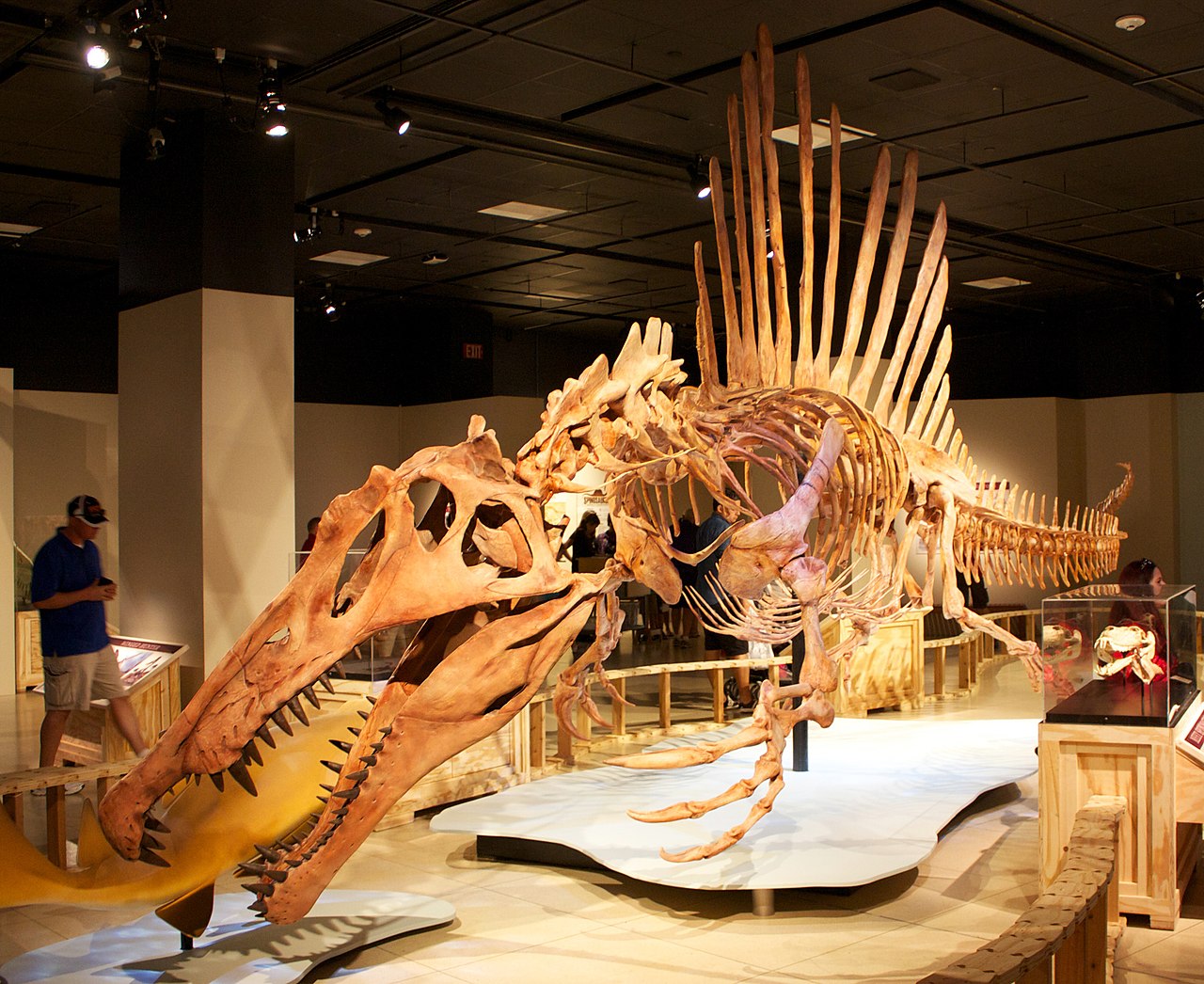


Anatomy and adaptations
Key traits of Spinosaurus include a long, low rostrum with conical, largely unserrated teeth well suited to grasping slippery prey, nostrils set farther back on the snout than in many theropods, and elongate neural spines along the back. Several modern studies have interpreted aspects of the skeleton—dense limb bones, limb proportions, and a laterally flattened tail—as evidence consistent with a semi-aquatic lifestyle, capable of swimming or powerful wading. These features contrast with typical land-based theropod proportions and suggest ecological specializations toward hunting in rivers, deltas and nearshore waters.
- Skull and teeth: elongated jaws with interlocking conical teeth for catching fish and other prey.
- Sail: neural spines extend from vertebrae to form a visible crest; the function is debated (display, thermoregulation, fat storage or species recognition).
- Tail and limbs: evidence for a laterally compressed tail and modified hindlimb anatomy that could assist aquatic propulsion.
Discovery and research history
The first Spinosaurus fossils were described by Ernst Stromer from material collected in what is now Egypt in the early 20th century; those original specimens were destroyed in the 1944 bombing of Munich. Additional fragmentary remains from across North Africa led to different interpretations of size and lifestyle for decades. A more complete specimen recovered in recent years from Morocco—exposed by local collectors and later studied by paleontologists—provided crucial new data and renewed debate about posture, locomotion and habitat use (more complete skeleton, fossil material).
Species and classification
Two named species have been proposed historically. The type species, S. aegyptiacus, was described from Egyptian material; additional names have been suggested from other North African finds, including material historically assigned to S. marocannus. Because many specimens are fragmentary, the number of valid species remains under review. Spinosaurus is placed in the family Spinosauridae and within the subfamily Spinosaurinae; some phylogenetic analyses support the monophyly of Spinosaurinae and distinguish Spinosaurus from related genera such as Irritator, while other studies emphasize relationships with baryonychine taxa like Baryonyx.
Paleobiology, ecology and debates
Interpretations of Spinosaurus emphasize piscivory and hunting along waterways. Support for aquatic or semi-aquatic habits includes snout and tooth morphology, inferred bone density, and tail structure interpreted as a swimming aid. Opposing views caution that some features could allow a mixed lifestyle, with the animal capable of terrestrial movement and shoreline scavenging or hunting. Whether Spinosaurus was routinely quadrupedal on land, how it moved between water and shore, and its maximum size relative to other large theropods are still active research topics.
Fossil record and significance
Spinosaurus fossils remain relatively rare and often fragmentary, which complicates reconstruction and comparison. The loss of Stromer’s original specimens in World War II and the later discovery of more complete Moroccan material have both shaped modern interpretations. Because it differs markedly from other large theropods, Spinosaurus has helped broaden understanding of dinosaur ecological diversity, demonstrating that some large predatory dinosaurs adapted to aquatic or semi-aquatic niches rather than occupying only terrestrial roles. Readers interested in specimen-level information and field reports can consult museum summaries and technical literature referencing discovery sites in Egypt and fieldwork in Morocco.
Open questions
Important unresolved issues include precise estimates of body size and mass, the function of the dorsal sail, the degree of aquatic adaptation, and taxonomic limits within the genus. New finds, reanalysis of existing bones and comparative studies continue to refine our picture of this unusual predator.
For further reading and specimen records see museum catalogues and peer-reviewed papers that discuss Spinosaurus anatomy, ecology and relationships (search summaries on semi-aquatic ecology, original descriptions from Egypt, reports on Moroccan material Morocco and comparative studies with Baryonyx and Irritator).
Questions and answers
Q: What is Spinosaurus?
A: Spinosaurus was a massive semi-aquatic dinosaur from the Cretaceous era, approximately 99 to 93.5 million years ago.
Q: How big was Spinosaurus compared to other carnivorous dinosaurs?
A: Spinosaurus was the largest known terrestrial carnivore, possibly even larger than Tyrannosaurus rex.
Q: What made Spinosaurus suited to life in the water?
A: Spinosaurus had paddle-like feet and nostrils on top of its crocodile-like head, allowing it to submerge and swim like a crocodile.
Q: How did Spinosaurus move on land?
A: Spinosaurus was more clumsy on land and moved as a quadruped.
Q: Where were Spinosaurus bones initially discovered?
A: Spinosaurus bones were first found in Egypt by German paleontologist Ernst Stromer in 1912.
Q: How many Spinosaurus specimens have been unearthed?
A: Six Spinosaurus specimens have been found, but it is believed that some good material was destroyed in a 1944 bombing raid in Munich.
Q: What does the material support regarding the classification of Spinosaurus?
A: The material supports the monophyly of the Spinosaurinae group and the separation of Spinosaurus and Irritator.
Related articles
Author
AlegsaOnline.com Spinosaurus — sail-backed semi-aquatic theropod Leandro Alegsa
URL: https://en.alegsaonline.com/art/92695
Sources
- doi.org : 10.1111/1475-4983.00181
- bbc.co.uk : bbc.co.uk/news/science-environment-29143096
- sciencemag.org : sciencemag.org/content/early/2014/09/10/science.1258750
- sciencemag.org : sciencemag.org/content/345/6202/1232.summary
- nytimes.com : nytimes.com/2014/09/12/science/a-nomads-find-helps-solve-the-mystery-of-the-spinosaurus.h…