
Spinal cord: structure, function, and clinical importance
Compact overview of the spinal cord: anatomy, protective coverings, roles in conduction and reflexes, development, and common clinical issues.
Overview
The spinal cord is a long, cylindrical core of nervous tissue that links the body with the brain. It acts as a highway for nerve signals, carrying information to and from the brain and coordinating many local reflexes. Anatomically it is closely associated with the vertebral column and is often described as a bundle of nerves organized into segments that give rise to spinal nerves.
Image gallery
10 Images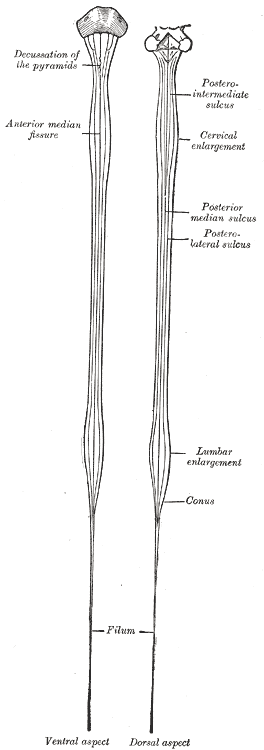


Structure and protection
The cord is segmented, with each segment connected to the rest of the body by a pair of spinal nerves. In most adults the spinal cord terminates roughly at the level of the first or second lumbar vertebra, and the remaining nerve roots continue downward in the vertebral canal. The cord is protected by bone (the vertebrae), three layers of meninges, and cerebrospinal fluid. These layers and fluids cushion and support the delicate neural tissue.
Function
Its principal role is signal transmission between the brain and the body. Information travels upward toward the brain (sensory pathways) and downward from the brain to muscles and organs (motor pathways). In addition, the spinal cord mediates many reflexes—rapid, automatic responses that do not require conscious brain processing. The main functions therefore include conduction, integration of reflexes, and local processing.
Key functions and examples
- Sensory conveyance: touch, pain, temperature, proprioception to higher centers.
- Motor control: voluntary movement commands relayed to muscles.
- Reflexes: withdrawal from painful stimuli, stretch reflexes that maintain posture.
Clinical significance and development
Because it connects the central nervous system with the periphery, injury or disease of the spinal cord can produce weakness, loss of sensation, autonomic dysfunction, or paralysis below the level of damage. Common issues include traumatic injury, inflammatory conditions, degenerative disease, and congenital malformations. Understanding cord anatomy and its segmental organization is essential for diagnosis and treatment planning.
Embryologically the spinal cord develops from the neural tube and undergoes changes in length relative to the vertebral column during growth, which explains why nerve roots extend beyond the cord's terminal end in adults. Its central role in nervous system function makes it a major focus of neurology, neurosurgery, and rehabilitation medicine.
Questions and answers
Q: What is the spinal cord?
A: The spinal cord is a bundle of nerves that go to and from the brain.
Q: What protects the spinal cord?
A: The bony vertebral column protects the spinal cord.
Q: What is the main function of the spinal cord?
A: The main function of the spinal cord is to transmit neural inputs between the periphery and the brain.
Q: What happens when neural inputs are transmitted through the spinal cord?
A: When neural inputs are transmitted through the spinal cord, they are carried between the body's peripheral nervous system and the brain.
Q: Is the spinal cord important for movement?
A: Yes, the spinal cord is very important for movement as it helps to facilitate communication between the brain and muscles throughout the body.
Q: Can the spinal cord regenerate if it is damaged?
A: Regeneration of the spinal cord is limited, and the extent of recovery depends on the severity and location of the damage.
Q: How does the spinal cord relate to the nervous system?
A: The spinal cord is an integral part of the nervous system, linking the brain and the rest of the body's nerves to help regulate bodily functions and facilitate movement.
Related articles
Author
AlegsaOnline.com Spinal cord: structure, function, and clinical importance Leandro Alegsa
URL: https://en.alegsaonline.com/art/92683