
Basketball
Basketball is a team sport in which two teams aim to score by shooting a ball through a raised hoop. It features dribbling, passing, shooting, set positions, timed periods, and widespread international play.
Overview
Basketball is a fast-paced team sport played on a rectangular court in which two opposing teams attempt to score points by putting a ball through an elevated hoop. Standard teams field five players at a time, though informal and variant formats exist. The sport emphasizes ball control, coordinated movement, and athletic skills such as running, jumping, passing and shooting. It is widely played around the world at recreational, scholastic, amateur and professional levels, and is one of the core team sports of international competitions and multi-sport events (global popularity).
Image gallery
10 Images

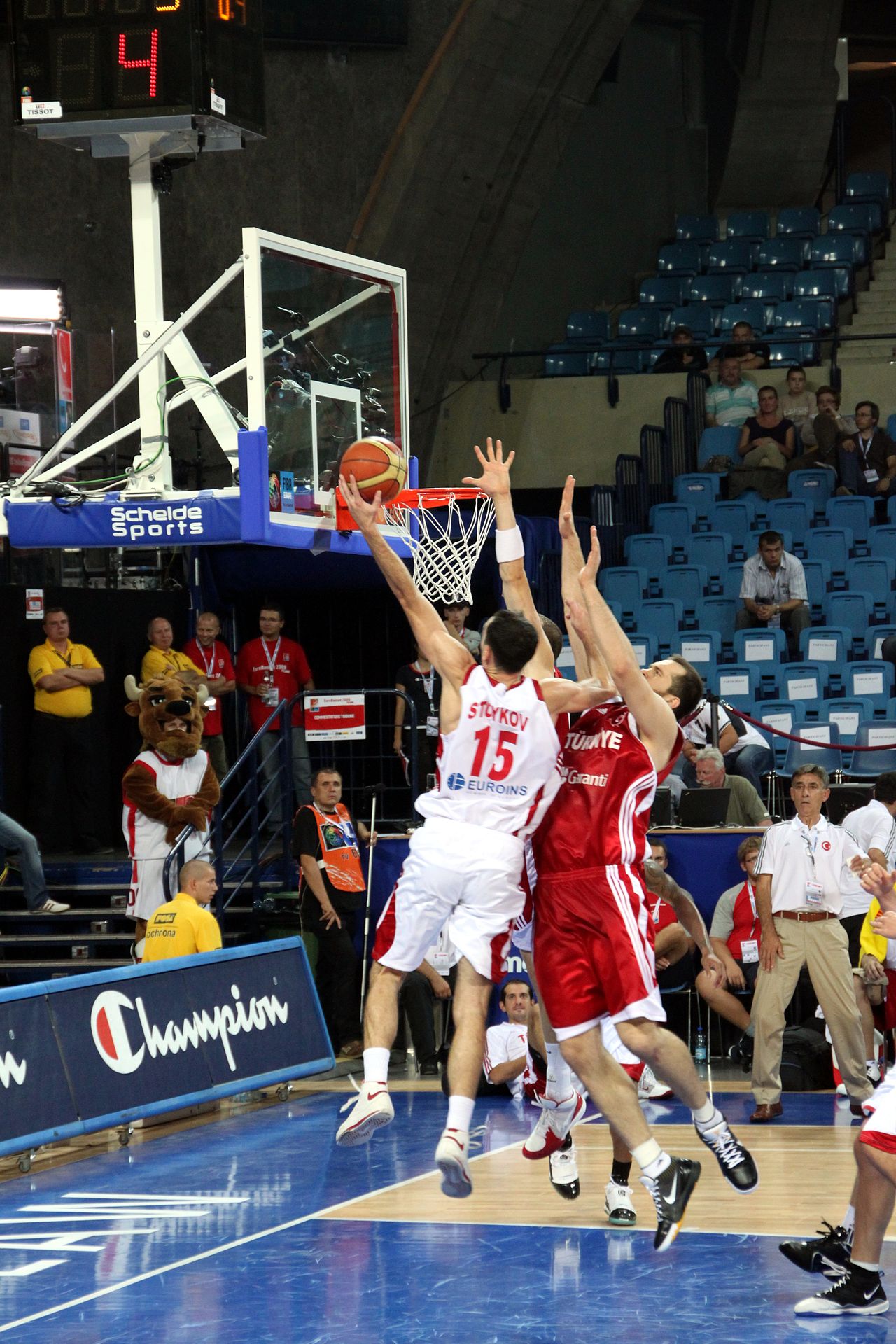




Court, Equipment and Basic Structure
The playing surface is a rectangular court with a hoop and backboard at each end. Courts have marked areas including the three-point line, free-throw line and restricted zone beneath the basket; exact dimensions vary by level and governing body. The ball used is spherical and generally designed to be gripped and bounced easily while moving with the hands. Games are divided into timed periods—commonly four quarters at the senior level—with the team scoring the most points declared the winner. Tied games typically go into one or more overtime periods to determine a victor.
Play, Positions and Tactics
Play alternates between offense and defense as teams attempt to create scoring opportunities and prevent opponents from scoring. Typical player roles include:
- Guards — usually quicker ballhandlers who initiate offense and defend the perimeter.
- Forwards — versatile players who work inside and outside, often involved in rebounding and scoring.
- Center — a taller player who operates close to the basket on offense and defense.
Tactics range from set offensive plays and isolation scoring to defensive schemes such as man-to-man and zone coverage. Ball control techniques include dribbling (bouncing the ball while moving), passing to teammates, cutting without the ball and screening to free a shooter.
Scoring, Fouls and Timekeeping
Points are awarded for field goals and free throws: most made field goals count as two points, shots made from beyond the three-point line count as three, and successful free throws count as one. When a player is fouled while shooting or accrues certain types of contact, the opposing team may be awarded free throws or possession. Personal fouls, technical fouls and violations such as traveling (taking too many steps without dribbling) and double-dribble (resuming dribble after stopping) interrupt play and can change possession or award free attempts. Many competitive leagues also use a shot clock to require a team to attempt a shot within a fixed time interval, speeding play and preventing stalling.
History and Development
Basketball was invented in the early 1890s as an indoor winter activity to keep athletes conditioned and engaged. The game was devised by a physical education instructor, James Naismith, as a less injury-prone alternative to more physical sports; he formulated the original rules and objectives in 1891 (James Naismith). From its origins in gymnasiums it expanded quickly through schools, colleges and clubs, evolving rules, codified equipment and organized competitions. Basketball became part of the Summer Olympic programme in the 1930s and has developed into a global sport with professional leagues, national teams, international tournaments and adaptive forms such as wheelchair basketball.
Variations, Cultural Role and Notable Facts
Variants include three-on-three (3x3) competitions, streetball, and youth or modified rules for different ages and abilities. The game has a strong cultural presence in many countries, influencing fashion, music and community life, and serving as a pathway for athlete development and social programs. Advances in strategy, training and officiating—such as the introduction of the shot clock and video review—have shaped the modern game. Basketball's relative simplicity in setup and low-cost equipment make it accessible in many environments, from urban courts to school gyms, ensuring its ongoing popularity and evolution.
For basic rules, official dimensions and further reading, consult governing organizations and rule books appropriate to the level of play.
Questions and answers
Q: How many players are usually on a basketball team?
A: A basketball team usually consists of five players.
Q: What is the objective of basketball?
A: The objective of basketball is to get the ball through a hoop mounted high on a backboard on the opponent's side of the court, while preventing the opponent from shooting it into your team's hoop.
Q: What skills do basketball players mainly use?
A: Basketball players mainly use skills such as dribbling, shooting, running, and jumping.
Q: How many points is each made basket worth?
A: Each made basket is worth two points.
Q: How many points is a basket made from beyond the three-point line worth?
A: A basket made from beyond the three-point line is worth three points.
Q: What are free throws in basketball and how many points are they worth?
A: Free throws are given to a player who gets into too much physical contact and are worth one point each.
Q: How long does a basketball game typically last and how is the winner determined?
A: A basketball game typically lasts for four quarters and the team with the most points at the end of the four quarters win the game. If the score is tied at the end of the game, there will be additional play time, called overtime, to allow one team to win the match.
Tags
Related articles
Author
AlegsaOnline.com Basketball Leandro Alegsa
URL: https://en.alegsaonline.com/art/9262