
Speaker of the Australian House of Representatives
The Speaker is the elected presiding officer of the House of Representatives in the Parliament of Australia, responsible for chairing proceedings, enforcing rules and representing the chamber.
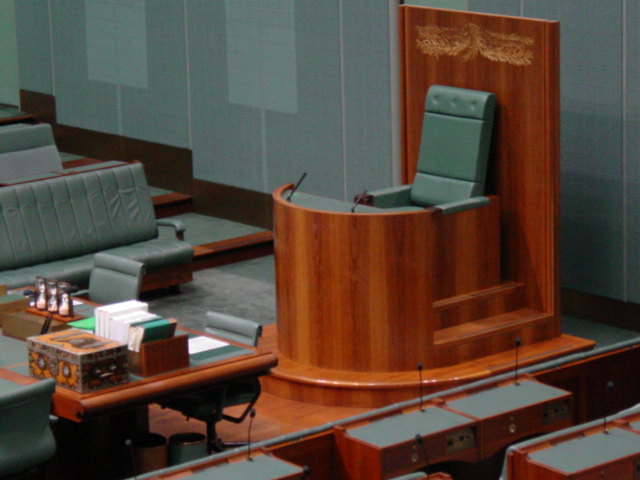
The Speaker of the House of Representatives is the presiding officer of the lower chamber of the Parliament of Australia. The Speaker is elected from among the members of the House of Representatives and is responsible for running sittings, applying the chamber's rules and representing the House in its relations with the Governor‑General, the Senate and external bodies. The current Speaker is Milton Dick. Notable past occupants include three women who have held the office: Joan Child, Anna Burke and Bronwyn Bishop, each marking milestones in the modern history of the chamber (see notable speakers).
Image gallery
6 Images


Functions and authorities
The Speaker's duties combine procedural, disciplinary and administrative roles. In the chamber the Speaker calls on members to speak, enforces standing orders, rules on points of order and ensures orderly debate. The Speaker can name members for disorder and order their suspension, and may refer matters of privilege or contempt to committee. In the event of an equality of votes the Speaker has a casting vote subject to long‑standing conventions that aim to preserve further debate or maintain the status quo rather than decide policy.
- Preside over debates and enforce standing orders
- Rule on points of order and interpret procedures
- Take disciplinary measures and refer matters to committees
- Manage administrative functions of the chamber and staff
- Represent the House in official and inter‑parliamentary matters
Election, tenure and impartiality
The Speaker is chosen by a vote of House members at the start of a new Parliament or when the position falls vacant. While the officeholder is normally a member of the governing party, the role requires impartiality when chairing debates. Practices vary: some Speakers step back from party meetings and refrain from participating in partisan debate, others retain more overt party ties. A Speaker remains a member of the House and serves until resignation, defeat at a general election, or removal by resolution of the chamber. Deputy and second Deputy Speakers support the office during sittings.
Origins and development
The office is established by the Australian Constitution (see section 35) and largely follows Westminster precedent derived from the House of Commons of the United Kingdom. Since Federation the role has evolved with parliamentary practice: procedural rules have been codified, committees expanded and expectations of neutrality grown. The Speaker remains a central figure in preserving the rules and decorum that allow representative debate to proceed.
As the arbiter of parliamentary procedure and guardian of chamber order, the Speaker plays a key part in Australia’s democratic system, balancing authority, impartiality and the practical needs of a modern legislature.
Questions and answers
Q: Who is the Speaker of the Australian House of Representatives?
A: The Speaker of the Australian House of Representatives is Milton Dick.
Q: What is the House of Representatives?
A: The House of Representatives is the lower house of the Parliament of Australia.
Q: Who is in charge of the upper house of the Parliament of Australia?
A: The President of the Senate is in charge of the upper house of the Parliament of Australia.
Q: How many female speakers have there been in the Australian House of Representatives?
A: There have been three female speakers in the Australian House of Representatives.
Q: What is the role of the speaker?
A: The role of the speaker is to be the person in charge of the House of Representatives.
Q: What part of the Australian Constitution created the office of speaker?
A: Section 35 of the Constitution of Australia created the office of speaker.
Q: Where was the role of speaker copied from?
A: The role of speaker was copied from the House of Commons of the United Kingdom.
Related articles
Author
AlegsaOnline.com Speaker of the Australian House of Representatives Leandro Alegsa
URL: https://en.alegsaonline.com/art/92527
Sources
- aph.gov.au : Speaker of the House of Representatives, second edition: APH
- scaleplus.law.gov.au : Scaleplus
- aph.gov.au : House of Representatives Practice
- parlinfo.aph.gov.au : Commonwealth, Parliamentary Debates, House of Representatives
- theaustralian.com.au : "Oakeshott nearly brings down the house"
- abc.net.au : "Coalition takes credit for saving Speaker"
- news.smh.com.au : "Abbott averts Speaker crisis"
- aph.gov.au : "Appendix 2 Speakers of the House of Representatives"
- theaustralian.com.au : "Rats prepared to ditch their parties to survive"
- abc.net.au : "Pomp-seeker Slipper told to get on with job"
- aph.gov.au : Commonwealth Hansard, Parliamentary Debates, House of Representatives
- abc.net.au : "New procession ushers in Slipper era"