
Basilosaurus — an early whale of the Late Eocene
Basilosaurus was a large, eel‑like archaeocete whale of the Late Eocene whose fossils clarified the whale transition from land to sea and were found in places such as the United States and Egypt.
Overview
Basilosaurus is an extinct genus of early whale (archaeocete) that lived in warm coastal seas during the Late Eocene. Despite its name, which ends in the Greek-derived suffix "-saurus" (meaning lizard), Basilosaurus was a fully marine mammal rather than a reptile. Individuals reached very large sizes and occupied upper levels of the marine food web before their extinction near the end of the Eocene.
Image gallery
10 Images


Distinctive features and anatomy
Basilosaurus had an unusually long, serpentine body compared with modern whales, with elongated vertebrae that gave it an eel-like profile. Key features include well-developed, differentiated teeth (heterodont dentition) suited for grasping and shearing prey; forward-positioned nostrils typical of early whales; and tiny, external hind limbs that were no longer capable of supporting weight on land. Ear bones and inner ear structure show adaptations for hearing in water, indicating a fully aquatic lifestyle.
Fossil discovery and taxonomic history
Early discoveries of Basilosaurus remains in North America led to confusion about their identity. The animal's fossilized bones were at first thought to belong to a giant reptile because of the long vertebrae and overall size; the name reflects that early misinterpretation. Subsequent study recognized the specimens as mammalian and as part of the whale lineage. Paleontologists have debated names and classifications historically, but modern taxonomy places Basilosaurus among the archaeocetes, an early group of whales that record the transition from land to sea.
Ecology, diet, and behavior
Basilosaurus was a top predator in Eocene seas. Its teeth and jaw structure suggest it hunted fish, sharks, and smaller marine mammals. The long, powerful body would have supported a strong swimming stroke driven by the tail; however, the exact shape of the tail fluke and precise swimming style are reconstructed from skeletal proportions rather than preserved soft tissues. Small hind limbs likely played no role in locomotion and may have had reproductive or other minor functions.
Scientific importance
Basilosaurus occupies an important place in studies of whale evolution because its anatomy combines primitive and derived traits. It preserves vestigial hind limbs, showing a stage after terrestrial ancestors returned to the sea but before the loss of external hind limbs seen in modern cetaceans. Its fossils therefore help bridge the gap between fully terrestrial artiodactyl-like ancestors and modern whales, illustrating both functional and vestigial changes in morphology.
Where fossils have been found
Notable Basilosaurus specimens come from several regions known for Late Eocene marine deposits. Significant finds include localities in what is now the southern United States (Louisiana and areas of the United States where early material was unearthed), and rich Egyptian horizons such as the Fayum deposits (Egypt) where multiple skeletons have been studied. Isolated or fragmentary remains attributable to Basilosaurus or close relatives have also been reported from parts of the Middle East, including sites in Jordan. Historical figures in the study and naming of these fossils include early paleontologists whose proposals and debates are part of the taxonomic record (see historic discussions).
- Main epochs: Late Eocene
- Key regions: Louisiana, United States, Egypt, Jordan
- Further reading and resources: historical taxonomy
Basilosaurus remains continue to be important in museum collections and in research that reconstructs the morphology, lifestyles, and evolutionary pathways of early whales. Ongoing fieldwork and comparative anatomy refine our understanding of how modern cetaceans evolved from four‑legged land mammals into the highly specialized marine animals we see today.
Questions and answers
Q: What is Basilosaurus?
A: Basilosaurus is a genus of cetacean, a group of marine mammals that includes whales, dolphins, and porpoises.
Q: When did Basilosaurus live?
A: Basilosaurus lived from 40 to 34 million years ago in the Late Eocene.
Q: Where were the first Basilosaurus fossils found?
A: The first Basilosaurus fossils were found in Louisiana, USA.
Q: Why was Basilosaurus initially believed to be a reptile?
A: Basilosaurus was initially believed to be some sort of reptile because the first fossil of B. cetoides was discovered in the United States and was given the suffix -"saurus".
Q: What did Richard Owen want to rename Basilosaurus and why couldn't he?
A: Richard Owen wanted to rename Basilosaurus to Zeuglodon ("yoked tooth"), but by taxonomic rules the creature's first name remained permanent.
Q: What is the length of Basilosaurus?
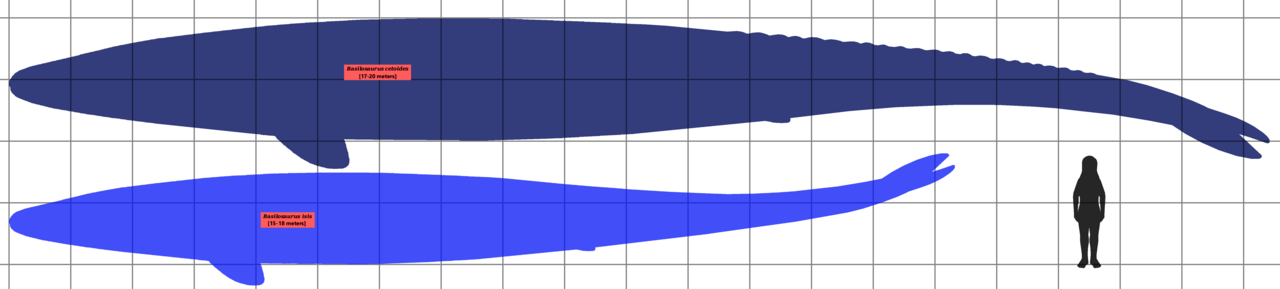
A: At 15–20 m (49–66 ft), Basilosaurus was one of the largest oceanic animals of its time.
Q: When did Basilosaurus go extinct?
A: Basilosaurus went extinct during the Eocene Extinction.
Related articles
Author
AlegsaOnline.com Basilosaurus — an early whale of the Late Eocene Leandro Alegsa
URL: https://en.alegsaonline.com/art/9252
Sources
- publicationsonline.carnegiescience.edu : A review of the Archaeoceti
- worldcat.org : 681376
- bbc.co.uk : "Basilosaurus"
- tandfonline.com : tandfonline.com/doi/abs/10.1671/.VBBJY9sqeHM
- jstor.org : "Evolution of Whales from Land to Sea"
- www-personal.umich.edu : "Early Evolution of Whales: A Century of Research in Egypt"
- ncbi.nlm.nih.gov : "Stomach contents of the archaeocete Basilosaurus isis: Apex predator in oceans of the late Eocene"
- doi.org : 10.1371/journal.pone.0209021
- pubmed.ncbi.nlm.nih.gov : 30625131