
Space Shuttle Challenger disaster (January 28, 1986)
On January 28, 1986, Challenger disintegrated 73 seconds after liftoff, killing seven. A failed O-ring in a right solid rocket booster and managerial lapses prompted a major investigation and a prolonged shuttle grounding.
Overview
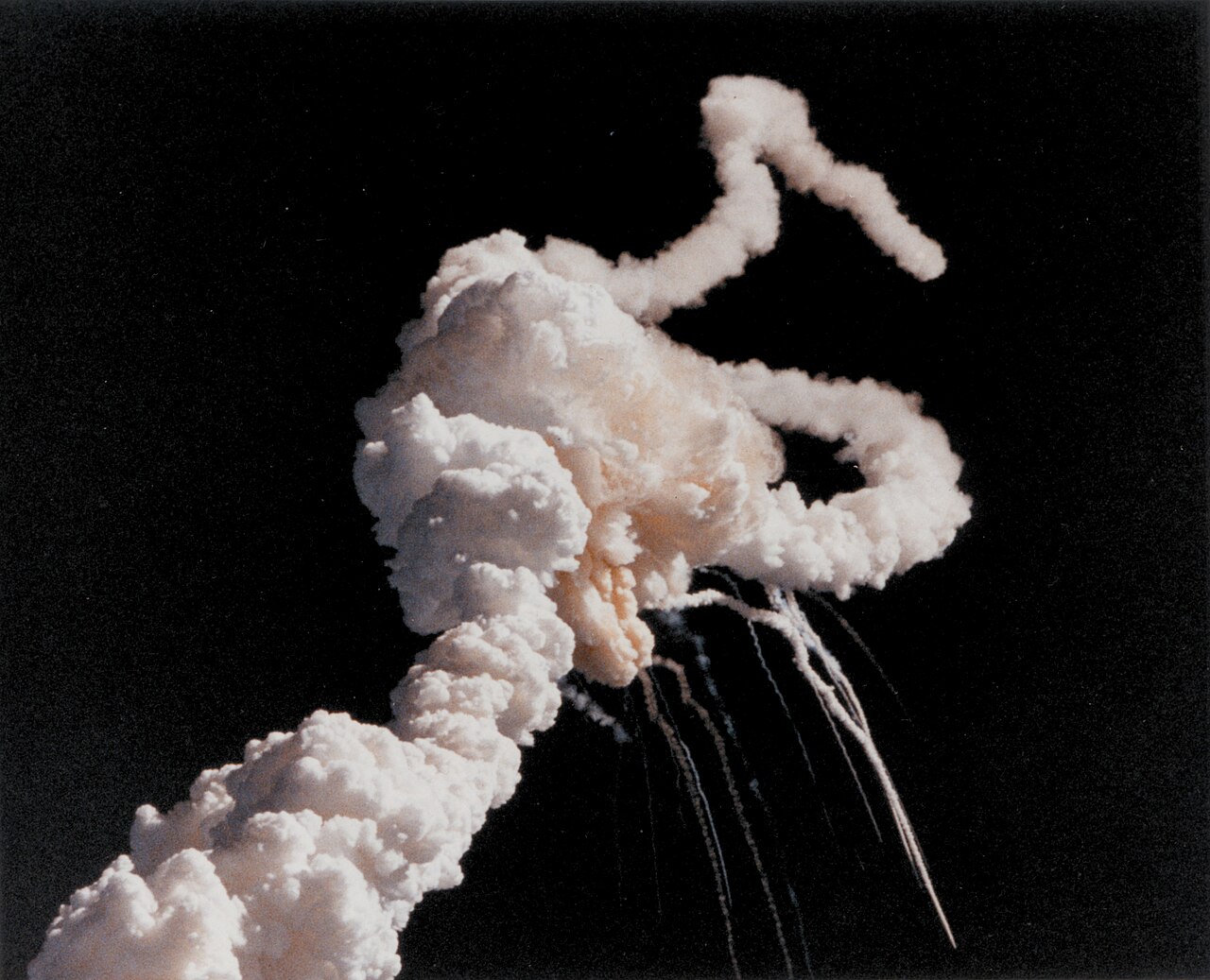
On January 28, 1986, the Space Shuttle Challenger broke apart 73 seconds after liftoff from Cape Canaveral. The accident, occurring during a widely televised launch, killed all seven crew members aboard. The vehicle was operated by the United States space agency as part of the Space Shuttle program. The loss of Challenger prompted an immediate suspension of shuttle flights while investigators examined the technical causes and organizational factors that allowed the mission to proceed.
Image gallery
10 Images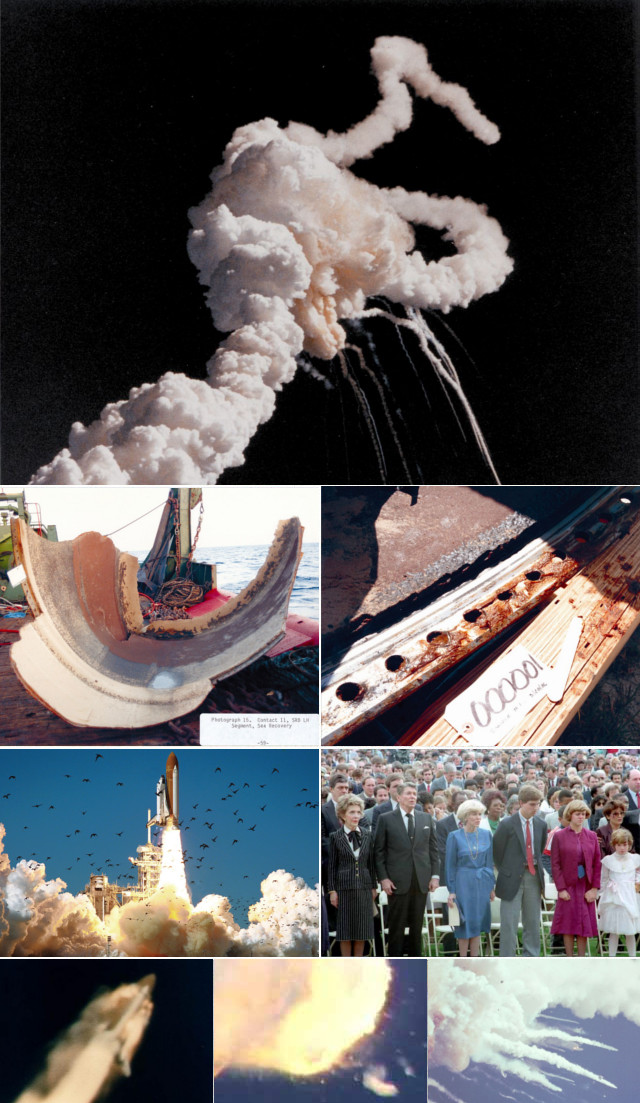




Background and launch conditions
The Challenger mission was the 25th flight of the Space Shuttle fleet and carried a mixed crew of career astronauts and civilian participants, including a teacher selected for a teacher-in-space initiative. On the morning of the launch conditions at the pad were unusually cold for Florida, and engineers had expressed concerns about the effects of low temperature on booster components. Despite those cautions, launch proceeded under schedule pressure and management judgment.
Crew
- Francis R. Scobee (Commander)
- Michael J. Smith (Pilot)
- Ronald McNair (Mission Specialist)
- Ellison Onizuka (Mission Specialist)
- Judith Resnik (Mission Specialist)
- Gregory Jarvis (Payload Specialist)
- Christa McAuliffe (Payload Specialist, teacher)
Technical cause and sequence
Accident investigators determined the immediate mechanical cause was the failure of an O-ring seal in the joint of the right solid rocket booster. A compromised seal permitted combustion gases to escape; those hot gases impinged on adjacent structure and ultimately led to structural failure of the external tank and orbiter. The failure of the O-ring in the booster joint is widely cited as the proximate component-level cause of the breakup (cause), while additional aerodynamic and structural events followed rapidly.
Investigation and organizational findings
The presidential Rogers Commission conducted the formal inquiry into the disaster. Its report documented both the hardware weaknesses and significant shortcomings in decision-making, communication, and risk assessment by contractors and agency managers. The commission highlighted that the booster joint design was sensitive to low temperatures and that engineers' warnings about launch conditions were not fully heeded. These findings broadened the understanding of the accident beyond a single component to include organizational and cultural factors.
Recovery and human consequences
Recovery teams retrieved debris and remains from the ocean over subsequent weeks; much of the wreckage was catalogued for analysis. The human toll and public visibility of the event had a profound effect on the nation, the space community, and the families of the crew. Memorials and remembrances have continued to honor the crew and to reflect on the human dimensions of high-risk exploration.
Aftermath, reforms and legacy
Shuttle flights were suspended for more than two years while the booster joint was redesigned, procedures were revised, and safety oversight was strengthened. The program implemented technical changes to the solid rocket boosters and made organizational reforms intended to improve engineering independence and risk communication. The Challenger disaster remains a key case study in engineering ethics, systems safety, and organizational decision-making, and it reshaped how human spaceflight programs manage technical and managerial risk.
Further reading
For technical and historical detail consult primary investigation reports, engineering analyses, and historical summaries maintained in official archives. Relevant sources include documentation on the solid rocket booster design (right solid rocket booster), agency histories and safety reviews (NASA), program summaries (Space Shuttle program), and materials describing the role of hot-gas flow in the failure mechanism (hot gases).
Analyses of the managerial and cultural aspects of the accident are available in commission findings and subsequent studies that address how known technical risk became acceptable under operational and schedule pressures (cause).
Questions and answers
Q: What happened on January 28, 1986?
A: On January 28, 1986, the NASA's Space Shuttle Challenger broke up 73 seconds after liftoff and all seven crew members were killed.
Q: How many flights had the Space Shuttle completed prior to the disaster?
A: Prior to the disaster, the Space Shuttle had completed 25 flights.
Q: What caused the explosion of the Space Shuttle Challenger?
A: The cause of the explosion was a part called an O-ring that broke in the right solid rocket booster. During flight, hot gases escaped from this O-ring and made it break apart.
Q: How long did shuttles stop flying for after this incident?
A: Shuttles stopped flying for two and a half years following this incident.
Q: What is an O-ring?
A: An O-ring is a mechanical gasket in a shape of a ring which is used as a seal between two or more parts in order to prevent leakage or escape of fluid or gas.
Q: Where was the O-ring located on the Space Shuttle Challenger?
A: The O-ring was located on the right solid rocket booster of the Space Shuttle Challenger.
Related articles
Author
AlegsaOnline.com Space Shuttle Challenger disaster (January 28, 1986) Leandro Alegsa
URL: https://en.alegsaonline.com/art/92414