
Space Race
Mid-20th-century rivalry between the United States and the Soviet Union to achieve superior spaceflight capability, producing first satellites, human orbital flights, Moon landings, and long-term international cooperation.
Overview
The Space Race was a defining element of the mid-20th century in which two Cold War adversaries competed to master and demonstrate superior spaceflight technology. It pitted the Soviet Union against the United States amid broader Cold War rivalry. Its roots lay in military and political pressures that followed World War II, especially the development of the intercontinental ballistic missile and the wider nuclear arms race. Both nations treated advances in space as important to national security, prestige, and scientific leadership.
Image gallery
3 Images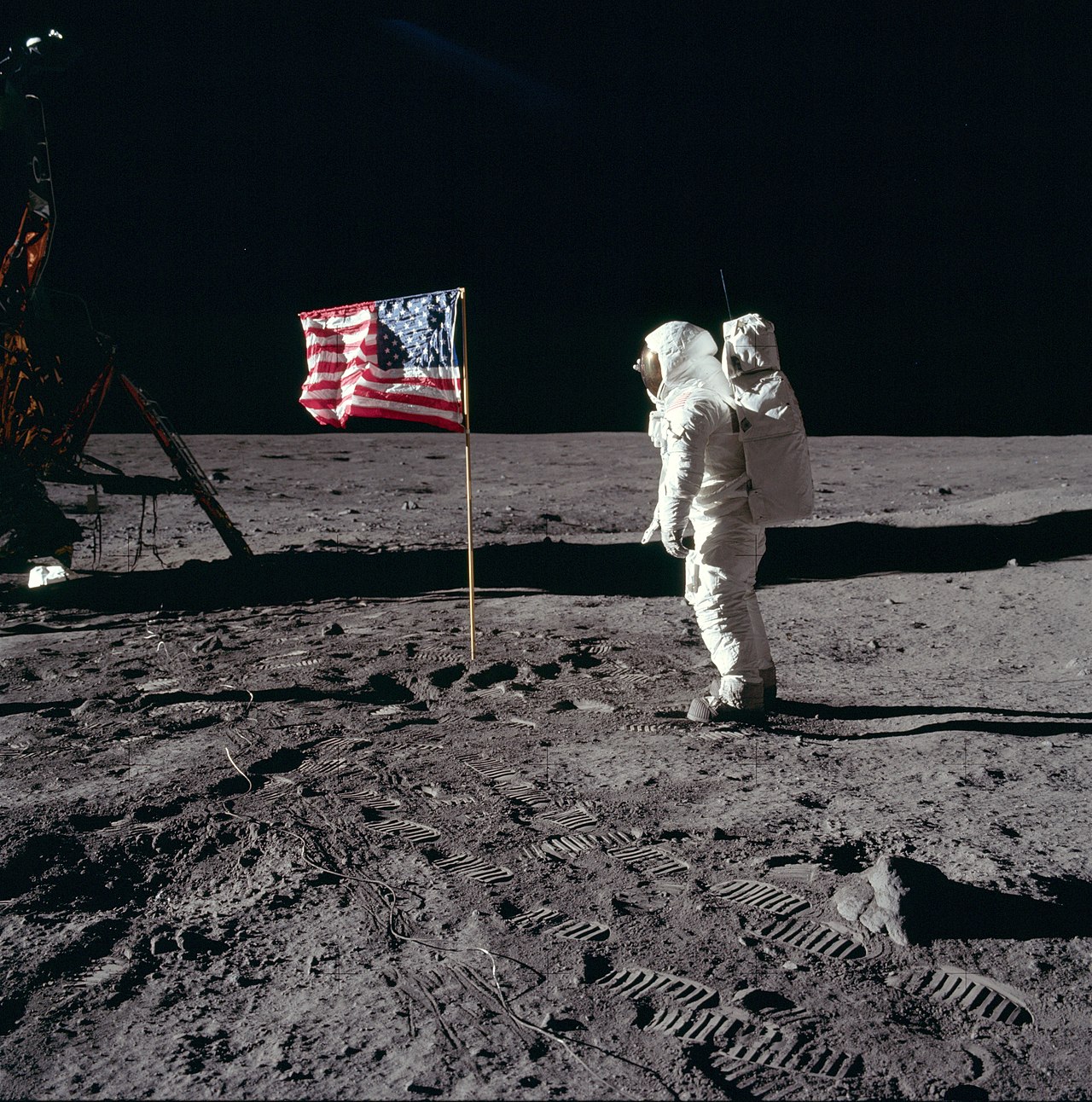


Early achievements and technical scope
The public contest accelerated after an exchange of announcements tied to the International Geophysical Year. The Soviet launch of Sputnik 1 in 1957 shocked international observers and demonstrated practical orbital capability. The USSR followed with the first human orbital flight by Yuri Gagarin in 1961 and several other pioneering missions that extended endurance and crew size and introduced spacewalks. Parallel activity included the deployment of artificial satellites, scientific and communications platforms in low Earth orbit, and uncrewed planetary missions—early automated probes to the Moon, Venus and Mars—that expanded knowledge of the solar system (uncrewed probes).
Turning points and the Apollo challenge
The competition shifted when John F. Kennedy committed the United States to land a person on the Moon and return them safely to Earth. That political objective drove a concentrated national effort producing new large cryogenic rockets and spacecraft. Developments included longer-duration missions, orbital rendezvous and docking techniques, extravehicular activity, and high-energy propulsion systems used in the Saturn family—advances tied to the design of powerful launch vehicles. The culmination was Apollo 11 in July 1969, which landed two astronauts on the lunar surface and returned them to Earth, a milestone widely regarded as a decisive technological and symbolic achievement.
Representative timeline
- 1957 — Launch of Sputnik 1, first artificial satellite to orbit Earth.
- 1957–1958 — Public momentum from the International Geophysical Year accelerates national programs.
- 1961 — First human orbital flight by Yuri Gagarin.
- 1961–1969 — U.S. Apollo program responds to Kennedy's challenge.
- 1969 — Apollo 11 achieves the first crewed lunar landing.
- 1975 — The Apollo–Soyuz mission marked a period of détente and demonstrated international docking procedures.
- 1980s–1990s — Long-duration station operations aboard Mir and operations of the Space Shuttle lead toward partnership on the International Space Station.
Technological and scientific impact
Beyond geopolitical symbolism, the Space Race delivered enduring technical and scientific benefits. Satellite systems revolutionized communications, weather forecasting, navigation, and Earth observation; robotic missions returned data and samples that transformed planetary science; and human spaceflight produced extensive medical and physiological research on adaptation to microgravity. Engineering advances in materials, computing, telemetry, and rocketry found widespread civilian uses. Many inventions and operational practices developed during the period persist in modern spacecraft and launch systems.
Legacy, distinctions and international cooperation
Although the Soviet program achieved important firsts, the U.S. lunar landings remain a central milestone. After the intense decades of rivalry, programs gradually moved from confrontation to collaboration: the 1975 joint mission and later cooperative projects such as Space Shuttle visits to Mir and the multinational construction of the International Space Station illustrate that transition. The Space Race reshaped scientific institutions, directed funding and education toward science and engineering, and established space as a sustained arena for both competition and cooperation. For broader context and primary documents, readers can consult official program histories and archival material from participating agencies and national archives (Cold War era collections and program sites are widely available in public repositories).
- Key domains: military applications, scientific research, national prestige.
- Enduring outcomes: satellite infrastructure, planetary exploration heritage, international partnerships.
- Notable distinctions: first satellite (Sputnik 1), first human orbital flight (Gagarin), first crewed lunar landing (Apollo 11).
Further study can examine technical reports on specific launch vehicles, mission transcripts, and scientific findings from robotic missions to the Moon, Venus, and Mars. The transformation from rivalry to cooperative station-building remains one of the most significant political and operational outcomes of the era.
Questions and answers
Q: What was the Space Race?
A: The Space Race was a 20th-century competition between two Cold War enemies, the Soviet Union (USSR) and the United States (US), to achieve better spaceflight capability than the other. It had its origins in the intercontinental ballistic missile-based nuclear arms race between the two nations following World War II.
Q: When did the Space Race begin?
A: The competition began on August 2, 1955, when the Soviet Union responded to the US announcement four days earlier of intent to launch artificial satellites during the "International Geophysical Year" (July 1, 1957 to December 31, 1958).
Q: What were some of the achievements of each country during this time?
A: The Soviet Union achieved several early firsts such as launching an artificial satellite, sending a human into space, and having flight durations measured in days instead of hours. Meanwhile, The US demonstrated superior technology by achieving flights up to two weeks long; rendezvous and docking in space; astronauts working outside spacecraft; and using high-energy liquid hydrogen as rocket fuel in their Saturn rockets.
Q: What was John F Kennedy's goal for his country?
A: John F Kennedy set a goal for his country that they would land a man on Moon and return him safely back to Earth.
Q: Was this goal achieved?
A: Yes! This goal was acheived with Apollo 11 mission which sent three men into space and landed two of them on Moon - a singular achievement far outweighing any combination of Soviet achievements.
Q: How did relations between USSR and US change after Apollo 11 mission?
A: After Apollo 11 mission there was a period of détente where both countries agreed to cooperate on Apollo-Soyuz Test Project (ASTP). This eventually led to joint development of an international docking standard APAS-75 as well as Shuttle-Mir Program and International Space Station programs between US & Russian Federation.
Related articles
Author
AlegsaOnline.com Space Race Leandro Alegsa
URL: https://en.alegsaonline.com/art/92410