
Space Needle (Seattle observation tower)
Iconic observation tower in Seattle built for the 1962 World's Fair, notable for its observation deck, rotating restaurant, engineering for wind and earthquake resistance, and cultural significance.
The Space Needle is the landmark observation tower that dominates the skyline of Seattle, Washington. Located on the grounds of the Seattle Center, it was erected for the 1962 World's Fair (the Century 21 Exposition) and quickly became a symbol of the city. Visitors come to enjoy panoramic views, a restaurant that rotates around the tower's axis, and a compact museum-like experience of Seattle's urban and natural setting.
Image gallery
10 Images


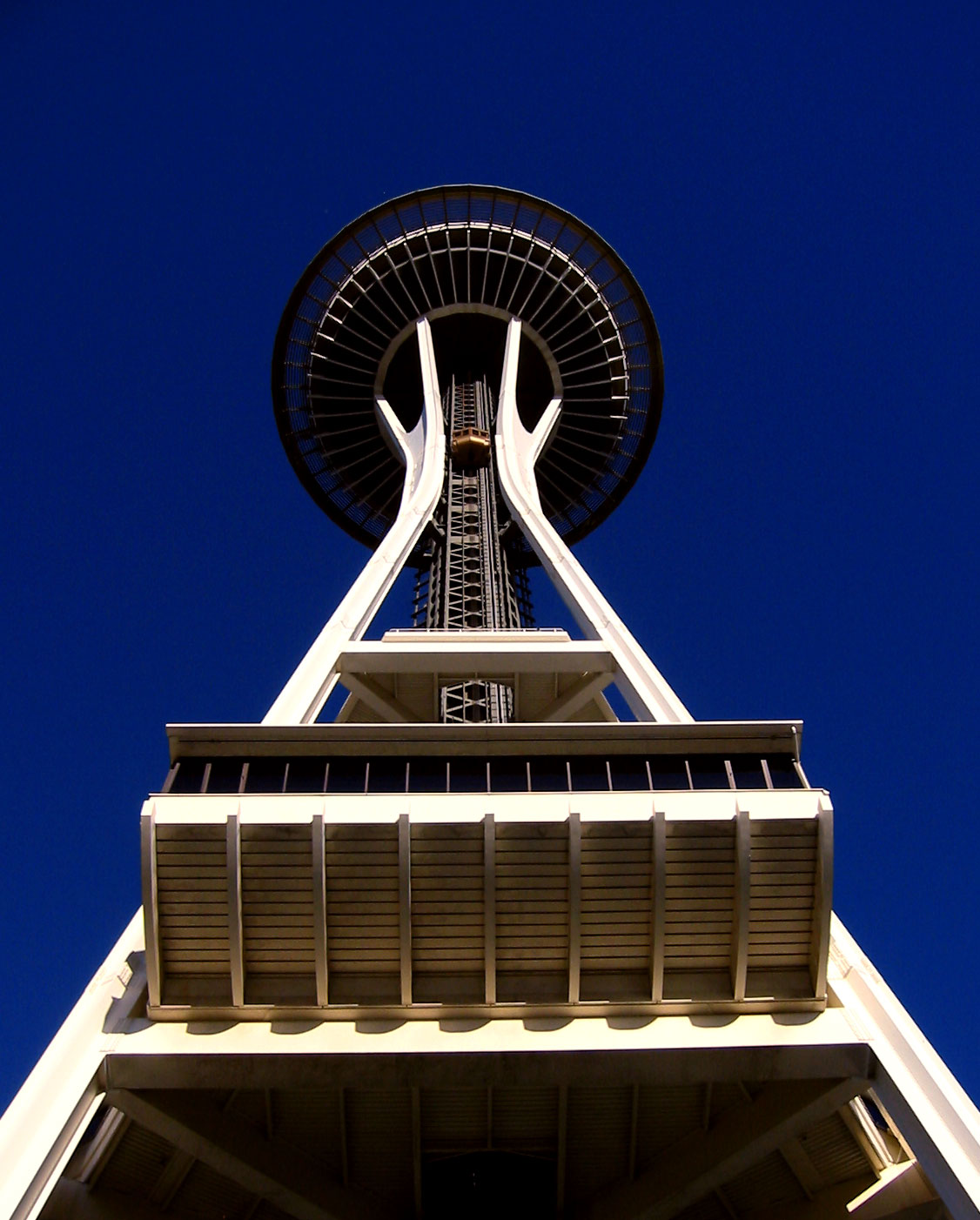

Design and key features
- Location: sits at the heart of the Seattle Center (Seattle Center), a cultural and entertainment campus.
- Dimensions: rises to about 605 feet (184 m) with a base width near 138 feet (42 m); its mass is commonly given as about 9,550 tons (tonnage).
- Observation deck: a publicly accessible viewing platform at roughly 520 feet that provides 360° panoramas.
- Restaurant: the rotating SkyCity restaurant sits below the deck at roughly 500 feet and slowly revolves to present all-around views (rotating dining).
- Vertical transport: high-speed elevators carry guests to the top; the cars are engineered for quick access while balancing comfort and safety (elevators).
History and construction
Conceived as a futuristic centerpiece for the 1962 World's Fair, the tower opened the same year and attracted millions to the exposition. During the fair, elevator traffic routinely reached tens of thousands of visitors per day, and the event drew over two million attendees overall. At the time it was completed, the structure was the tallest building west of the Mississippi River (regional milestone) and quickly entered civic and popular imagination as an emblem of mid‑20th century optimism.
Visiting the Space Needle
Guests typically ascend in elevators that can travel at about 10 miles per hour and reach the observation level in under a minute—the commonly cited trip time is about 41 seconds, although operations can vary. On windy days attendants may reduce elevator speed to maintain comfort. From the deck and restaurant visitors can see the downtown skyline, waterfront and harbor areas, and distant mountain ranges; common sightlines include the Olympic Mountains (Olympic), Mount Rainier (Mount Rainier) and Mount Baker (Mount Baker), along with Elliott Bay and nearby islands. Lines and wait times can be long at peak hours, but the site offers a mixture of quick visits and longer dining experiences.
Engineering and safety
The Space Needle was engineered with resilience in mind: its design accounts for high wind loads (often quoted to resist winds up to 200 miles per hour) and significant seismic forces. Published descriptions emphasize resistance to major earthquakes—including magnitudes commonly referenced in discussions of regional seismic risk (earthquakes and a design magnitude often cited as 9.1)—to help it survive events like the historic Cascadia earthquake. The structure is fitted with multiple lightning protection devices, including roof‑mounted rods to reduce strike damage (lightning rods and lightning protection).
Legacy and notable facts
More than a tourist attraction, the Space Needle functions as a cultural icon and visual shorthand for Seattle in photographs, films and marketing. It has been preserved and adapted over decades with upgrades to visitor facilities, displays and safety systems. Its distinctive silhouette remains one of the most recognized civic monuments in the Pacific Northwest.
For further official information and visitor details, consult facility and tourism resources: Seattle Center overview, structural and technical summaries (specifications), historical context (regional history), environmental and safety notes about wind and earthquakes, design magnitude references (9.1), lightning protection (rod systems and lightning), details on the rotating restaurant, viewing directions toward the Olympic range, Mount Rainier and Mount Baker, and elevator information (elevators).
Questions and answers
Q: What is the Space Needle?
A: The Space Needle is a tower in Seattle, Washington located at the Seattle Center. It was built for the 1962 World's Fair and stands 605 feet (184 m) high and 138 feet (42 m) wide.
Q: How many people used the elevators of the Space Needle during its opening for the 1962 World's Fair?
A: During its opening for the 1962 World's Fair, almost 20,000 people used the elevators every day.
Q: How many visitors came to the World Fair overall?
A: Over 2.3 million visitors came to the World Fair overall.
Q: What kind of protection does it have against natural disasters?
A: The Space Needle is built not to fall in wind up to 200 miles per hour (89 m/s) and earthquakes of up to 9.1 magnitude, which gives protection against an earthquake as powerful as the 1700 Cascadia earthquake. It also has 25 lightning rods on its roof to protect it from lightning strikes.
Q: What can be seen from atop of this tower?
A: From atop of this tower, one can see Downtown Seattle skyline, Olympic and Cascade Mountains, Mount Rainier, Mount Baker, Elliott Bay and islands around it all in one view.
Q: How long does it take to get to top by elevator?
A: It takes 41 seconds by elevator traveling at 10 miles per hour (4.5 m/s). On windy days however, they are slowed down to 5 miles per hour (2.2 m/s).
Q: When was it made a historic landmark?
A:The Space Needle was made a historic landmark on April 19th 1999 by city's Landmarks Preservation Board
Related articles
Author
AlegsaOnline.com Space Needle (Seattle observation tower) Leandro Alegsa
URL: https://en.alegsaonline.com/art/92404
Sources
- emporis.com : Space Needle
- glasssteelandstone.com : Space Needle
- skyscraperpage.com : Space Needle
- en.structurae.de : Space Needle
- spaceneedle.com : "Space Needle Fun Facts"
- u-s-history.com : "The Space Needle"
- historylink.org : "Seattle holds groundbreaking ceremony for the Space Needle on April 17, 1961"