
South Eastern and Chatham Railway (SECR): history, routes and legacy
Overview of the South Eastern and Chatham Railway (SECR), a working union of two companies that managed mainline, suburban and cross-Channel services in Kent from 1899 until the 1923 Grouping.
Overview
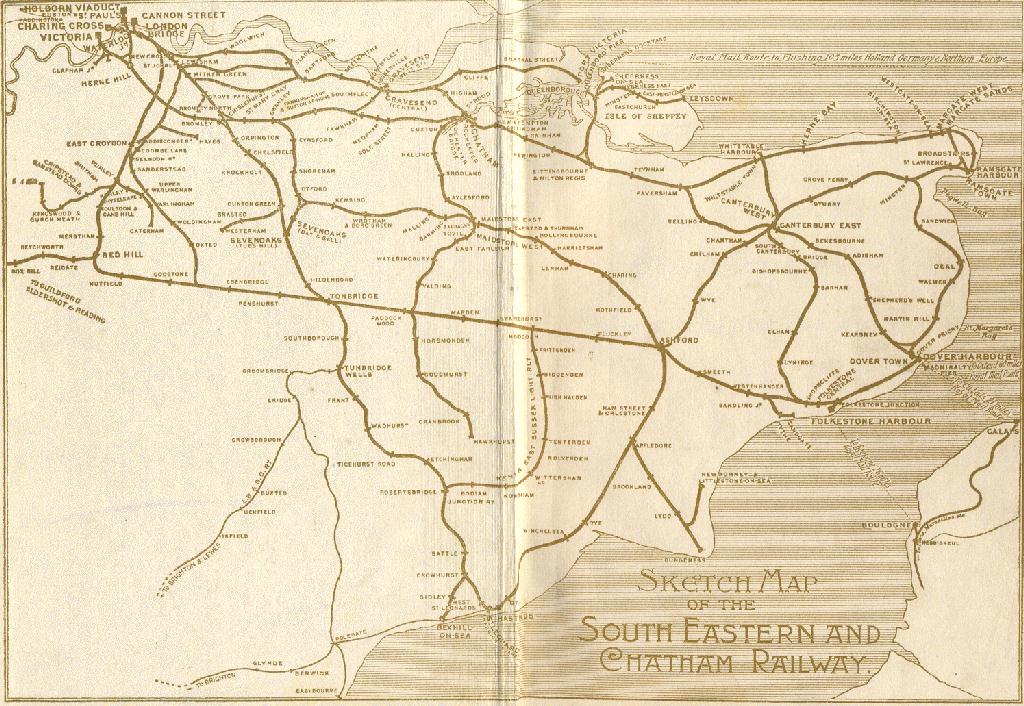
The South Eastern and Chatham Railway (commonly abbreviated SECR) was formed as a working union of two neighbouring companies, the South Eastern Railway and the London, Chatham and Dover Railway. It coordinated services between London and towns across south‑east England, especially the county of Kent. The arrangement began in 1899 and continued until the railways were grouped into the Southern Railway in 1923.
Image gallery
9 Images



Why a working union was created
By the late 19th century the two companies served many of the same destinations and faced financial pressure from duplicated routes and competing services. Rather than a full merger, a joint management arrangement was established to reduce waste, simplify timetables and share resources while the original companies remained legally separate. The SECR thus operated as a single practical railway system across much of Kent and the approaches to London.
Key routes and services
- Mainline passenger services linking London with coastal towns and ferry ports on the English Channel, including important connections to the Channel for services to France and Belgium.
- Extensive suburban and commuter operation feeding London terminals and serving growing commuter populations in the late Victorian and Edwardian eras.
- Freight and goods traffic supporting local industry, agriculture and the ports; military movements were also significant during times of conflict.
Characteristics and challenges
The SECR inherited a mixed set of infrastructure: double and single tracks, varied station facilities and non‑standard rolling stock from its parent companies. Management focused on reducing duplication of services, standardising practices where possible and improving journey times. Nonetheless, the region posed operational challenges: dense suburban demand close to London, seasonal traffic to seaside resorts, and the need to co‑ordinate with ferry operators at the Channel ports.
Importance and legacy
Between 1899 and 1923 the SECR held a practical monopoly over many rail services in Kent and to the main Channel ports. Its organisation shaped route patterns, station locations and suburban development that influenced travel in the south‑east for decades. When the Railways Act of 1921 took effect, the SECR's operations and assets were absorbed into the Southern Railway, which continued to develop and electrify many of the lines originally managed by the SECR.
Notable facts
- The SECR was a practical amalgamation rather than a full corporate merger; the original companies remained in existence until the 1923 Grouping.
- Its network provided vital links between London, coastal Kent and the Channel ports of the English south coast, including major ferry gateways.
- Connections established under the SECR supported international travel to France and Belgium, and fostered commuter growth around London.
For further reading about the parent companies and the railway geography of the region, see company histories of the South Eastern Railway and the London, Chatham and Dover Railway, as well as studies of Victorian and Edwardian railway competition in south‑east England. Contemporary timetables and maps illustrate how the SECR organised services to the Channel ports and suburban termini around London.
Questions and answers
Q: What is the South Eastern and Chatham Railway (SECR)?
A: The South Eastern and Chatham Railway (SECR) was a union of two neighboring railways, the South Eastern Railway (SER) and London, Chatham and Dover Railway (LCDR), which operated between London and south east England.
Q: What was the monopoly of the SECR in Kent?
A: Between 1899 and 1923, the SECR had a monopoly of railway services in Kent and to the main Channel ports for ferries to France and Belgium.
Q: Which railway company did the SECR become a part of in 1923?
A: In 1923, the SECR became a part of the Southern Railway under the Railways Act 1921.
Q: What is the Southern Railway?
A: The Southern Railway is a railway company that the SECR became a part of in 1923.
Q: What were the two railways that comprised the SECR?
A: The two railways that comprised the SECR were the South Eastern Railway (SER) and London, Chatham and Dover Railway (LCDR).
Q: What was the geographical area that the SECR operated in?
A: The SECR operated between London and south east England.
Q: What were the main Channel ports that the SECR had a monopoly of railway services to?
A: The SECR had a monopoly of railway services to the main Channel ports for ferries to France and Belgium.
Related articles
Author
AlegsaOnline.com South Eastern and Chatham Railway (SECR): history, routes and legacy Leandro Alegsa
URL: https://en.alegsaonline.com/art/92151