
South Caucasus (Transcaucasia): geography, peoples, resources and disputes
Overview of the South Caucasus (Transcaucasia): its geography between the Greater Caucasus and Turkey/Iran, constituent states, natural resources, ethnic diversity and modern political challenges.
Overview
The South Caucasus, commonly called Transcaucasia, is the southern portion of the greater Caucasus region, lying between Europe and Asia. It occupies the strip of land that stretches from the southern slopes of the Greater Caucasus mountains to the frontiers with Turkey and Iran, and is flanked to the west and east by the Black Sea and the Caspian Sea respectively. The name Transcaucasia reflects its position 'across' the main Caucasus ridge when approached from the north.
Image gallery
5 Images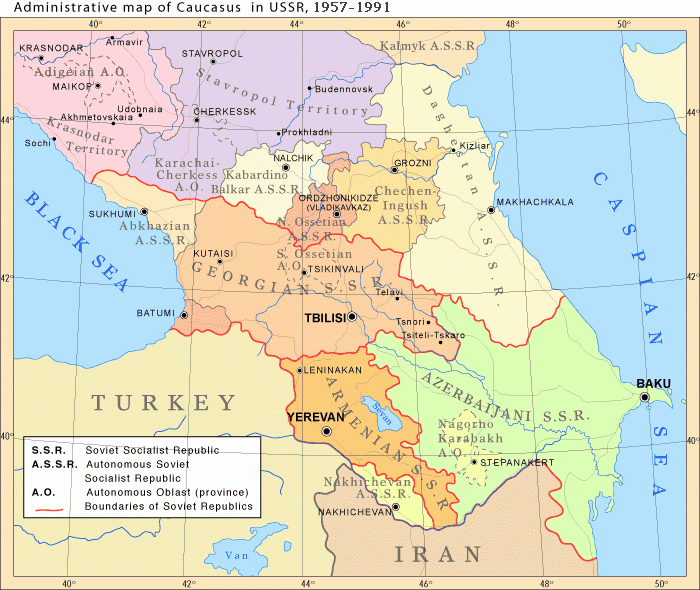


Geography and environment
The region contains a compact mix of high mountain ranges, river valleys and coastal plains. The Greater and Lesser Caucasus ranges create sharp climatic contrasts: alpine zones and glaciated peaks at higher elevations give way to humid subtropical lowlands on the Black Sea side and semi-arid plains near the Caspian. This diversity supports a wide range of ecosystems and agricultural zones, from tea and citrus in coastal lowlands to vineyards and temperate orchards inland.
Political divisions and population
Today the South Caucasus comprises three internationally recognized states: Armenia, Georgia and Azerbaijan. Most of each country lies within Transcaucasia; additionally, the Azerbaijani exclave of Nakhchivan is separated from the main territory by Armenian land. The population is ethnically and linguistically varied, including Indo-European, Kartvelian and Turkic language families, with significant minority communities and diasporas. Urban centres, rural highland communities and coastal settlements each maintain distinct cultural traditions.
Economy and natural resources
The South Caucasus economy mixes extractive industries, agriculture and services. Notable products and resources include:
- Oil and natural gas reserves, mainly off the Caspian shores and in some onshore fields.
- Manganese and other mineral deposits important for metallurgy and exports.
- Traditional agricultural products such as tea, wine and citrus fruits in suitable microclimates.
Transport corridors across the region are strategically important for linking energy and trade routes between Europe and Asia.
History and contemporary issues
The South Caucasus has a long layered history of local kingdoms, empires and trade networks. In modern times the region experienced imperial rule, followed by incorporation into the Russian Empire and then the Soviet Union. Since the collapse of the Soviet state the area has undergone state-building, economic transition and renewed regional rivalry; it remains one of the more complex parts of the post-Soviet space. Several territorial disputes and conflicts persist, shaping security and diplomacy in the region. Prominent contested areas include:
- Abkhazia — a breakaway region of Georgia with limited international recognition.
- South Ossetia — another Georgian region with de facto autonomy and contested status.
- Nagorno-Karabakh — a predominantly ethnic Armenian enclave inside Azerbaijan that has been the focus of armed conflict and negotiated ceasefires.
Importance and distinctions
The South Caucasus is significant for its strategic location at the crossroads of continents, its cultural and linguistic diversity, and its role as a corridor for pipelines, railways and roads connecting regional powers. Conservationists value its biodiversity and unique mountain habitats, while historians and linguists study its array of ancient traditions and languages. Understanding the South Caucasus requires attention to both its physical geography and the complex layers of political history that continue to influence daily life across the region.
For further reading on regional geography, politics and economy consult specialized sources and country studies that examine modern developments and the status of disputed territories in more detail.
Questions and answers
Q: What is South Caucasus?
A: South Caucasus is the southern area of the Caucasus region between Europe and Asia, going from the Greater Caucasus to the Turkish and Iranian borders, between the Black and Caspian Seas.
Q: What countries are included in Transcaucasia?
A: All of Armenia is in Transcaucasia; the majority of Georgia and Azerbaijan, including the exclave of Naxçıvan, fall within this area.
Q: What are some products produced in South Caucasus?
A: The countries in the region produce oil, manganese ore, tea, citrus fruits, and wine.
Q: How is the region of South Caucasus described?
A: The region is one of the most complicated in the post-Soviet area.
Q: What are the three heavily disputed areas in South Caucasus?
A: The three heavily disputed areas in South Caucasus are Abkhazia and South Ossetia in Georgia, and Nagorno-Karabakh in Azerbaijan.
Q: Why is South Caucasus considered complicated?
A: South Caucasus is considered complicated because of the heavily disputed areas and historical conflicts within the region.
Q: What bodies of water define the borders of South Caucasus?
A: The borders of South Caucasus are defined by the Black and Caspian Seas.
Related articles
Author
AlegsaOnline.com South Caucasus (Transcaucasia): geography, peoples, resources and disputes Leandro Alegsa
URL: https://en.alegsaonline.com/art/92133
Sources
- bartleby.com : Transcaucasia (The Columbia Encyclopedia article)