
Sophene (Tsopk): an ancient Armenian province and Hellenistic kingdom
Sophene (Tsopk) was a historic province in southwest Greater Armenia, later a Hellenistic realm and a Roman province. Located in present southeastern Turkey, it played a strategic role between Armenia and Mesopotamia.
Sophene, known in Armenian as Tsopk, was a territorial and political entity in the ancient Near East. Situated in the southwest of the Armenian highlands, it formed one of the traditional provinces of Greater Armenia and at times operated as an independent or semi-independent kingdom. Over several centuries Sophene passed through Urartian, Armenian, Hellenistic and Roman spheres of influence, and its territory now lies within modern southeastern Turkey (see map).
Image gallery
5 Images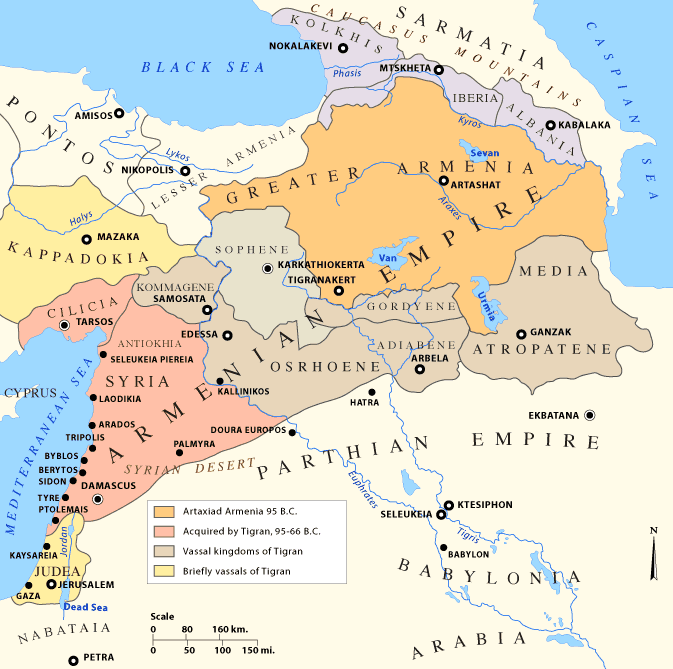


Geography and subdivisions
Classical Armenian sources place Sophene among the principal provinces of Greater Armenia. The 7th-century geographical compendium attributed to Anania Shirakatsi, the Ashkharatsuyts, lists it as one of the kingdom's key regions and names eight cantons or gavars within it: Khordzyan, Hashtyank, Paghnatun, Balahovit, Tsopk (also called Shahunyats), Andzit, Degiq and Gavreq. These subunits describe a landscape of river valleys and upland plateaus that connected the Armenian plateau to the upper reaches of the Mesopotamian plains and to important east–west routes.
Early history and political development
Archaeological and textual evidence indicates that in the early first millennium BC the area belonged to the Urartian cultural and political orbit; Urartian kings asserted control across the Armenian highlands and engaged in population resettlement policies. One well-known episode describes how an Urartian ruler relocated inhabitants from border regions to the newly founded fortress of Erebuni, a foundation traditionally linked to the site of modern Yerevan. By the later Iron Age the region became incorporated into the emerging Armenian polities ruled by the Orontid dynasty.
The collapse of the Achaemenid imperial order after the campaigns of Alexander the Great and the fragmentation of power in the Hellenistic period produced new opportunities for local rulers. During the 3rd–2nd centuries BC, under pressure and influence from the Seleucid realm, Sophene separated at times from the larger Armenian state and formed a dynastic polity often associated with the Orontid line. Seleucid attempts to administer the region included appointing military governors; in the aftermath of Antiochus III’s defeats the local strategoi declared kingship, establishing ruling houses in both Sophene and neighboring Armenia.
Roman era and later integration
Sophene’s strategic location made it a focus of Roman–Armenian contest. In the late Republic and early imperial period Roman intervention reshaped boundaries; commanders such as Pompey and later imperial authorities recognized or reassigned local rulers. For a time Sophene was administered as part of the Roman eastern settlement system and is recorded as a Roman province (Roman Empire), with the city of Amida (known today as Diyarbakır) prominent as its principal urban center. Around the mid-first century AD a client ruler, Gaius Julius Sohaemus, is noted in classical sources as holding authority in the region. In later administrative reforms of the late antique period Sophene was incorporated into broader Armenian provinces and was listed among the districts forming the province sometimes referred to as Armenia IV.
Significance and legacy
Sophene served as a cultural and strategic frontier zone between the Armenian highlands and Mesopotamia. Its dynastic shifts illustrate the wider patterns of Hellenistic fragmentation and Roman intervention in the Near East. Material remains, ancient place-names and Armenian historiography preserve traces of its administrative divisions and ruling families. Modern scholarship draws on classical authors, Armenian geographical works such as the Ashkharatsuyts and archaeological studies to reconstruct Sophene’s shifting role. The province’s layered history—Urartian ties, Orontid and Armenian rule, a brief independent Hellenistic kingship, and later incorporation into Roman and Byzantine structures—makes it a useful case for understanding the interaction of local and imperial forces in antiquity.
For further reading on ancient Armenian provinces and the Roman administration of the east, consult specialized works and archaeological reports that explore Sophene’s material culture, urban centers, and its place within the networks linking the Anatolian plateau to Mesopotamia and Iran.
Achaemenid Empire | Tigranes the Great | Roman provincial organization
Questions and answers
Q: What is Sophene?
A: Sophene (also known as Tsopk) was a province of the Armenian Kingdom and of the Roman Empire, located in modern-day southeastern Turkey.
Q: How many cantons were part of Tsopk?
A: Tsopk consisted of 8 cantons (gavars): Khordzyan, Hashtyank, Paghnatun, Balahovit, Tsopk (Shahunyats), Andzit, Degiq, and Gavreq (Goreq).
Q: When did it become part of the Armenian Kingdom?
A: Around 600 BC, Tsopk became part of the newly emerged ancient Armenian Kingdom of Orontids.
Q: Who attempted to weaken Armenia by splitting off Commagene and Tsopk into a separate kingdom?
A: The Seleucid Empire attempted to weaken Armenia by splitting off Commagene and Tsopk into a separate Hellenistic kingdom.
Q: Who declared themselves independent kings after Antiochus' defeat at Magnesia in 190 BC?
A: Artaxias I and Zariadres declared themselves independent kings after Antiochus' defeat at Magnesia in 190 BC.
Q: How did Tigranes the Great reunify Greater Armenia with Tsopk?
A: Tigranes the Great reunified Greater Armenia with Tsopke by conquering it in the 80s BC.
Q: What happened to Sophene when it became part of the Roman Empire?
A: When Sophene became part of the Roman Empire it was made into a province and its capital was Amida (modern Diyarbakır).
Related articles
Author
AlegsaOnline.com Sophene (Tsopk): an ancient Armenian province and Hellenistic kingdom Leandro Alegsa
URL: https://en.alegsaonline.com/art/91934