
Basal ganglia: structure, function, and clinical significance
An overview of the basal ganglia (basal nuclei): their components, circuits, roles in movement, learning and motivation, and relevance to neurological and psychiatric conditions.
Overview
The basal ganglia, often called the basal nuclei, are a group of deep brain nuclei located beneath the cerebral cortex. They are integral parts of the forebrain that interact with the midbrain and the thalamus to influence behaviour. Although small in volume compared with the cortex, these nuclei are central to selecting, initiating and regulating actions and habits. Disruption of their normal function produces characteristic movement and cognitive symptoms.
Image gallery
8 Images




Major components and organization
The basal ganglia are not a single structure but a collection of interconnected nuclei. Key components include:
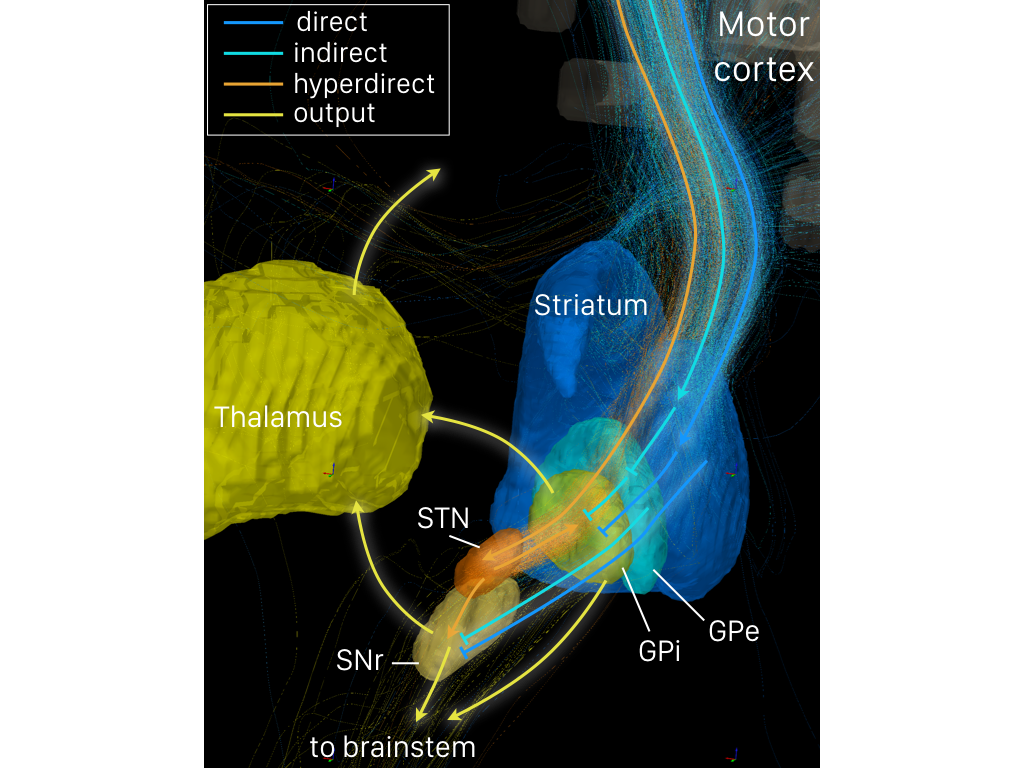
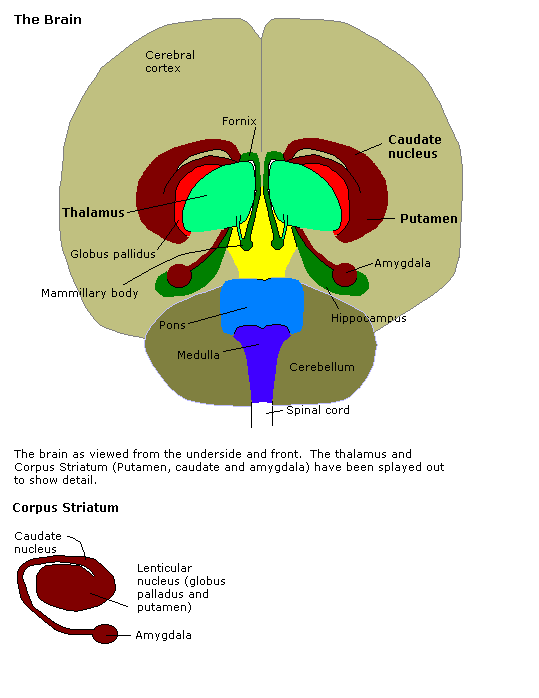
- Striatum — the principal input zone, composed mainly of the caudate nucleus and putamen.
- Globus pallidus (pallidum) — often divided into internal and external segments that route information toward the thalamus.
- Substantia nigra — a midbrain structure with a dopaminergic portion that modulates striatal activity.
- Subthalamic nucleus — a small excitatory nucleus that participates in circuit dynamics.
- Nucleus accumbens — part of the ventral striatum involved in reward and motivation.
Circuits and functional principles
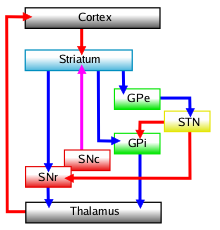
Information flows through parallel loops that link cortex, basal ganglia and thalamus. Two commonly described routes are the so-called direct and indirect pathways, which respectively facilitate and suppress particular motor programs. Dopamine, released from the substantia nigra, modulates these pathways and thereby influences action selection. One influential view is that the basal ganglia help suppress competing motor systems until a selected action is released; in other words, they contribute to gating and switching of behaviour and to learning of stimulus–response routines.
Functions and examples
The basal ganglia contribute to several domains of brain function. They are crucial for voluntary movement and for fine control of sequential actions; damage can lead to slowness, stiffness or involuntary movements. Beyond motor control, these nuclei support habit formation, procedural learning, decision-making about when to act, eye movements, and aspects of emotion and motivation. The ventral striatum and nucleus accumbens are particularly implicated in reward processing and reinforcement learning, shaping how actions are valued over time.
Clinical relevance and historical notes
Dysfunction of the basal ganglia underlies a range of neurological and psychiatric conditions. Degeneration of dopaminergic neurons in the substantia nigra is a hallmark of Parkinsonian syndromes, producing bradykinesia, rigidity and tremor. Loss of striatal neurons produces the involuntary, dance-like movements seen in Huntington disease. Abnormal basal ganglia activity is also implicated in dystonia, Tourette syndrome, obsessive–compulsive disorder and addiction. Clinical and experimental studies have gradually clarified these roles, though many details of basal ganglia computation remain active areas of research.
Notable distinctions and open questions
While commonly associated with movement, the basal ganglia are best understood as multifunctional processors that integrate cognitive, limbic and sensorimotor signals. Models emphasizing action selection complement those stressing reinforcement learning or pattern inhibition. Current work combines anatomy, electrophysiology and imaging to resolve how different cell types and pathways implement flexible behaviour. For further reading on cortical interactions and motor control see movement-related reviews, on motivational aspects see motivation and reward, and for studies of inhibition across motor systems see experimental evidence. Additional resources: cortex interactions, midbrain connections, thalamic relays.
Questions and answers
Q: What are the basal ganglia?
A: The basal ganglia are three areas under the cerebral cortex that are vital to movement.
Q: What happens if there is damage in the basal ganglia?
A: Damage in the basal ganglia results in damaged ability to move.
Q: What are the three areas under the cerebral cortex that make up the basal ganglia?
A: The three areas are the striatum, pallidum (or globus pallidus), and substantia nigra.
Q: What range of behaviors are controlled by the nuclei in the basal ganglia?
A: The nuclei in the basal ganglia control voluntary motor control, learning procedures for routine behaviors or "habits", cognitive emotional functions, and motivation.
Q: What is the role of the basal ganglia in behavior switching?
A: The basal ganglia inhibit (suppress) a number of motor systems, and a release of this inhibition lets a motor system act. This "behavior switching" is influenced by signals from many parts of the brain, including the prefrontal cortex.
Q: What is the function of the prefrontal cortex in behavior switching?
A: The prefrontal cortex plays a key role in doing things and influences behavior switching by sending signals to the basal ganglia.
Q: What other parts of the brain influence behavior switching?
A: Signals from many parts of the brain, including the prefrontal cortex, influence behavior switching.
Related articles
Author
AlegsaOnline.com Basal ganglia: structure, function, and clinical significance Leandro Alegsa
URL: https://en.alegsaonline.com/art/9185
Sources
- pubmed.ncbi.nlm.nih.gov : 10893428
- ncbi.nlm.nih.gov : "Conditional routing of information to the cortex: a model of the basal ganglia's role in cognitive coordination"
- doi.org : 10.1037/a0019077
- pubmed.ncbi.nlm.nih.gov : 20438237
- doi.org : 10.1007/s00422-010-0401-y
- pubmed.ncbi.nlm.nih.gov : 20644953
- doi.org : 10.1016/j.neuropsychologia.2010.03.015
- pubmed.ncbi.nlm.nih.gov : 20303998
- doi.org : 10.1016/S0165-0173(98)00002-2
- pubmed.ncbi.nlm.nih.gov : 9651523