
Sonderkommando photographs at Auschwitz (August 1944)
Four clandestine, blurry images taken inside Auschwitz-Birkenau by a Sonderkommando prisoner in August 1944. Smuggled out, they remain rare photographic evidence of the extermination process.
The Sonderkommando photographs are a set of four clandestine images made in August 1944 inside the Auschwitz complex during World War II. Taken at great risk by a prisoner who worked in the camp, they were later smuggled out and preserved by survivors and postwar institutions. Because so little direct visual documentation of the extermination process was taken by insiders, these photographs occupy a unique place in the historical record.
Image gallery
6 Images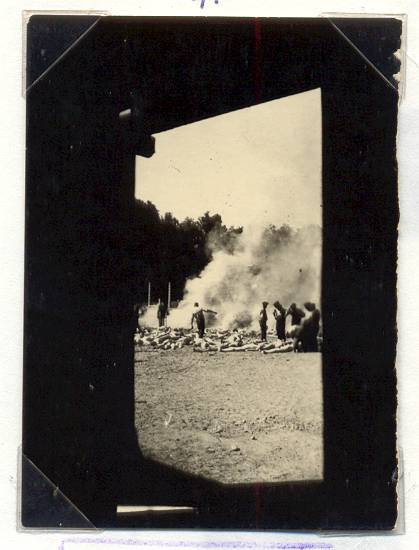


What the pictures show
The four frames, catalogued by the Auschwitz-Birkenau State Museum as numbers 280–283, are blurred and composed under severe constraint. Two were taken from inside a gas chamber and two from outside. One image shows a group of naked women before being driven into a gas chamber; another depicts the burning of corpses in an open pit associated with cremation and disposal operations. One frame is mostly trees and sky, the result of aiming the camera from the hip, and one more records activity around the disposal area. Scholars describe their content cautiously because the images are indistinct but unmistakeable in their subject matter.
Context and origin
The photographs were taken at Auschwitz, specifically in the extermination sector known as Auschwitz II-Birkenau, during World War II. The person who released the negatives is generally identified only as a prisoner-photographer; his exact identity is not universally agreed by historians, and his act was clandestine because members of the Sonderkommando were under constant threat of execution. The images themselves are often referenced simply as the Sonderkommando photographs.
How they were taken and preserved
The photos were taken with a small camera that had to be aimed covertly—often from the hip—so framing and focus were poor. Contemporary accounts explain that the film was concealed and smuggled out of the camp by members of the surrounding resistance. In published descriptions the negatives were hidden in an everyday object and passed on to outside contacts; these actions involved the Polish resistance and sympathetic individuals who helped move the material out. The original film roll and fragments of documentation reached postwar repositories and were catalogued; the material in the frames has been described in connection with cremation and gassing operations, and the word cremation is frequently used in interpretive captions.
Significance and limitations
The images are important because they provide rare photographic testimony of victims and the processes of extermination from inside the camp. At the same time, their clarity is limited by the conditions under which they were made: hurried, covert, and from difficult vantage points using a compromised camera. The smuggling of the film out of Auschwitz and its subsequent preservation were acts of resistance and evidentiary rescue that allow historians and educators to show direct visual evidence alongside testimony and documents.
Uses, reception, and related facts
- Historians and museums reference the photographs when discussing the operation of gas chambers and disposal at Auschwitz II-Birkenau and the role of forced labor units such as the Sonderkommando.
- Because the images are both rare and sensitive, they are used with contextual explanations in exhibitions, publications, and educational materials to avoid misinterpretation.
- The story of their concealment and delivery to the outside has been highlighted as an example of covert documentation by prisoners and the assistance given by local resistance movements such as the Polish resistance.
- Researchers stress caution: the photographer’s identity remains a subject of debate in scholarship and the images should be read together with survivor testimony rather than as isolated proof.
For readers seeking more detailed archival information, institutions that curate Holocaust records maintain catalogues and descriptions of the negatives. The photographs remain a powerful, though partial and fragile, piece of the evidentiary mosaic documenting the genocide and the circumstances in which prisoners were compelled to bear witness.
Further contextual materials and reproductions are available through institutional collections and specialized studies; referenced archival entries and interpretive notes often appear alongside reproductions identified by their museum catalogue numbers and explanatory captions.
Photographer | Gas chambers | Auschwitz | World War II
Photographs | Auschwitz II-Birkenau | Sonderkommando | Camera | Polish resistance | Film | Cremation
Questions and answers
Q: What are the Sonderkommando photographs?
A: They are four blurry pictures taken secretly in August 1944 inside the Auschwitz concentration camp during World War II.
Q: Who took the Sonderkommando photographs?
A: A prisoner in Auschwitz II-Birkenau took the photographs.
Q: What was Auschwitz II-Birkenau?
A: It was Auschwitz's extermination camp, where people were sent to be killed in gas chambers.
Q: Who were the Sonderkommando?
A: They were a group of inmates forced to work in and around the gas chambers.
Q: How were the Sonderkommando photographs taken?
A: The photographer had to aim the camera from his hip and was not able to focus it to keep from being caught.
Q: How were the Sonderkommando photographs smuggled out of the camp?
A: The Polish resistance snuck the camera film out in a toothpaste tube.
Q: What do the Sonderkommando photographs show?
A: They show what happened around the gas chambers, including the cremation of dead bodies in a fire pit and a group of naked women just before they went into the gas chamber.
Related articles
Author
AlegsaOnline.com Sonderkommando photographs at Auschwitz (August 1944) Leandro Alegsa
URL: https://en.alegsaonline.com/art/91811
Sources
- yadvashem.org : "Inside the Epicenter of the Horror – Photographs of the Sonderkommando"
- books.google.com : 16
- jstor.org : "The Sonderkommando Photographs"