
Solar sail: Propulsion by light — principles, history, and uses
A solar sail is a spacecraft propulsion concept that uses radiation pressure from sunlight to produce continuous thrust. This article explains the physics, design, history, missions, and practical considerations.
Overview
A solar sail (also called a light sail or photon sail) is a method of spacecraft propulsion that harnesses the momentum carried by electromagnetic radiation. Instead of carrying propellant, a solar sail uses a large, highly reflective surface to intercept photons from sunlight and convert their tiny impulses into measurable thrust. Over long durations this continuous, low-level force can produce significant changes in a spacecraft's velocity and trajectory.
Image gallery
10 Images




How it works
The fundamental physical effect behind solar sailing is radiation pressure: when light reflects off or is absorbed by a surface it transfers momentum to that surface. For a reflective sail, the momentum transfer is larger than for an absorptive one because photons reverse direction on reflection. Although the force per square metre is very small near Earth, cumulative acceleration over weeks or months can alter orbits, enable stationkeeping without propellant, or gradually build up high speeds for deep-space missions. Attitude and thrust vectoring are achieved by tilting or reshaping the sail to change the angle of incidence of the incoming light.
Design and components
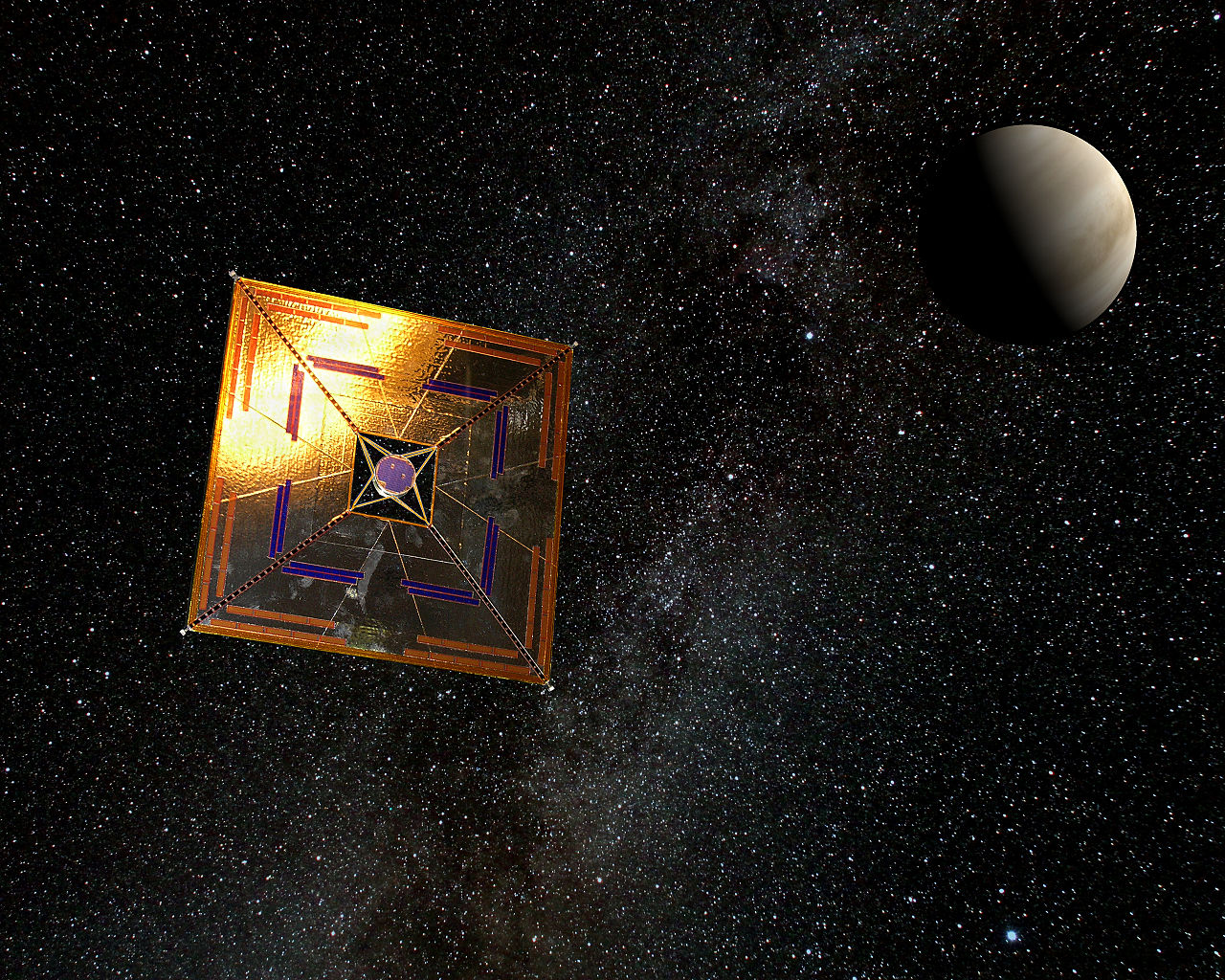
A typical solar sail system consists of a large, lightweight reflective membrane (often made of aluminized polymer or similar thin films), a structural deployment mechanism (booms or inflatable struts), attitude-control hardware, and the spacecraft bus with power and communications. Practical designs balance sail area, mass, stowage volume for launch, and robustness to micrometeoroid impacts and thermal cycling. Some concepts explore segmented sails, hybrid systems combining small thrusters, and concentrator arrays that focus sunlight for photon propulsion or secondary power uses.
History and development
The idea traces back centuries: early observers suggested that light could exert force, and the thought of harnessing "heavenly breezes" for motion dates to Johannes Kepler. The theoretical underpinning became solid with 19th-century advances in electromagnetism that described radiation pressure. In the 20th and 21st centuries, solar sails moved from science fiction into experimental reality. Several demonstration missions have flown, showing deployment techniques and controlled solar sailing in Earth orbit and beyond.
Applications and missions
Solar sails are attractive for missions that benefit from long-duration, propellantless thrust: stationkeeping at non-traditional orbits, slow but continuous orbit raising, cargo transport where time is flexible, and exploratory probes that can gradually escape the inner solar system. Notable technology demonstrations and proposals have tested deployment, navigation, and long-duration exposure to the space environment. Their low-thrust, high-impulse nature complements conventional chemical or electric propulsion depending on mission goals.
Practical considerations and notable facts
- Advantages: no propellant required for primary thrust, potential for very long missions, simplified refueling logistics.
- Challenges: very weak instantaneous thrust, large deployed area, susceptibility to damage and degradation from space weather, and precise attitude control requirements.
- Design trade-offs include material choice, reflectivity, deployment reliability, and mission architecture to exploit slow continuous acceleration.
For further technical background, historical context, mission reports, and related topics, see these resources:
- Propulsion fundamentals and solar sail overview
- Radiation pressure and photon momentum
- Solar irradiance and its variation with distance
- Sailboat analogy and maneuvering concepts
- Sailing terms and wind analogy
- Atmospheric wind vs. photon pressure comparison
- Early conceptual proposals and historical notes
- Kepler and historical references
- Maxwell's contributions to electromagnetic theory
- Electromagnetic radiation and field theory
- Effects of solar pressure on spacecraft navigation
- Solar sails in science fiction and inspiration
- Cultural references such as works by Jules Verne
Solar sailing remains an active area of research and demonstration because its unique mix of advantages and constraints fits particular mission niches. As materials, deployment methods, and mission planning improve, solar sails could play a growing role in science, exploration, and small-satellite operations.
Questions and answers
Q: What is a solar sail?
A: A solar sail (or light sails or photon sails) is a proposed method of spacecraft propulsion using radiation pressure exerted by sunlight.
Q: Who first proposed the concept of a solar sail?
A: The concept was first proposed in the 17th century by Johannes Kepler.
Q: What did James Clerk Maxwell publish that provided the foundation for the science behind the solar sail?
A: James Clerk Maxwell published his theory of electromagnetic fields and radiation, which showed that light (one form of electromagnetic radiation) can put pressure on an object, known as radiation pressure.
Q: How does solar pressure act on spacecraft?
A: Solar pressure acts on spacecraft, in space or in orbit around a planet, displacing them thousands of kilometers and affecting their orientation.
Q: When was this effect first taken into account when planning interplanetary missions?
A: This has been done since the time of the early interplanetary spacecraft of the 1960s.
Q: In what other contexts has the concept of a solar sail been used?
A: The concept of solar sail has also been used in science fiction, such as the works of Jules Verne.
Related articles
Author
AlegsaOnline.com Solar sail: Propulsion by light — principles, history, and uses Leandro Alegsa
URL: https://en.alegsaonline.com/art/91644
Sources
- scientificamerican.com : "Solar Sailing Success: Planetary Society Deploys LightSail 2"
- doi.org : 10.1098/rstl.1865.0008
- jaxa.jp : "Launch Day of the H-IIA Launch Vehicle No. 17(H-IIA F17)"
- space.com : "Ikaros: First Successful Solar Sail"
- space.skyrocket.de : "NanoSail D"
- space.com : "LightSail 2 sends back first signals from its solar-surfing test flight"
- slate.com : "SpaceX just launched something really cool into space"
- arstechnica.com : "So, how much did the Planetary Society's light sail really sail?"