
Snowball Earth: global glaciation events and scientific debate
Summary of the Snowball Earth hypothesis, the geological evidence and mechanisms, competing views (including Slushball variants), and implications for Earth's climate and life.
Overview
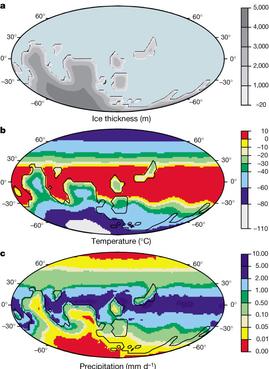
Snowball Earth denotes hypotheses that, at one or more times in deep time, Earth’s surface became almost entirely covered by ice. The term is usually applied to episodes in the Neoproterozoic portion of the Proterozoic eon, when some researchers interpret sedimentary records as indicating near-global glaciation. A related idea, Slushball Earth, describes models with substantial sea-ice but persistent equatorial open-water or thin-ice regions that reduce the severity of the climate extremes.
Image gallery
10 Images





Key geological indicators
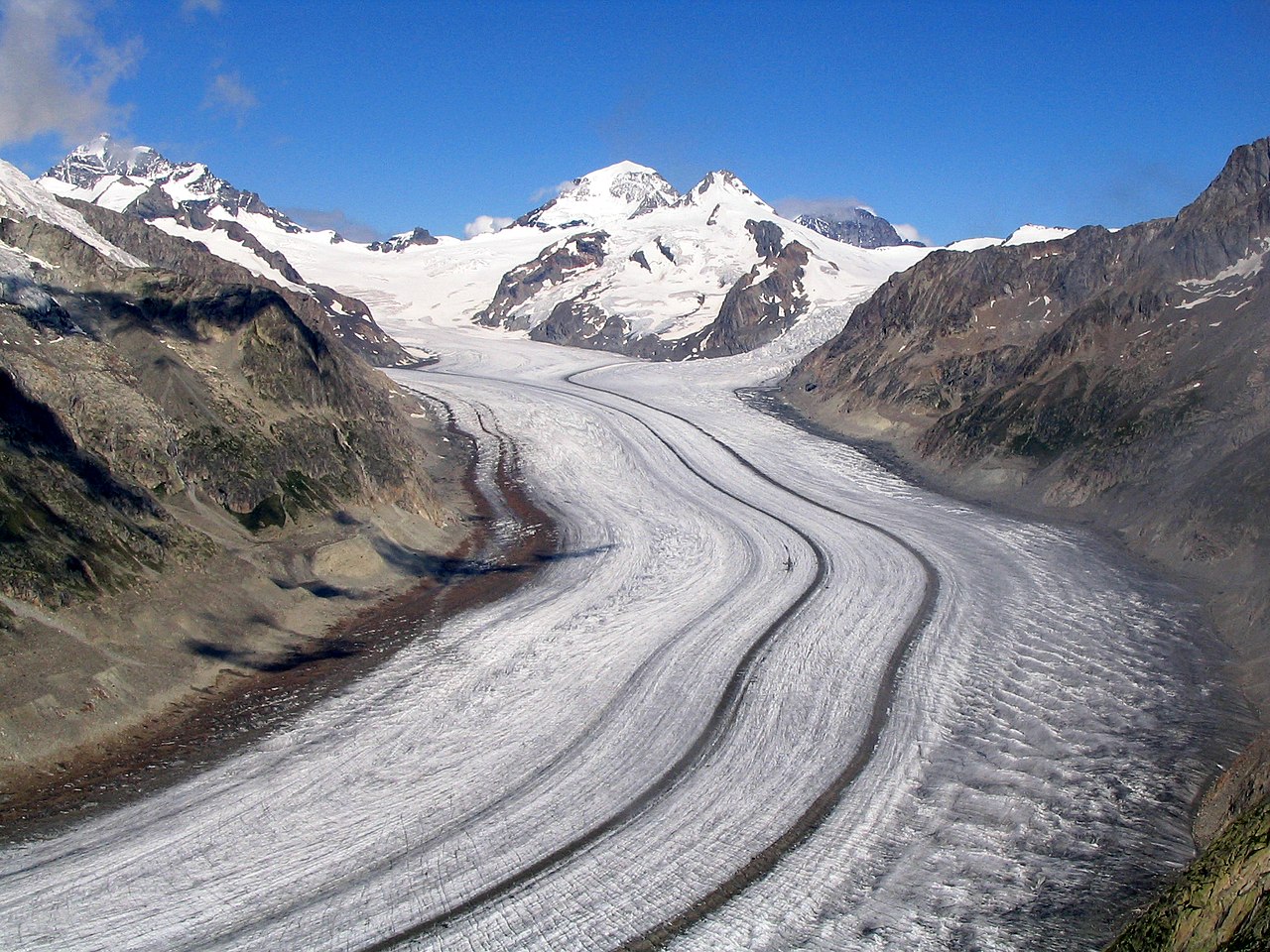
Proponents of global glaciation cite several recurring features in widely separated rock sequences. These include deposits of diamictite and tillite interpreted as sedimentary evidence of glacial action, isolated blocks or dropstones within fine sediments, and the abrupt appearance of thick "cap" carbonates immediately above glacial units — a pattern consistent with rapid changes in ocean chemistry and climate. Paleomagnetic studies that place some glacial strata at low, even tropical, latitudes are among the most striking claims supporting the idea that ice sheets reached far beyond the poles.
Mechanisms proposed
Several feedbacks and processes have been proposed to explain how global glaciation could start and how the planet might recover. Reduced greenhouse forcing, altered continental positions that change weathering rates, and a positive ice-albedo feedback that amplifies cooling are commonly cited factors. Many models require prolonged volcanic outgassing of CO2 while silicate weathering was greatly diminished under ice, allowing greenhouse gases to build up until deglaciation occurred. Studies combine geological constraints with numerical climate and geophysical simulations and analyses of sea-ice behavior to explore these mechanisms and their plausibility.
Competing interpretations and the Slushball alternative
- Supporters argue that low-latitude glacial indicators and global stratigraphic patterns are consistent with a near-global ice cover.
- Critics contend that some deposits can be explained by regional glaciation, tectonic reworking or depositional processes that do not require a totally frozen ocean, and they question whether whole-ocean ice cover is physically feasible.
- The Slushball Earth model posits bands of open water or mobile thin ice near the equator that would permit continued photosynthesis and different ecological outcomes than a fully frozen planet.
Timing and broader context
Evidence for extreme Neoproterozoic glaciations appears in multiple continents and has been given informal names in the literature to distinguish distinct glacial intervals. These events, whether global or regional, provide important tests for models of Earth's long-term climate, the carbon cycle, and plate tectonics. They also show that Earth's climate system can inhabit states very different from the modern interglacial condition.
Biological and environmental consequences
Extended or intensified glaciations would have altered ocean chemistry, nutrient availability and redox conditions, with potentially profound consequences for microbial and early multicellular life. Advocates of strong-glaciation scenarios argue that extreme environmental stress and subsequent recoveries could have influenced the timing of biological innovations. Opponents urge caution: direct causal links between glaciation and major evolutionary steps remain debated and require multiple lines of corroborating evidence.
Research approaches and further reading
Work on Snowball Earth draws on field mapping of glacial and sedimentary units, paleomagnetic measurements that address inferred paleolatitudes, geochemical proxies, and climate model experiments. Readers interested in overviews of ancient glaciation, regional stratigraphic syntheses, or technical discussions of sea-ice dynamics and ice-ocean interactions can consult reviews and specialized datasets. For balanced perspectives see summaries that compare the geological evidence for low-latitude glaciation with alternative interpretations and papers that evaluate the geophysical feasibility of extensive sea ice.
Because the topic remains active, new field discoveries and refined models continue to reshape understanding. Surveys that reassess paleomagnetic constraints, reinterpret glacial deposits, and model intermediate states between full Snowball and Slushball scenarios illustrate how multiple disciplines contribute to this continuing scientific debate about Earth’s distant past. For introductory materials and accessible reviews, see institutional summaries and educational pages about planetary Earth history and climate, and articles that discuss glacial deposits, tropical records and latitudinal constraints in context (tropical evidence, latitudinal analyses).
Questions and answers
Q: What is Snowball Earth?
A: Snowball Earth or Icehouse Earth refers to times when the Earth's surface was nearly or entirely frozen.
Q: Is the occurrence of Snowball Earth still controversial?
A: Yes, the occurrence of Snowball (or Slushball) Earths is still controversial.
Q: When did widespread glaciation occur, according to the text?
A: According to the text, it is probable that widespread glaciation occurred in periods of the Proterozoic.
Q: What is debatable about the occurrence of Snowball Earths?
A: What is debatable is how widespread those glaciations were.
Q: What do proponents claim the Snowball Earth theory explains?
A: Proponents claim the theory explains sedimentary deposits of glacial origin at tropical latitudes and other strange features of the geological record.
Q: What do opponents of the Snowball Earth theory doubt?
A: Opponents do not draw the same inferences from the geological evidence, and doubt the geophysical feasibility of an entirely ice or slush-covered ocean.
Q: What is the Proterozoic?
A: The Proterozoic is a geological eon that occurred between 2.5 billion and 541 million years ago.
Tags
Related articles
Author
AlegsaOnline.com Snowball Earth: global glaciation events and scientific debate Leandro Alegsa
URL: https://en.alegsaonline.com/art/91345
Sources
- cosis.net : "Paleomagnetism of the Paleoproterozoic Gowganda and Lorrain formations, Ontario: low palaeolatitude for Huronian glaciation"
- doi.org : 10.1016/S0012-821X(97)00181-7
- pnas.org : "The Paleoproterozoic snowball Earth: A climate disaster triggered by the evolution of"
- doi.org : 10.1073/pnas.0504878102
- pubmed.ncbi.nlm.nih.gov : 16061801
- sciencedaily.com : "New evidence supports three major glaciation events in the distant past"
- doi.org : 10.2113/108.4.557
- doi.org : 10.1038/ngeo355