
Sniper rifle: design, use, history, and distinguishing features
A sniper rifle is a precision firearm optimized for accurate long‑range fire. This article summarizes components, action types, calibers, ballistics, history, roles, training, maintenance and legal/ethical considerations.
Overview
A sniper rifle is a firearm purpose‑built to deliver deliberate, highly accurate shots at long distances. It differs from a general‑purpose rifle in that the system of rifle, optic and support gear is optimized for precision, consistent external ballistics and controlled shot placement rather than volume of fire. A shooter who operates such a weapon in combat or law enforcement is commonly described as a sniper, and the role is often defined by marksmanship and observation skills as much as by the weapon itself. Sniper employment is most frequently associated with military forces, police units and specialized hunting or competitive shooting, and it addresses situations where long‑range accuracy changes the tactical options available to commanders and law‑abiding citizens alike. Historically the use of long‑range precision fire developed as optics, cartridges and metallurgy improved, allowing skilled marksmen to engage targets at increasingly greater distances and with predictable outcomes; in the modern era those developments continue to refine both capability and doctrine in the military and other contexts.
Image gallery
10 Images




Design and key components
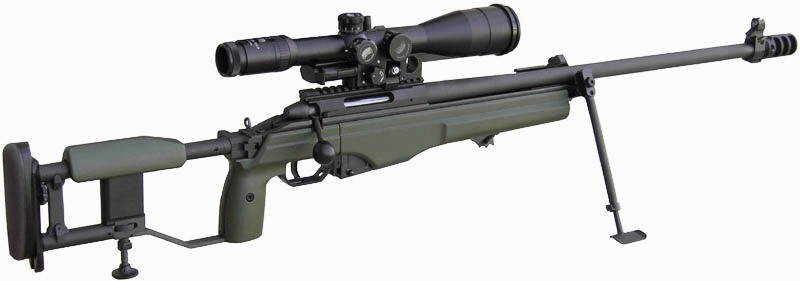
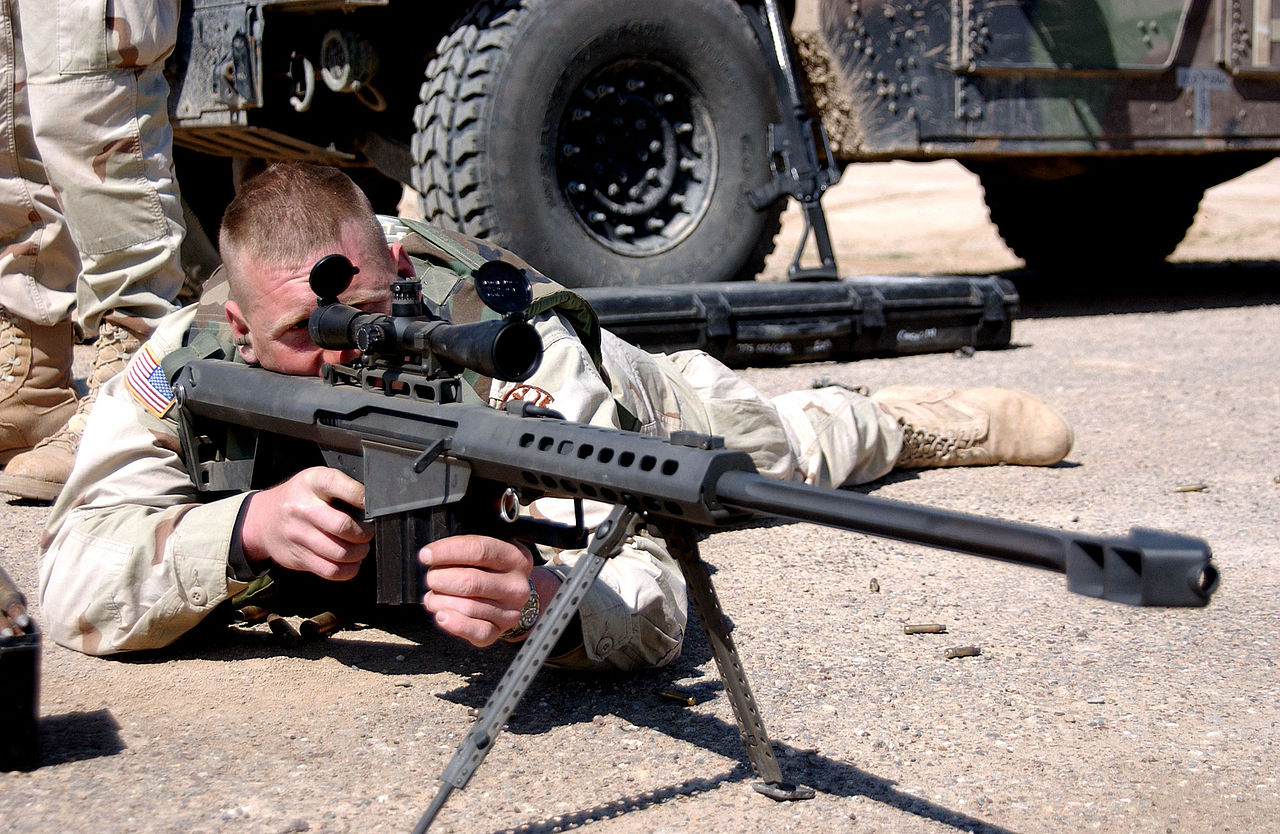
Precision rifles share a number of characteristic design choices that prioritize repeatability and control. Many designs use a heavy, match‑grade barrel that is often free‑floated from the stock to minimize the effect of pressure on the barrel harmonics. Stocks are typically adjustable to match the shooter’s position, and match triggers help ensure a predictable, light break. A high‑magnification optic—often described as a sniper scope—is mounted on a stable rail system, and spotting tools or small observation optics comparable to a hand telescope are regularly used by an observer or spotter to measure wind and range. Support gear such as a bipod, monopod or specialized slings aid in forming a stable firing position.
- Barrel and bedding — careful manufacturing controls, consistent chamber dimensions and solid bedding help reduce shot‑to‑shot variance.
- Action — the mechanism that chambers and fires cartridges; different action types trade rate of fire against absolute single‑shot precision.
- Optics and reticles — precision adjustments for elevation and windage, and reticles suited for holdover calculations, are central to long‑range use.
- Support and measurement — ranging devices, ballistic tables and wind‑reading tools are integral to accurate engagement.
Action types and calibers
Two common action families are bolt‑action and semi‑automatic rifles. Bolt‑action rifles are often favored where maximum single‑shot accuracy and mechanical simplicity are priorities; semi‑automatic variants allow faster follow‑up shots and can be preferred in dynamic situations. Choice of cartridge strongly affects effective range, recoil, weight and logistics. Ammunition considerations—commonly referred to as ammunition—include bullet weight, powder charge, and consistency, which together influence muzzle velocity and trajectory. Calibers used for precision roles range from smaller, low‑recoil types for short‑range or suppressed work to larger cartridges designed for long‑range or anti‑material roles; caliber is often stated by the projectile diameter or by a standard cartridge designation.
Ballistics, effective range and special cases
Effective range is a function of rifle accuracy, cartridge performance, atmospheric conditions and shooter skill. External ballistics—trajectory, wind drift, and retained energy—determine where a shot will land relative to the aiming point. Some large‑bore systems chambered in very powerful cartridges can engage materiel targets or deliver accurate fire at extreme distances, while lighter‑caliber systems are easier to carry and conceal but have shorter practical ranges. In rare historical examples, large support weapons adapted with optics were used at extreme distances; although such adaptations may achieve long‑range hits, they differ substantially from purpose‑designed sniper platforms in ergonomics, portability and doctrine. Contemporary precision platforms often draw on well‑known commercial actions and aftermarket enhancements such as the family of designs based on the Remington 700 action, and they pair those actions with purpose‑made barrels, stocks and optics to achieve the desired performance.
History and development
The practice of deliberate long‑range shooting existed in various forms before modern firearms, but the deliberate development of specialized long‑range rifles accelerated with advances in cartridge design, rifling, smokeless powder and optics in the late 19th and early 20th centuries. As doctrine and manufacturing matured, many militaries formalized the role of sniper and began issuing or acquiring dedicated weapons and training. Over successive conflicts improvements in glass, ammunition manufacturing and ballistic understanding steadily extended practical ranges and refined concealment and observation techniques. Alongside military evolution, law enforcement and civilian competitive communities developed their own standards and best practices, and these communities often influence equipment choices and training for precision shooting roles at home and abroad.
Roles, training and employment
Sniper teams typically emphasize marksmanship, camouflage and observation. A two‑person team—shooter and spotter—allows one member to observe environmental effects such as wind and distance while the other concentrates on shot execution. Training covers trigger control and breathing, observation and range estimation, ballistic calculation, and safe ammunition handling. Even in solo operations, the ability to judge wind, hold for distance and maintain steady, repeatable positions separates proficient practitioners from novices. Some uses of precision rifles are police counter‑sniper, hostage rescue or selective law‑ful hunting; each application has different rules of engagement and legal frameworks that govern when and how precision fire is justified or authorized.
Maintenance and safety
Regular maintenance improves reliability and accuracy: cleaning the bore and action to remove fouling, inspecting for wear or obstructions, and following manufacturer‑recommended lubrication practices are standard. While routine fouling can degrade accuracy, catastrophic failures are typically associated with obstructions, improper ammunition or severe misuse rather than ordinary lack of cleaning; following safe handling practices and service schedules reduces the risk of malfunction. Proper training in inspection, storage and transport is essential to safe ownership and operation.
Legal and ethical considerations
Laws and regulations governing precision rifles and their use vary widely by jurisdiction and by context—military, law enforcement or civilian. Ethical and legal frameworks govern when long‑range lethal force may be applied, and professional users are trained to apply rules of engagement and legal constraints consistently. For civilian owners, compliance with local statutes, safe storage and training remain key responsibilities.
Further reading and resources
Those seeking additional technical, historical or legal detail can consult specialized firearms engineering texts, military manuals and accredited training organizations. Introductory overviews and manufacturer specifications clarify differences between general‑purpose arms and precision platforms; comparison articles often contrast a normal rifle with dedicated precision systems. For information on personnel roles and training standards see resources produced by military training centers and recognized law enforcement schools, and for examples of specific designs consult published references on long‑range employment, biographies of notable individuals in the discipline, and authoritative histories of trigger and action evolution. For technical details about machine‑gun‑based extreme‑range incidents and their distinction from rifle sniping, see analyses that discuss heavy machine gun adaptations. Finally, comparative reviews often examine the tradeoffs of doctrine and equipment in representative platforms, including examples informed by the popular Remington‑based family and other well‑known systems referenced in manufacturer literature.
Questions and answers
Q: What is a sniper rifle?
A: A sniper rifle is a type of gun used to accurately shoot targets from long distances away. It is much more accurate than a normal rifle and almost all of them use a special telescope called a sniper scope that allows them to see targets very far away.
Q: What are the two different kinds of sniper rifles?
A: The two different kinds of sniper rifles are bolt action rifles, which fire one shot at a time and require the user to ready the next shot, and semi-automatic ("semi-auto") rifles which fire one shot each time the trigger is pulled and automatically ready the next shot for firing.
Q: Are fully automatic rifles ever used as sniper rifles?
A: In rare instances, fully automatic rifles can be converted into snipers but they generally are not used due to their inaccuracy at short ranges and expense.
Q: What are some examples of bolt action and semi-automatic sniper rifles?
A: Examples of bolt action sniper rifles are the M40, R700, and M24 while examples of semi-automatic ones are the M21, Dragunov, and the M82 Barret .50 caliber.
Q: What range do Sniper Rifle bullets come in?
A: Sniper rifle bullets range in caliber (the diameter or width) from as small as .22 inches (5.59 mm) with the .22 LR (long rifle) bullet fired by many small pistols to as large as .5 inches (12.7 mm) with the .50 Browning Machine Gun (BMG) bullet which is fired by vehicle mounted heavy machine guns.
Q: How often should you clean your barrel on your Sniper Rifle?
A: You should clean your barrel on your Sniper Rifle every day in order to get rid of any liquid buildup that could cause disastrous situations or even let it explode upon firing.
Q: When would someone use a smaller round like .22 LR with a sound suppressor?
A: Smaller rounds like .22 LR with sound suppressors may be used at very close range quickly and quietly break street lights or kill vermin or small animals since they have too weak power for longer range work or shots on human sized targets
Tags
Related articles
Author
AlegsaOnline.com Sniper rifle: design, use, history, and distinguishing features Leandro Alegsa
URL: https://en.alegsaonline.com/art/91319
Sources
- world.guns.ru : "Modern Firearms - Sniper Rifles - Intro"
- militaryfactory.com : "M110 Semi-automatic Sniper System"
- globalsecurity.org : "Sniper Rifles"
- firearmstactical.com : "Tactical Briefs, February/March 2000"
- defensenews.com : "Eurosatory news"
- commons.wikimedia.org : Sniper rifles