
SNCF Class BB 7200 electric locomotives
A class of 1.5 kV DC Bo′Bo′ electric locomotives built for SNCF in the late 20th century, part of the 'Nez Cassé' family and used for both passenger and freight service across France.
Overview
The SNCF Class BB 7200 is a family of four-axle electric locomotives built for operation on 1.5 kV DC lines in France. These locomotives are part of the distinctive "Nez Cassé" (broken nose) styling developed for a range of SNCF motive power. Designed for mixed-traffic duties, the BB 7200 series was procured to renew and standardize traction on the DC network and to pair with related AC and dual-voltage types. They are classed as 1.5 kV DC machines and normally appear in SNCF service numbering between 7201 and 7440; for more on the electrical system see 1.5 kV DC, and for operator information see SNCF.
Image gallery
2 Images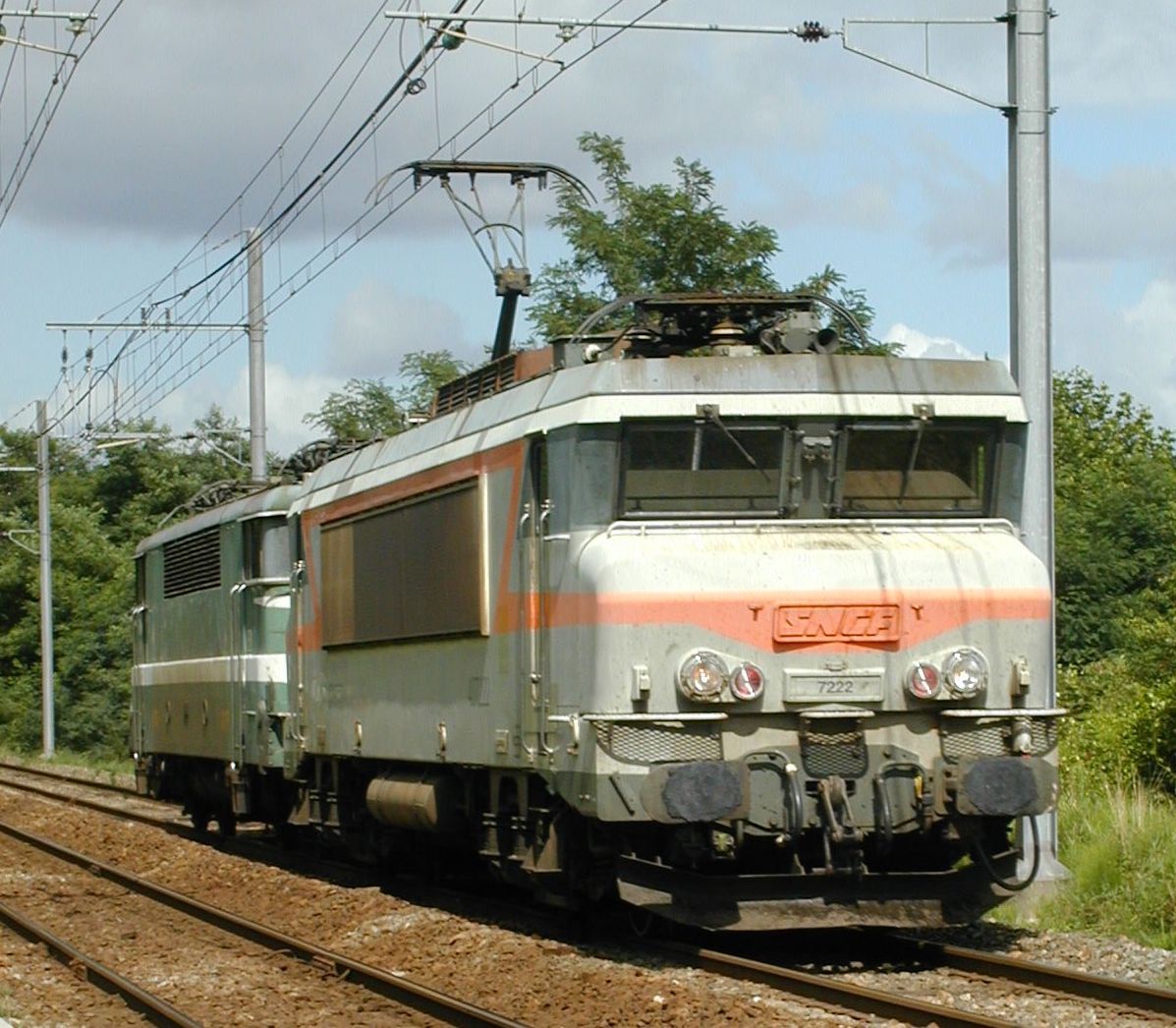

Design and characteristics
Mechanically the locomotives use a Bo′Bo′ (four-axle) layout with each axle driven by its own traction motor. The general layout and cab profile follow the Nez Cassé aesthetic created by designers such as Paul Arzens, giving the class a recognizable angular front end. The BB 7200 family was built with rugged traction systems suitable for both sustained express passenger work and slow, heavy freight trains. Many units have standardised equipment allowing coupling with a variety of rolling stock and train heating arrangements for passenger use. Some examples carry cast builder or identity plates on the frame.
History and development
The BB 7200 series was introduced in the late 1970s and produced into the 1980s to replace older DC locomotives and to provide a modern, modular fleet for the 1.5 kV parts of the French network. They were manufactured by French builders in collaboration and form part of a broader family that includes an AC counterpart, the BB 15000, and a dual-voltage derivative, the BB 22200. This numbering reflects the relationship among the types: BB 7200 (DC) and BB 15000 (AC) combine conceptually into the BB 22200 (dual-voltage), a useful mnemonic for their interoperability and lineage; see also the dual-voltage class Class BB 22200.
Service use and examples
In regular service the BB 7200 locomotives have been employed on a wide range of duties: long-distance express trains, regional passenger workings and freight services across the southern and western DC electrified network. Several units were later adapted for suburban push–pull operations on commuter routes around Paris. For example, during the 2012–2013 period a number of BB 7200s were modified to the BB 7600 specification to serve Transilien services such as those on the Paris – Montparnasse corridor. The Dutch NS Class 1600 is a near contemporary and close cousin of the BB 7200 design; for a comparative example see NS Class 1600.
Variants, conversions and notable facts
Beyond the standard BB 7200 production many units have undergone modifications during their careers. A subset was re-geared and altered for suburban duties and redesignated BB 7600 to better suit frequent-stop commuter service. A small number of locomotives were lost in serious accidents over the years; units reported destroyed include 7209, 7210, 7308 and 7348. Preservation groups and railway museums have expressed interest in retaining representative examples because the class exemplifies late 20th-century French electric traction and the Nez Cassé lineage that influenced several other European locomotives.
Legacy and distinctions
The BB 7200 remains notable for being a workhorse of the French DC electrified network and for its place within the Nez Cassé family that also produced AC and dual-voltage siblings. Its long service life, adaptability to different train types and the later conversions to suburban roles illustrate the flexibility of the basic design. The class has therefore played an important role in modernising SNCF traction and influencing designs beyond France, while ongoing replacements by newer multiple-units and locomotives are gradually reducing its front-line presence.
Questions and answers
Q: What is the SNCF Class BB 7200?
A: The SNCF Class BB 7200 is a 1.5kV DC electric locomotive.
Q: Who operates the SNCF Class BB 7200?
A: The SNCF operates the SNCF Class BB 7200 in France.
Q: What is the "Nez Cassé" family of locomotives?
A: The "Nez Cassé" family of locomotives includes the SNCF Class BB 7200, BB 15000 (AC version), and BB 22200 (dual-voltage version).
Q: What is the NS Class 1600, and where is it operated?
A: The NS Class 1600 is a DC locomotive based on the BB 7200, and it is operated in the Netherlands.
Q: How are the dual-voltage locomotives numbered?
A: The dual-voltage locomotives are numbered to show that the DC and AC class make them. The SNCF Class BB 7200 and BB 15000 together make the SNCF Class BB 22200.
Q: Which locomotive numbers have been destroyed in accidents?
A: Locomotive numbers 7209, 7210, 7308, and 7348 have all been destroyed in accidents.
Q: Which locomotives were modified to become BB 7600 locomotives, and where were they operated?
A: In 2012 and 2013, the locomotives numbered 7311, 7312, 7314, 7325, 7327, 7330m 7332, 7335, 7337, 7339, 7341, and 7342 were modified to become BB 7600 locomotives. They were operated on the Transilien Paris – Montparnasse line.
Related articles
Author
AlegsaOnline.com SNCF Class BB 7200 electric locomotives Leandro Alegsa
URL: https://en.alegsaonline.com/art/91309
Sources
- commons.wikimedia.org : SNCF Class BB 7200