
Smith v. Allwright (1944) — ending the white primary
Supreme Court decision that struck down racially exclusionary primaries, ruling political party primaries are part of the public electoral process and cannot deny Black voters the franchise.
Overview
Smith v. Allwright (1944) is a landmark United States Supreme Court decision that declared it unconstitutional for states to permit political parties to exclude Black citizens from primary elections. The Court held that when a primary is an integral stage of the public electoral process, racial exclusion by party officials amounts to state action and violates the Fifteenth Amendment. The ruling dismantled the legal basis for so-called "white primaries" across the South.
The case is often cited as a turning point in voting rights litigation and civil rights law. It reversed an earlier precedent and opened the door to broader challenges against racially discriminatory voting practices.
Image gallery
1 Image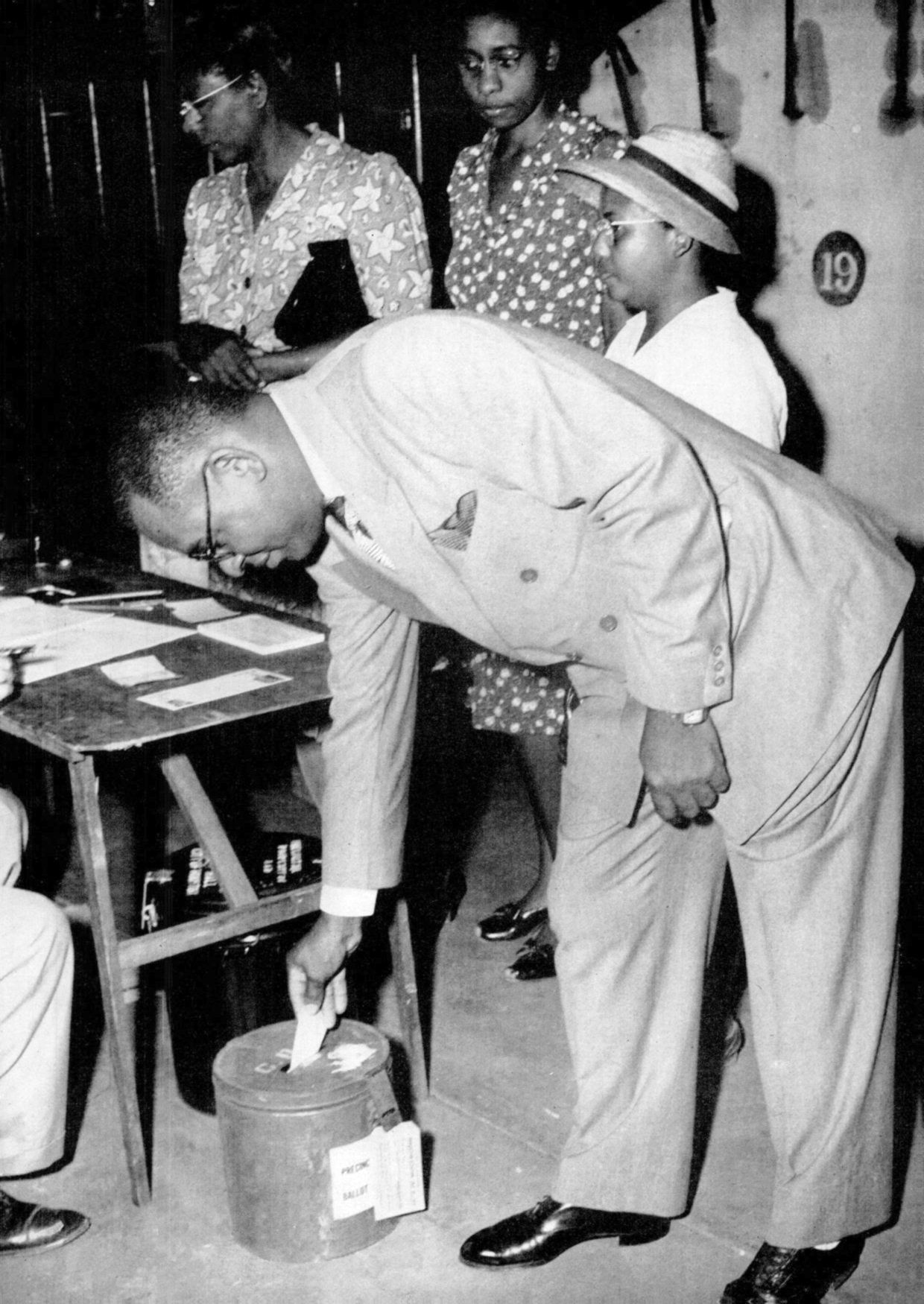
Legal reasoning and holdings
The Court examined whether discrimination by a political party in a primary election constituted private conduct or state action. Writing for the majority, the Court found that primaries administered under state law are an essential part of the electoral machinery; therefore, racial exclusion in that context cannot stand. The decision applied constitutional protections against racial discrimination in voting to primary elections.
- Key principle: When private organizations perform functions closely tied to the government’s responsibility for elections, their actions may be subject to constitutional constraints.
- Consequence: States could not authorize parties to hold racially exclusive primaries.
Background and development
In the decades after Reconstruction many Southern states used a variety of laws and practices to prevent Black citizens from voting. One widely used device was the "white primary": political parties, especially the Democratic Party in one-party Southern states, restricted primary participation to white voters. Because the primary often determined the ultimate officeholder, exclusion from the primary effectively disenfranchised Black voters.
The Court’s decision in Smith v. Allwright overruled an earlier case that had allowed parties to claim a private-association status for discriminatory primaries. By recognizing that primaries are part of the public electoral process, Smith removed a major legal shield for racially exclusionary practices.
Impact and significance
Smith v. Allwright had immediate and long-term effects. In the short term, it invalidated white primary systems in states that had relied on party rules to exclude Black voters. Over time, the case strengthened the constitutional framework for later challenges to discriminatory voting laws and informed subsequent civil rights litigation and legislation aimed at protecting the franchise.
The decision is frequently mentioned alongside other landmark rulings and reforms in the struggle for equal voting rights. For further reading, see the Court’s opinion and subsequent commentary by legal historians and civil rights scholars: case summary, Supreme Court records, and analyses of primary elections as public functions at political context.
Notable distinctions and facts
Smith v. Allwright is distinct because it addressed the interface of private party activity and public authority. It is often contrasted with the earlier ruling that permitted white primaries; the later reversal underscored the Court’s willingness to reconsider precedent when constitutional voting rights were at stake. The decision helped catalyze voter registration and participation efforts and is cited in discussions about the evolution of the Fifteenth Amendment’s protection of the right to vote.
For additional resources on related topics and historical documents, consult scholarly overviews and archival materials: historical background, state-level practices, civil rights implications, and subsequent legal developments.
Questions and answers
Q: What was Smith v. Allwright?
A: Smith v. Allwright was a landmark decision by the United States Supreme Court.
Q: What did the decision of Smith v. Allwright make unconstitutional?
A: The decision of Smith v. Allwright made it unconstitutional to keep African Americans from voting in a Democratic Party primary in Texas.
Q: Did the decision of Smith v. Allwright only apply to Texas?
A: No, by extension it covered white primaries in all states.
Q: Which previous case did Smith v. Allwright overturn?
A: Smith v. Allwright overturned Grovey v. Townsend (1935) which had allowed the Democratic party to hold all-white primaries that excluded black voters.
Q: When did Smith v. Allwright happen?
A: Smith v. Allwright happened in 1944.
Q: What impact did Smith v. Allwright have on African American voting rights?
A: Smith v. Allwright had a significant impact on African American voting rights as it made it unconstitutional to keep African Americans from voting in a Democratic Party primary in Texas and had an extension in all states.
Q: What was the name of the case that Smith v. Allwright overturned?
A: The name of the case that Smith v. Allwright overturned was Grovey v. Townsend.
Related articles
Author
AlegsaOnline.com Smith v. Allwright (1944) — ending the white primary Leandro Alegsa
URL: https://en.alegsaonline.com/art/91236
Sources
- naacpldf.org : "Landmark: Smith v. Allwright"
- texaspolitics.utexas.edu : "Smith vs. Allwright: white primaries"
- senate.gov : "Landmark Legislation: Thirteenth, Fourteenth, & Fifteenth Amendments"
- highbeam.com : highbeam.com
- questia.com : questia.com/read/78818214/making-civil-rights-law-thurgood-marshall-and-the